
Mudéjar Lazo Interlaced Geometric Strapwork represents the pinnacle of Hispanic-Islamic ornamental stereotomy in timber. Rather than applying decorative fretwork atop flat panels, carpenters integrated strapwork directly into the structural roof diaphragms. Using grooved intermediate timber cross-members called peinazos slotted between heavy ceiling joists (alfardas), joiners mapped interlocking geometric stars based on 8, 10, 12, or 16 points. The ribs weave under and over in mathematical infinity, locking the ceiling into an integrated seismic diaphragm.
At a Glance: Key Takeaways
- Stereotomic Joinery: Peinazos cross-members grooved and notched into rafter chords to build star geometries.
- Infinite Star Wheels (Ruedas): 8-point, 10-point, and 12-point polygonal star tessellations woven across spans.
- Over-Under Ribbon Weaving: Three-dimensional relief where strapwork braids alternate over and under in continuous loops.
- Aromatic Scots Pine & Cedar: Resinous heartwoods quartersawn to avoid warping across high-altitude temperature shifts.
- Seismic Diaphragm Action: Thousands of interlocking mortises creating a flexible, earthquake-resilient ceiling shell.
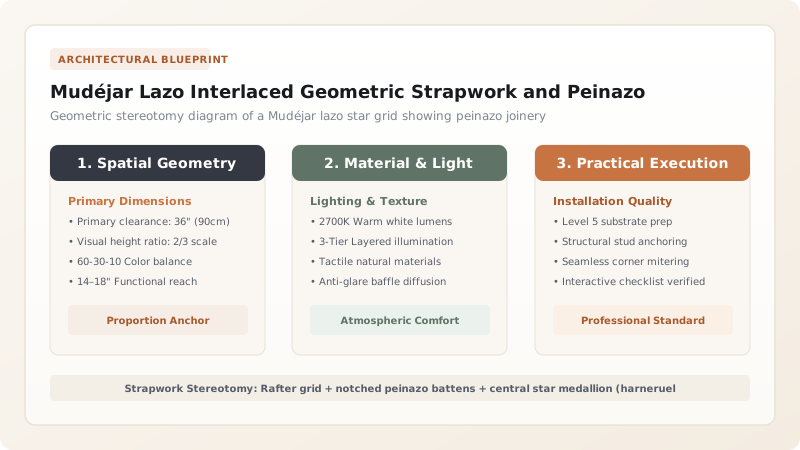
1. Mathematical Principles of Lazo Geometry
The foundation of lazo (lace or knotwork) is Euclidean geometry governed by Islamic proportions codified in Spanish carpentry manuals by Diego López de Arenas (1619) and Fray Andrés de San Miguel. The system begins with a regular polygon inscribed inside a circle, generating concentric radiating chords.
By extending the chords until they intersect, artisans formed ruedas (star wheels) containing 8, 10, 12, or 16 points. In a complete ceiling, multiple adjacent star wheels are bridged by secondary geometric ribbons called calles (streets) and agramilas (beveled margin lines), creating an unending tapestry that symbolizes celestial infinity without beginning or end.
2. Peinazo Joinery Mechanics & Structural Interlock
Unlike Renaissance strapwork, which was often sawn from thin boards and glued to a plaster substrate, Mudéjar lazo is an integral structural grid. The primary ceiling rafters (pares) are plowed with lateral grooves.
Intermediate cross-members, known as peinazos, are cut with compound mitered lap joints and sliding tongues that slot directly into these grooves. When all peinazos are assembled across an entire ceiling span, they lock hundreds of timber members into a unified, torsionally rigid spatial web that resists seasonal warping and wind-induced racking loads.
3. The Almizate and Central Harneruelos
In a pitched collar-beam ceiling (armadura de par y nudillo), the flat horizontal apex formed by the collar beams is termed the almizate. This elevated plateau serves as the main focal stage for the most complex lazo configurations.
Within the almizate, polygonal openings framed by peinazos are enclosed from above by harneruelos—flat timber boards painted with vegetal arabesques, gilded rosette bosses (racimos), or miniature three-dimensional hanging pendentive cones (mocárabes) carved from lime or cedar wood.
Mudéjar Lazo Star Wheel Classification & Proportions
Use this reference table to calculate exact physical dimensions, ratios, and specifications before purchasing:
| Lazo Typology | Angular Subdivisions | Typical Hall Application | Structural Rib Depth |
|---|---|---|---|
| Lazo de a Ocho (8-Point Star) | 45° increments / Octagonal root | Residential halls, cloister corridors | 90mm - 120mm rib depth |
| Lazo de a Diez (10-Point Star) | 36° increments / Decagonal root | Chapel ceilings, palace antechambers | 110mm - 140mm rib depth |
| Lazo de a Doce (12-Point Star) | 30° increments / Dodecagonal root | Cathedral presbyteries, royal throne rooms | 130mm - 180mm rib depth |
| Lazo de a Dieciséis (16-Point Star) | 22.5° increments / Hexadecagonal root | Monumental cathedral crossings & domes | 160mm - 220mm rib depth |
Geometric & Fabrication Constraints
Every successful decoration project must account for physical and environmental constraints:
Extreme Angular Rigor
A 0.25° error in the initial cartabón bevel accumulates across an 8-point wheel into an unclosable 2° gap.
Compound Three-Dimensional Joinery
At hips and valleys (limas), peinazos must be cut with dual-axis compound miters.
Protocol for Laying Out and Joinery-Cutting Mudéjar Peinazos
Execute this professional sequence to achieve flawless results without backtracking:
Geometric Drafting on Scribe Floor
Draft full-scale star wheel layout on gypsum plaster tracing floor using compass, trammel points, and straightedge.
Timber Billet Dressing & Grooving
Plane quartersawn Scots pine battens to 35mm x 90mm cross-section; rout continuous 12mm edge rebate grooves.
Template Scribing with Cartabón
Transfer intersection angles to wooden billets using specialized wooden angle bevels (cartabones de lazo).
Compound Halving Notch Cutting
Saw and chisel half-lap compound mitered notches at all strapwork intersections holding ±0.5mm precision.
Sub-Assembly of Star Medallions
Pre-assemble central star modules on workshop bench; secure joints with dry oak trenails (trigales).
Ceiling Infill Slotting & Pegging
Hoist pre-assembled star clusters into overhead rafter grid; slide peinazo tongues into rafter grooves and pin with oak dowels.
Common Mistakes & Countermeasures
Avoid these costly errors that compromise aesthetics, ergonomics, and budget:
Laying out lazo star patterns without compensating for rafter bevel slope angles
Fastening peinazo strapwork with modern drywall screws through the face
Project Execution Checklist
Track your physical progress. Checkboxes persist automatically on this device:
Frequently Asked Questions
What is a cartabón in Mudéjar carpentry?
A cartabón is a dedicated triangular wooden template representing the exact mathematical angles required to construct a specific star geometry (e.g., an 8-point or 12-point star), allowing carpenters to transfer precise angles onto hundreds of peinazos without measuring.
Can lazo ceilings be disassembled and restored?
Yes. Because authentic lazo ceilings are joined with interlocking dry joinery and wooden pegs rather than modern glues, conservators can carefully unpin peinazos, clean timbers, treat for woodworm, and reassemble them without structural damage.


