
The Conservation of Mudéjar Polychrome Tempera and Gilded Mocárabes requires delicate scientific intervention to stabilize centuries-old organic media. Painted directly onto rabbit-skin gesso grounds using egg tempera, azurite, cinnabar, and carbon black pigments alongside genuine water-gilded 24k gold leaf, these ceilings suffer from woodworm infestation, paint flaking, and soot darkening. Modern conservation prioritizes anoxic nitrogen pest eradication, ultrasonic mist consolidating flaking tempera with funori or sturgeon glue, and cleaning with chelated neutral aqueous solutions.
At a Glance: Key Takeaways
- Egg Tempera on Gesso: Mineral pigments (vermilion, azurite, orpiment) bound with egg yolk over animal-glue gesso.
- Water Gilding on Bole: Genuine 24k gold leaf laid over Armenian red clay bole, burnished to mirror gloss with agate stones.
- Carved Mocárabes Drops: Three-dimensional prismatic stalactite pendentive clusters suspended from ceiling corners.
- Anoxic Pest Eradication: Non-toxic nitrogen gas enclosures eliminating wood-boring Anobium punctatum beetles.
- Reversible Consolidation: Micro-injection of natural funori seaweed or sturgeon glue to reattach lifting paint scales.
1. Historic Polychrome Materials: Pigments, Bole & Gold
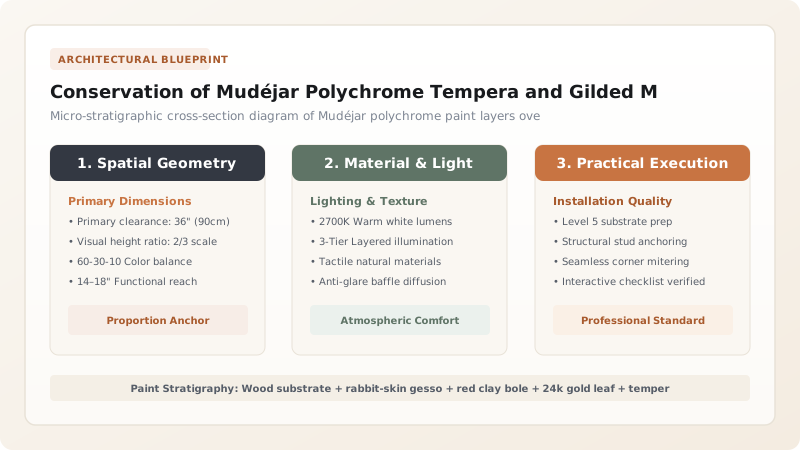
Mudéjar ceilings owe their dazzling visual radiance to a sophisticated layering of natural media. Carpenters primed seasoned Scots pine timber with multiple coats of gesso grueso and gesso fino (slaked plaster bound with rabbit-skin collagen glue).
For gilded elements such as central star rosettes and hanging mocárabes (stalactite pendentive prisms), artisans applied Armenian red clay bole, applied genuine 24-karat gold leaf, and hand-burnished the surface with agate stones. Flat timber panels (harneruelos) were painted with egg-yolk tempera using costly mineral pigments: lapis lazuli, azurite blue, cinnabar vermilion, and malachite green.
2. Primary Pathology: Wood-Boring Insects & Desiccation
Over centuries, Mudéjar ceilings face two lethal threats: xylophagous insect attack (principally common furniture beetles, Anobium punctatum, and deathwatch beetles, Xestobium rufovillosum) which hollow out timber cores, and paint cleavage.
As seasonal humidity fluctuates, timber expands and contracts at a different rate than the rigid brittle gesso ground. This shear stress breaks the collagen bond, resulting in micro-cupping, tenting, and spontaneous flaking of historic tempera paint and gold leaf.
3. Contemporary Scientific Restoration Protocols
Modern conservation strictly avoids invasive chemical pesticides or permanent synthetic varnishes. Instead, entire spaces or demounted modules undergo anoxic nitrogen treatment, maintaining oxygen levels below 0.1% for 21 days to eradicate 100% of insect larvae and eggs without chemical residues.
Flaking tempera and fragile gold leaf are consolidated using ultrasonic mist generators delivering 1% JunFunori (seaweed extract) or sturgeon bladder isinglass, gently drawn behind paint flakes via capillary action. Surface soot is removed using pH-buffered aqueous triammonium citrate sponges, preserving the authentic historic patina.
Mudéjar Polychrome Pigment Identification & Consolidation Matrix
Use this reference table to calculate exact physical dimensions, ratios, and specifications before purchasing:
| Pigment / Metal | Chemical Composition | Primary Vulnerability | Consolidation Adhesive | Cleaning Method |
|---|---|---|---|---|
| Water-Gilded Gold Leaf | Au (23.5k - 24k) over Bole | Bole detachment, mechanical abrasion | 1.5% Sturgeon Isinglass Glue | Dry micro-sponge wiping |
| Azurite Blue | 2CuCO3·Cu(OH)2 | Acid rain darkening, powdery cleavage | 1% JunFunori aqueous mist | Buffered aqueous gel (pH 7.0) |
| Cinnabar / Vermilion | HgS (Mercury Sulfide) | Light-induced darkening to metacinnabar | 2% Klucel G in ethanol | Neutral chelating swab rolling |
| Malachite Green | CuCO3·Cu(OH)2 | Discoloration from alkalis and soaps | 1.5% Funori seaweed mucilage | Hydrocarbon solvent emulsion |
Access & Restoration Constraints
Every successful decoration project must account for physical and environmental constraints:
Overhead Ergonomics
Conservators work on scaffolding 12 meters above floor level, requiring specialized motorized lift platforms.
Toxic Historic Pigments
Cinnabar (mercury) and orpiment (arsenic) require full HEPA respiratory protection during dry cleaning.
Protocol for In-Situ Consolidation of Historic Polychrome Ceiling Panels
Execute this professional sequence to achieve flawless results without backtracking:
Microscopic Stratigraphy & UV Fluorescence
Inspect painted surfaces under raking light and ultraviolet illumination to map previous overpaints and loose paint scales.
Anoxic Insect Eradication
Enclose chamber or timber modules in multi-layer barrier foil; displace oxygen with 99.9% pure nitrogen gas for 28 days.
Local Paint Scale Re-Adhesion
Inject 1.5% sturgeon glue behind tented paint flakes; warm gently with thermostatically controlled silicone heating spatula at 42°C.
Surface Soot & Wax Removal
Roll cotton swabs moistened with triammonium citrate aqueous solution (pH 7.2) across dirty surfaces to lift grime.
Timber Void Micro-Consolidation
Consolidate insect-hollowed timber cores by micro-injecting 5% Paraloid B-72 dissolved in acetone/ethanol.
Reversible Inpainting (Tratteggio)
Inpaint paint losses using fine vertical hatching (tratteggio) executed in reversible watercolor pigments.
Common Mistakes & Countermeasures
Avoid these costly errors that compromise aesthetics, ergonomics, and budget:
Applying synthetic polyurethane or epoxy coatings across historic painted wood
Cleaning water-gilded mocárabes with water or standard household detergents
Project Execution Checklist
Track your physical progress. Checkboxes persist automatically on this device:
Frequently Asked Questions
What are mocárabes in Mudéjar architecture?
Mocárabes are three-dimensional prismatic wooden or stucco architectural elements inspired by Islamic muqarnas stalactites, clustered together in descending geometries at ceiling corners, corbels, and dome squinches.
Why is sturgeon glue preferred over modern epoxy for wood painting conservation?
Sturgeon isinglass glue has unmatched flexibility, extraordinary tensile adhesion, does not shrink or embrittle with age, and remains 100% reversible with mild moisture and gentle heat even after centuries.


