
Construct false-bottom secret drawers by building a standard 5/8" solid maple drawer box with an extra 1-1/2" of vertical height. Install the true bottom in a lower dado, mount brass gravity drop pins or spring pushers in the sub-floor corners, and overlay a precision-fitted 1/4" matching false bottom panel that unlocks only with a hidden magnet.
At a Glance: Key Takeaways
- Optical Depth Illusion: Sizing drawer sides 1-1/2" deeper hides a 1-inch sub-cavity that is visually undetectable from above.
- Magnetic Gravity Drop Pins: Steel/brass locking pins drop into floor sockets by gravity, releasing only when a magnet lifts them upward.
- Pneumatic Spring Plunger Ejectors: Pressing a secret corner tilts the false floor upward 1 inch for effortless removal.
- 0.5mm Hairline Perimeter Tolerance: Precision-machined false floor fits so tightly that casual inspectors perceive it as the solid box bottom.
- Magnetic Suction Lifting Cup: Placing a decorative magnetic coaster or wooden block on the floor provides the lifting handle.
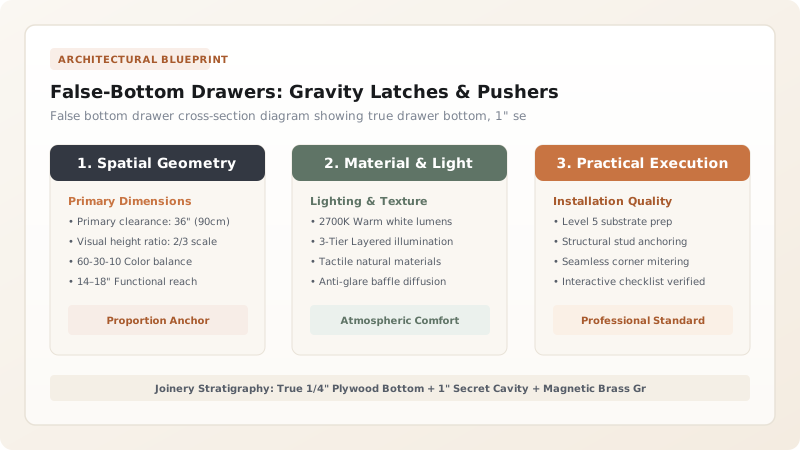
1. Optical Illusion Joinery: 1-1/2" Extra Depth & Sub-Floor Framing
The secret to an undetectable false bottom is the human eye's inability to judge internal drawer depth vs external slide height. By milling the drawer box 1-1/2 inches taller than normal, a 1-inch deep concealed sub-floor well is created.
The True Bottom Panel is installed in the lowest dado. A secondary perimeter hardwood ledger supports the Removable 1/4" False Floor made from the exact same sheet of pre-finished maple plywood. Learn dovetail construction in drawer box hardwood species.

2. Mechanical Gravity Latches & Spring-Loaded Corner Tilters
To prevent the false floor from rattling when the drawer is opened and slammed, install Spring-Loaded Ball Detents or Magnetic Gravity Pins.
A hidden Spring Pusher Plunger in the rear corner tilts the floor up when a secret mechanical release is triggered. Review RFID locks in magnetic reed and RFID locks and explore secret compartments hub.
False-Bottom Drawer Release Mechanisms Comparison
Use this reference table to calculate exact physical dimensions, ratios, and specifications before purchasing:
| Release Mechanism | Lifting Method | Rattle Resistance | Security Level |
|---|---|---|---|
| Magnetic Gravity Pin + Suction Magnet (Optimal) | Magnetic lifting coaster | 100% Locked (Zero rattle when slammed) | 5 / 5 (Undetectable to physical search) |
| Corner Touch-Tilt Spring Rocker | Press rear left corner | Moderate (Requires spring friction) | 4 / 5 (Fast mechanical access) |
| Finger Hole Cutout (Avoid) | Finger hole in corner | Low | 1 / 5 (FAILS: Completely obvious to anyone) |
| Friction Fit Plywood (No Latch) | Knife blade prying | High | 3 / 5 (Damages wood edges when prying) |
Mismatched Wood Grain Reveal Constraints
Every successful decoration project must account for physical and environmental constraints:
Cutting False Bottom from Different Plywood Sheet with Different Grain and Color
If the false floor wood color or grain pattern differs from the drawer sides or true bottom, the human eye immediately identifies the seam; cut the false bottom and true bottom from the EXACT same sheet of pre-finished maple plywood, aligning grain direction identically.
How to Build a False-Bottom Secret Drawer Box
Execute this professional sequence to achieve flawless results without backtracking:
Mill Drawer Box Sides 1-1/2" Taller than Standard
Mill 5/8" solid maple box sides to 5-1/2" height instead of standard 4" height to house the 1" secret well.
Rout Lower Dado for True Bottom and Ledger for False Floor
Rout 1/4" dado 1/2" from bottom for true floor; glue 1/4" × 1/4" hardwood perimeter ledger strip 1-1/4" above it.
Assemble Drawer Box with Dovetail Joinery
Join corners with half-blind dovetails, sliding the true 1/4" bottom panel into the lower dado.
Install Brass Gravity Drop Pin in Sub-Floor Ledger
Drill 1/4" vertical hole through ledger; insert steel core brass gravity pin that locks into false floor underside.
Mount Miniature Spring Plunger in Rear Corner
Screw 10-lb spring ejector pin in rear left corner under ledger; when unlocked, spring tilts floor up 1/2".
Cut False Bottom Panel with 0.5mm Hairline Clearance
Cut matching pre-finished maple plywood panel to exact interior dimensions (leaving tight 0.5mm perimeter gap).
Test Release with Neodymium Magnetic Coaster
Drop false floor in place (locks automatically); place magnetic coaster on secret spot to lift pin and extract panel.
Common Mistakes & Countermeasures
Avoid these costly errors that compromise aesthetics, ergonomics, and budget:
Making the False Bottom Floor Too Loose in the Box
Project Execution Checklist
Track your physical progress. Checkboxes persist automatically on this device:
Frequently Asked Questions
How deep can a false bottom compartment be?
A false bottom is typically 1.0 to 1.5 inches deep—perfect for passports, jewelry, gold coins, and documents. For larger items (such as handguns or safe boxes), design a full-depth false back compartment behind the drawer instead.


