
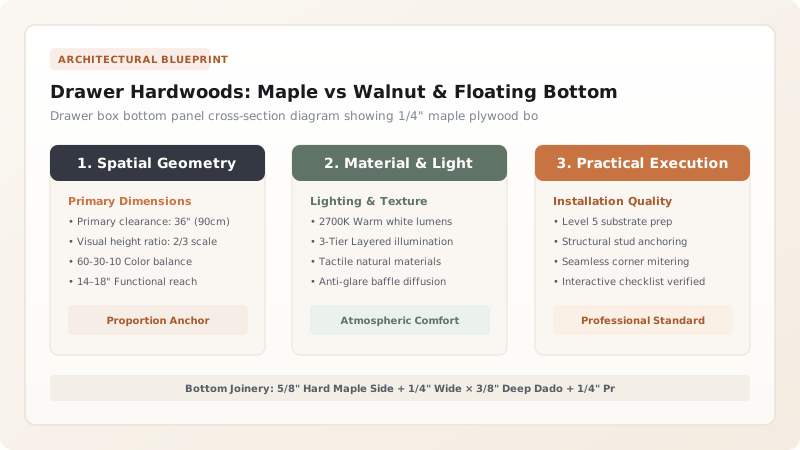
Construct premium custom drawer boxes using 5/8" kiln-dried Solid Hard White Maple (*Acer saccharum*, Janka 1450) or North American Black Walnut (*Juglans nigra*). House a 1/4" pre-finished birch or maple plywood bottom panel in a 1/4" wide × 3/8" deep dado groove cut 1/2" from the bottom edge, leaving a 1/8" floating expansion gap without glue.
At a Glance: Key Takeaways
- Hard White Maple (Janka 1,450 lbf): High density resists denting from heavy cutlery and pots; clean light blonde aesthetic.
- Black Walnut (Janka 1,010 lbf): Premium luxury contrast timber paired with dark bronze hardware in custom kitchens.
- Baltic Birch Multi-Ply (9-Ply 12mm / 1/2"): Void-free cross-laminated birch provides unmatched dimensional stability for utility drawers.
- 1/4" Plywood Bottom vs Solid Wood: Plywood eliminates seasonal cross-grain expansion that causes wide drawers to bind in summer.
- 1/8-Inch Floating Expansion Clearance: Allows sub-frame movement without splitting side dovetails during humidity swings.
1. Wood Science: Janka Hardness, Dimensional Stability & Grain Texture
Drawer boxes endure constant impact from heavy metal silverware, ceramic cookware, and aggressive daily closing. Softwoods (like Pine or Poplar) dent easily and tear out during dovetail routing.
The industry benchmark is North American Hard White Maple (*Acer saccharum*) with a Janka Hardness of 1,450 lbf. It machines with glass-smooth end-grain and resists denting. For dark custom interiors, American Black Walnut (*Juglans nigra*) offers rich contrast. Learn dovetail ratios in through vs half-blind dovetails.

2. Floating Bottom Panel Dado Mechanics & 1/8" Expansion Clearance
Solid wood expands and contracts across its grain width with changes in relative humidity (\(\Delta W = W \times \Delta \text{MC} \times C_R\)). If a drawer bottom is glued tight, the box will crack in winter.
House a 1/4" Pre-Finished Plywood Bottom in a 3/8" Deep Dado, sizing the panel 1/8-inch narrower than the frame opening to float freely. Review slide spacing in undermount slide clearances and explore dovetail joinery hub.
Drawer Box Materials Comparison
Use this reference table to calculate exact physical dimensions, ratios, and specifications before purchasing:
| Material Species | Janka Hardness | Dimensional Movement (T/R Ratio) | Cabinetry Application |
|---|---|---|---|
| Solid Hard White Maple (Optimal) | 1,450 lbf (Very Hard) | 1.9 (High stability / low warpage) | High-End Custom Kitchens & Baths |
| Solid Black Walnut | 1,010 lbf (Medium Hard) | 1.4 (Extremely stable / rich tone) | Luxury Architectural Credenzas & Pantries |
| Baltic Birch Multi-Ply (9-Ply 12mm) | N/A (Cross-laminated) | 0.1% (Near zero seasonal movement) | Modern Minimalist / Heavy Pot Drawers |
| Yellow Poplar / Whitewood (Avoid) | 540 lbf (Soft / Green streaks) | 2.2 (Prone to seasonal twisting) | Budget builder production only |
1/4" Bottom Sag Under Heavy Pot Load Constraints
Every successful decoration project must account for physical and environmental constraints:
Heavy 36-Inch Wide Cast Iron Cookware Drawer Bowing 1/4" Bottom Panel
In wide pot drawers (30"–36" width), a 1/4" plywood bottom sags under 75 lbs of cast iron pans, dragging on slides; upgrade wide drawer bottoms to 3/8" (9mm) or 1/2" (12mm) Baltic birch plywood, or screw an intermediate hardwood center support rib beneath the 1/4" panel.
How to Mill, Dado, and Size a Drawer Bottom Panel
Execute this professional sequence to achieve flawless results without backtracking:
Select Straight-Grained Kiln-Dried Hard Maple (6%–8% MC)
Verify moisture content with pin meter; rip and crosscut lumber to rough drawer component sizes.
Face-Joint and Thickness-Plane to Exactly 5/8" (16mm)
Plane all four drawer box boards to identical 5/8" thickness; verify parallel edges on table saw.
Rout 1/4" Wide × 3/8" Deep Dado Groove
Set table saw dado stack to 1/4"; position fence to cut groove exactly 1/2" above bottom edge on all 4 pieces.
Calculate Exact Bottom Panel Dimensions
Measure inside frame opening; add 5/8" (two 5/16" tongue depths); subtract 1/8" for expansion gap.
Cut 1/4" Pre-Finished Maple Plywood Bottom
Cut panel on sliding table saw with 80-tooth blade to prevent veneer chip-out; verify 100% squareness.
Assemble Drawer Box with Floating Bottom Panel
Slide bottom into grooves during dovetail assembly; apply glue ONLY to dovetail corners, leaving bottom floating.
Common Mistakes & Countermeasures
Avoid these costly errors that compromise aesthetics, ergonomics, and budget:
Using Low-Grade MDF Core Plywood for Drawer Bottoms
Project Execution Checklist
Track your physical progress. Checkboxes persist automatically on this device:
Frequently Asked Questions
What finish should be applied to the inside of a solid maple drawer box?
Apply a non-off-gassing finish such as low-VOC pre-catalyzed water-based lacquer, hardwax oil (Osmo), or dewaxed shellac. Never use oil-based polyurethane inside closed drawers, which off-gasses offensive chemical fumes for years.


