
Build heirloom custom cabinetry drawer boxes from 5/8" solid hard maple or Baltic birch, joining corners with half-blind or through dovetails cut at a 1:8 angle (for hardwoods) or 1:6 angle (for softwoods). House a 1/4" plywood bottom in a dado groove set 1/2" above the bottom edge, allowing exact 1/2" side clearance for Blum Tandem undermount soft-close slides.
At a Glance: Key Takeaways
- Mechanical Tensile Interlock: Trapezoidal pins and tails resist pull-out forces indefinitely without relying solely on glue adhesion.
- 1:8 vs 1:6 Angle Slope Ratios: 1:8 (7.1°) is the gold standard for dense hardwoods (Maple/Walnut); 1:6 (9.5°) for softwoods (Pine/Cedar).
- 5/8-Inch Solid Hard Maple Sides: Provides optimal balance of structural rigidity, screw holding power, and refined aesthetic proportions.
- 1/2-Inch Undermount Slide Notch & Bore: Exact bottom clearance (1/2" / 13mm) required for concealed Blum Tandem soft-close runners.
- Floating Bottom Panel Dado Groove: 1/4" bottom captures inside a 1/4" deep groove without glue, allowing natural seasonal wood expansion.
In-Depth Guides in this Directory
Explore specialized subtopic blueprints, technical dimensions, and execution checklists:
Dovetail Ratios: 1:8 Hardwood Angles & Half-Blind Sockets
Master dovetail joint carpentry trigonometry: 1:8 hardwood angles (7.125°), 1:6 softwood angles (9.46°), half-blind socket depth calculations, and chisel socket chopping.
Drawer Hardwoods: Maple vs Walnut & Floating Bottom Math
Master cabinetry drawer box material science: Solid Hard Maple (*Acer saccharum*) vs Black Walnut, Baltic Birch multi-ply, 1/4" bottom groove dados, and seasonal wood expansion.
Undermount Slides: Clearances, Notches & Blum Clip Math
Master undermount soft-close drawer slide carpentry: Blum Tandem / Movento 1/2" side clearances, 1/2" bottom setback, rear hook boreholes, and front locking clips.
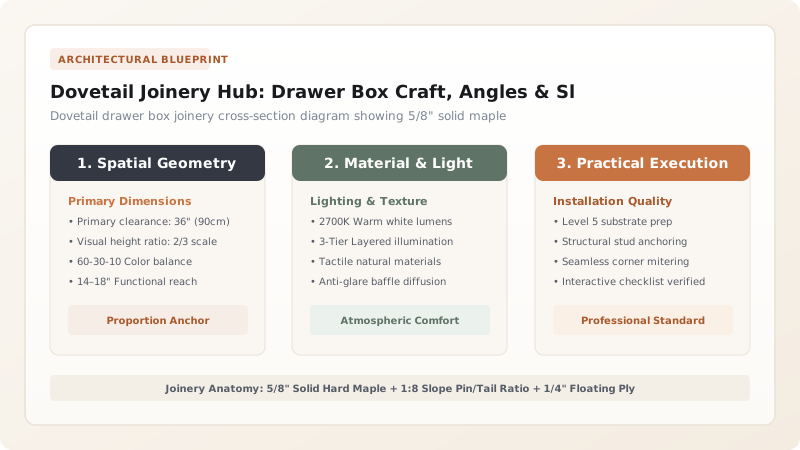
1. Joinery Mechanics: 1:8 Pin-to-Tail Ratios & Tensile Interlocking
In luxury architectural millwork, staple-and-glue or pocket-screw drawer boxes fail after several years of opening and slamming. Dovetail Joinery creates a true mechanical interlock.
The trapezoidal tail physically cannot pull through the pin socket when the drawer handle is pulled. Hardwoods require an Angle Ratio of 1:8 (\(7.1^{\circ}\)). Master joinery geometry in through vs half-blind dovetail angles and compare with under-cabinet integrated millwork lighting.

2. Hardwood Timber Selection & Undermount Soft-Close Clearances
Dovetailed drawer boxes are built from 5/8-inch Solid White Hard Maple or Quarter-Sawn Walnut with a 1/4-inch floating bottom panel.
Calibrate timber in drawer box hardwood species and bottom groove clearances and calibrate hardware in undermount soft-close slide clearances.
Cabinetry Drawer Box Joinery Methods Comparison
Use this reference table to calculate exact physical dimensions, ratios, and specifications before purchasing:
| Joinery Method | Mechanical Pull-Out Strength | Aesthetic Heirloom Quality | Lifespan under Heavy Load |
|---|---|---|---|
| Half-Blind / Through Dovetail (Optimal) | 100% Mechanical Lock (Extreme tensile) | 5 / 5 (Luxury Heirloom Custom Standard) | 50+ Years (Lifetime warranty) |
| Finger / Box Joint | High (Interlocking fingers / Glue dependent) | 4 / 5 (Modern clean geometric look) | 30+ Years |
| Dowel / Pocket Screw Joinery | Low (Relies on screw threads in end-grain) | 2 / 5 (Commercial production) | 5 to 10 Years (Loosens over time) |
| Stapled Rabbet & Melamine (Avoid) | Near Zero (Glued paper face) | 1 / 5 (Budget builder grade) | FAILS: Front rips off within 3 years |
Bottom Groove Misalignment Slide Collision Constraints
Every successful decoration project must account for physical and environmental constraints:
Routing Drawer Bottom Dado Groove Less Than 1/2" from Bottom Edge Blocking Undermount Slide
Concealed undermount slides (Blum Tandem) require exactly 1/2" (13mm) of vertical clearance beneath the drawer bottom panel; routing the groove at 1/4" or 3/8" causes the bottom panel to collide with the steel slide runners; strictly locate the bottom dado groove 1/2" above the bottom edge of all four drawer box sides.
How to Build and Fit a Dovetailed Hardwood Drawer Box
Execute this professional sequence to achieve flawless results without backtracking:
Mill 5/8" Solid Hard Maple Sides Flat and Square
Plane and joint hard maple lumber to uniform 5/8" (16mm) thickness; square all ends to exact drawer box dimensions.
Rout 1/4" Bottom Dado Groove 1/2" from Bottom Edge
Cut 1/4" wide × 1/4" deep groove along inside face of all four sides, positioned exactly 1/2" above bottom edge.
Cut Half-Blind Dovetails on Front and Through Tails on Rear
Cut pins and tails using Leigh dovetail jig or hand saw/chisels at 1:8 angle; dry-fit corners tightly.
Slide 1/4" Plywood Bottom into Grooves (No Glue)
Insert pre-finished maple plywood bottom panel into dadoes dry, allowing panel to float freely.
Apply PVA Glue to Dovetail Sockets and Clamp Square
Apply Titebond II to pin/tail contact faces; clamp box with corner clamps, verifying diagonal squareness.
Notch and Bore Rear of Drawer Box for Undermount Slides
Cut 1-3/8" wide × 7/16" high notch on rear bottom edge; drill 6mm hook hole in rear partition per slide spec.
Mount Front Locking Clips and Snap onto Undermount Runners
Fasten Blum front locking clips to bottom front corners with screws; click drawer onto cabinet slides.
Common Mistakes & Countermeasures
Avoid these costly errors that compromise aesthetics, ergonomics, and budget:
Gluing the Drawer Bottom Panel into the Dado Grooves
Project Execution Checklist
Track your physical progress. Checkboxes persist automatically on this device:
Frequently Asked Questions
What is the difference between half-blind and through dovetails?
Through dovetails expose the end-grain of both pins and tails on both exterior faces of the joint. Half-blind dovetails conceal the joint on the front face, showing wood pins only from the side—making them ideal for drawer boxes with integrated fronts.


