
Install invisible RFID cabinet locks (such as PS Locks Solo or Stealthlock) by mortising the lock body on the inside face of a solid wood panel, maintaining a 3/4" (19mm) to 1" (25mm) wood thickness directly over the internal antenna. Use 13.56MHz high-frequency cards or smartphone NFC chips to trigger the motorized deadbolt through the solid wood without exterior keyholes.
At a Glance: Key Takeaways
- 13.56MHz High-Frequency Inductive Coupling: Delivers reliable signal transmission through dense hardwoods, Corian, and glass.
- Maximum 32mm (1.25") Wood Thickness Limit: RF magnetic fields attenuate exponentially through wood; recessing sensor optimizes read range.
- 1,000 lb Shear Holding Force: Steel deadbolt resists pry bars and heavy kick-in attacks when anchored into solid hardwood gables.
- Low-Battery Fail-Open Safety Protocol: Motorized deadbolt automatically retracts and sounds audible alarm when battery drops below 3.6V.
- Hidden Emergency 9V Jumper Port: External micro-wire terminal allows instant unlocking with a 9V battery if batteries are completely dead.
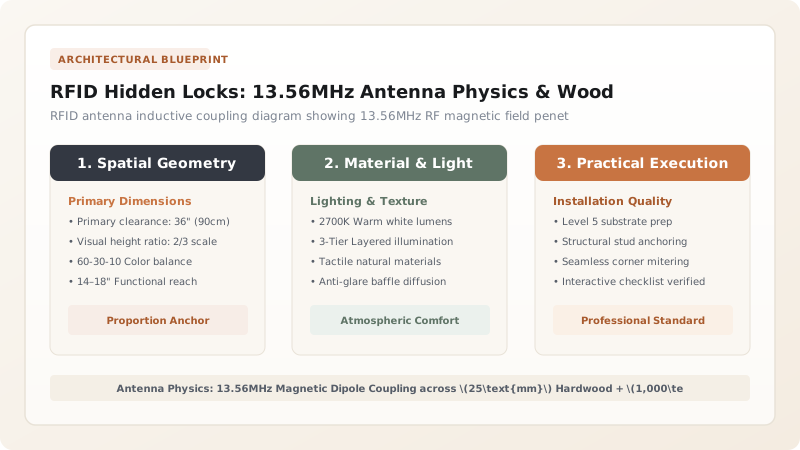
1. Electromagnetic Physics: 13.56MHz Inductive Coupling & Timber Permittivity
Invisible locks operate via Near-Field Inductive Magnetic Coupling. The internal lock coil emits an oscillating 13.56MHz magnetic field.
When an RFID card or smartphone passes within range, it draws power from the field and transmits an encrypted access code. Because dry wood has a low dielectric constant (\(\epsilon_r \approx 2.0\text{ to } 3.0\)), the radio signal passes cleanly through up to 32mm (1-1/4") of solid timber. Learn gravity latches in false-bottom drawer gravity latches.

2. Fail-Safe Engineering: Low-Voltage Auto-Release & 1,000 lb Shear Deadbolts
Homeowners fear getting locked out of their own secret safe when batteries die. Commercial-grade invisible locks incorporate Active Microprocessor Voltage Monitoring.
When battery level drops below 20%, the lock beeps continuously. If ignored, the motorized deadbolt retracts automatically before battery death. Review bookcase hinges in concealed bookcase pivot hinges and explore secret compartments hub.
Invisible Lock Technologies Comparison
Use this reference table to calculate exact physical dimensions, ratios, and specifications before purchasing:
| Lock Technology | Frequency / Mechanism | Effective Penetration Depth | Security & Encryption |
|---|---|---|---|
| 13.56MHz RFID / NFC (Optimal) | High-Frequency Radio Resonance | Up to 32mm (1.25") Wood | AES-128 Bit Encrypted (Smartphone compatible) |
| 125kHz Low-Frequency RFID | Low-Frequency EM Induction | Up to 25mm (1.00") Wood | Standard fixed code (Fob only) |
| Rare-Earth Neodymium Magnetic Reed | Static Magnetic Field (N-Pole) | Up to 20mm (0.75") Wood | Physical magnet key (No electronics) |
| Bluetooth BLE Wireless Lock | 2.4GHz Bluetooth Radio | Up to 100mm (4.00") Wood | App dependent / Bluetooth latency |
Metal Foil Shielding Signal Block Constraints
Every successful decoration project must account for physical and environmental constraints:
Metallic Paints or Carbon-Fiber Inlays Blocking RFID Wireless Signal Penetration
Metallic metallic flakes in decorative paint or carbon fiber foils act as a Faraday cage, blocking 13.56MHz radio waves; strictly ensure zero metallic paints, wire meshes, or metal foils are placed between the RFID antenna and the outer wood face.
How to Install and Program an Invisible RFID Lock
Execute this professional sequence to achieve flawless results without backtracking:
Determine Optimal Sensor Location on Cabinet Door
Choose natural tactile landmark (such as a wood knot, corner molding, or carving detail) as user touch point.
Rout Mortise Pocket on Inside Face of Door
Plunge rout 3" × 2.5" pocket to leave exactly 3/4" (19mm) wood thickness between lock antenna and outer face.
Fasten Lock Body with Heavy-Duty Screws
Screw lock mechanism into hardwood frame using four #8 stainless steel deep-thread wood screws.
Install Spring-Loaded Push Ejector Pin
Mount spring plunger adjacent to latch; this kicks the door open 1/2" the instant the lock retracts.
Mount Strike Plate Catch on Cabinet Partition
Fasten hardened steel strike plate to cabinet gable with 1-1/2" screws anchored into solid hardwood.
Pair Master Programming Card and User Fobs
Hold master card to lock for 5 beeps; swipe user cards and smartphone NFC tags to enroll access credentials.
Route Emergency 9V Jumper Wires to Hidden Location
Run micro-gauge backup power cable through cabinet bottom to hidden terminal behind removable toe-kick.
Common Mistakes & Countermeasures
Avoid these costly errors that compromise aesthetics, ergonomics, and budget:
Forgetting to Install a Spring-Loaded Push Ejector
Project Execution Checklist
Track your physical progress. Checkboxes persist automatically on this device:
Frequently Asked Questions
Can you use an Apple iPhone or Android phone as the RFID key?
Yes! Modern 13.56MHz locks (such as PS Locks with Bluetooth/NFC) pair directly with Apple Wallet NFC passes or custom iOS/Android security apps, allowing you to unlock the hidden compartment with your phone.


