
Build secret compartments in custom furniture and architectural millwork using invisible RFID / magnetic reed locks that penetrate through 1.25" of solid hardwood. Build false-bottom drawers with magnetic gravity latches and spring pushers, and hang heavy hidden room bookcases using 500 lb load-rated floor-mounted concealed pivot hinges (such as Murphy Door heavy-duty pivot hardware).
At a Glance: Key Takeaways
- Invisible RFID / Magnetic Locks: Wireless electronic deadbolts penetrate through solid 1-1/4" (32mm) hardwood with zero exterior keyholes.
- Mechanical Magnetic Gravity Drop Latches: Pure mechanical brass latches release only when a strong neodymium magnet is placed over a hidden sweet spot.
- False-Bottom Drawer Secret Wells: Hidden 1-inch sub-cavities beneath full-extension drawers accessible via push-pull false floors.
- 500 lb Load-Rated Concealed Pivot Hinges: Structural ball-bearing floor pivots transfer the entire bookcase weight directly into floor joists.
- Zero-Reveal Shadow Lines (1/8"): Precision architectural reveals disguise secret door seams as normal millwork wainscoting joints.
In-Depth Guides in this Directory
Explore specialized subtopic blueprints, technical dimensions, and execution checklists:
RFID Hidden Locks: 13.56MHz Antenna Physics & Wood Penetration
Master invisible electronic cabinet locking hardware: 13.56MHz RFID / NFC inductive antenna physics, 32mm hardwood penetration limits, 1,000 lb shear deadbolts, and low-battery fail-open protocols.
False-Bottom Drawers: Gravity Latches & Pushers
Master false-bottom drawer joinery: 1-inch hidden sub-floor cavities, magnetic gravity release pins, pneumatic touch-latch spring pushers, and seamless edge miters.
Secret Bookcase Hinges: 500 lb Pivot Ratings & Floor Anchors
Master secret hidden bookcase door structural engineering: 500 lb to 1,000 lb floor pivot hinge load calculations, torque cantilever math, ball-bearing thrust races, and zero-sag floor anchoring.
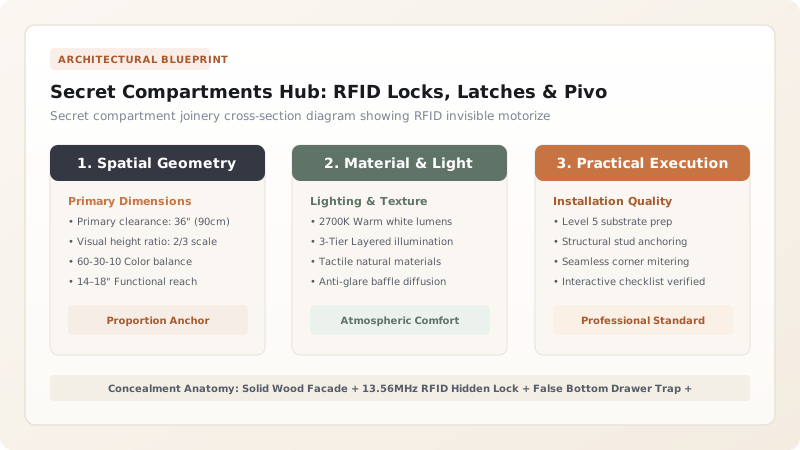
1. Concealed Locking Technology: 13.56MHz RFID & Magnetic Reed Latches
Modern secret compartments rely on completely invisible electronic locking mechanisms hidden inside the cabinetry core.
13.56MHz High-Frequency RFID and NFC Locks transmit radio frequency signals directly through up to 1.25 inches (32mm) of solid hardwood. For battery-free mechanical security, Hidden Magnetic Gravity Latches unlock when a rare-earth neodymium magnet is placed on a decorative wooden rosette. Master locking hardware in magnetic reed and RFID invisible cabinet locks and coordinate with false-bottom drawer gravity latches.

2. False-Bottom Joinery & 500 lb Concealed Bookcase Pivot Hinges
A secret room hidden behind a full-size library bookcase carries over 400 to 600 lbs of books and solid hardwood. Standard butt hinges or piano hinges will sag and jam within days.
Master heavy hinge engineering in concealed bookcase pivot hinge load ratings and explore dovetailed drawer boxes.
Secret Compartment Release Mechanisms Comparison
Use this reference table to calculate exact physical dimensions, ratios, and specifications before purchasing:
| Mechanism Type | Exterior Visual Evidence | Penetration Depth in Wood | Fail-Safe Battery Protocol |
|---|---|---|---|
| 13.56MHz RFID Motorized Lock (Optimal) | 0% Zero exterior keyholes | Up to 1.25" (32mm) Solid Hardwood | Auto-unlocks before battery dies + External backup port |
| Rare-Earth Magnetic Gravity Latch | 0% Zero exterior evidence | Up to 1.00" (25mm) Hardwood | 100% Battery-free pure mechanical |
| Concealed Touch-Latch Spring Pusher | 0% Zero exterior evidence | N/A (Push-to-open mechanical) | Pure mechanical / Push face to release |
| Traditional Mechanical Key Lock (Avoid) | Visible keyhole / Escutcheon | N/A | FAILS: Obvious visual target for intruders |
Electronic Battery Deadlock Lockout Constraints
Every successful decoration project must account for physical and environmental constraints:
Internal RFID Lock Battery Dying While Locked Trapping Valuables Inside Compartment
If cheap electronic locks lose power while engaged, the compartment is permanently trapped; install strictly professional architectural RFID locks (such as PS Locks or Stealthlock) equipped with an audible low-battery alarm, an automatic fail-open protocol before battery depletion, and a micro-USB emergency external power jumper.
How to Build a Concealed Secret Compartment with RFID Locking
Execute this professional sequence to achieve flawless results without backtracking:
Design False Cavity Behind Drawer or False Back
Frame 3" deep secret well behind functional kitchen cabinet back or under a false drawer bottom.
Rout 1/2" Recess in Sub-Panel for RFID Lock Body
Mortise inside sub-frame to house RFID motorized latch, maintaining 3/4" to 1" wood thickness to front face.
Install Spring-Loaded Push Ejector Pin
Mount spring plunger that automatically pushes the secret compartment door open 1/2" when the lock disengages.
Program RFID Master and User Access Cards
Swipe master programming card across lock sensor; pair user keycards, key fobs, or smartphone NFC chips.
Install Concealed Emergency External Power Jack
Route micro-gauge emergency power wire to hidden terminal beneath toe-kick for backup 9V battery connection.
Test 50 Open/Close Cycles Before Final Assembly
Verify flawless unlocking across full wood thickness before gluing exterior molding or installing drawers.
Common Mistakes & Countermeasures
Avoid these costly errors that compromise aesthetics, ergonomics, and budget:
Using Wood Thicker Than 1.25 Inches in Front of RFID Sensor
Project Execution Checklist
Track your physical progress. Checkboxes persist automatically on this device:
Frequently Asked Questions
Can secret bookcase doors be opened from the inside if accidentally closed?
YES! Life safety codes mandate that all walk-in secret rooms have an emergency mechanical manual release lever on the inside face of the door that immediately overrides any electronic or magnetic lock.


