
Engineer a Rumford throat by curving the masonry lintel breast into a smooth 3-to-4-inch radius aerodynamic airfoil, narrowing the throat passage to a precise 4-inch front-to-back slot. Position a hinged cast-iron damper over this slot, and corbel the smoke chamber above at a 60-degree angle, parging all internal transitions glassy-smooth with refractory mortar.
At a Glance: Key Takeaways
- Aerodynamic Airfoil Breast: A rounded masonry curve (3"–4" radius) eliminating separation bubbles and room smoke rollout.
- Venturi Throat Acceleration: Constricting gas flow into a 4-inch slot speeds up exhaust velocity, overpowering room downdrafts.
- Elimination of the Flat Smoke Shelf: Replaces wide horizontal dust-collecting shelves with a streamlined, vertical throat transition.
- Cast Iron Rumford Throat Damper: Streamlined hinged blade resting directly over the 4-inch slot with airtight rotary screw controls.
- Glassy-Smooth Refractory Parging: 1/2" refractory mortar troweled and burnished across all smoke chamber walls to minimize friction drag.
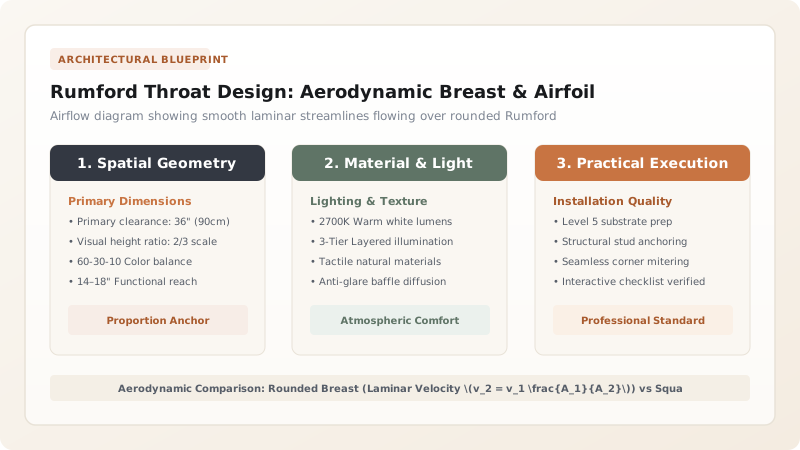
1. Fluid Mechanics: Laminar Streamlines vs Separation Bubbles
Standard masonry fireplaces feature a flat, sharp angle where the lintel meets the ceiling of the firebox. As rising smoke strikes this square corner, fluid mechanics dictates that the airflow separates, creating a violent Recirculation Vortex (Separation Bubble) that spills smoke into the room.
Count Rumford eliminated this eddy by introducing the Rounded Aerodynamic Breast. Rising air and smoke follow the curved masonry contour via the Coandă Effect, maintaining smooth laminar flow. The smoke accelerates smoothly through the narrow 4-inch Throat Slot, converting pressure energy into velocity and preventing smoke from reversing direction. Study firebox angles in firebox depth and coving geometry.

2. Sizing Engineering: Throat Dimensions & 60-Degree Smoke Chambers
The throat slot width must equal the full width of the firebox opening, but its front-to-back depth is strictly calibrated to 4 inches (or maximum 5 inches for openings over 48 inches wide).
Directly above this slot sits the Smoke Chamber, which must taper inward at an angle of At Least 60 Degrees to the Horizontal. Masons parge every brick step with a continuous 1/2-inch Bed of Refractory Cement, troweled smooth with a swimming pool float. This frictionless funnel channels exhaust directly into the first clay flue tile with zero thermal drag. Review mantel installation in marble surrounds and hearth extensions and explore the Rumford hub.
Fireplace Throat & Airflow Comparison
Use this reference table to calculate exact physical dimensions, ratios, and specifications before purchasing:
| Design Element | Rumford Aerodynamic Throat (Optimal) | Standard Conventional Masonry Throat |
|---|---|---|
| Lintel Profile | 3" to 4" Radius smoothly curved airfoil | Sharp 90° square steel angle iron |
| Throat Slot Depth | 4" Narrow slot (Accelerated velocity) | 8" to 12" Wide open gap (Sluggish draft) |
| Smoke Shelf | Virtually eliminated (Streamlined vertical transition) | Deep horizontal shelf (Traps cold air and soot) |
| Room Air Consumption | Low (Conserves conditioned room heat) | High (Sucks furnace-heated air up chimney) |
| Draft Resistance to Wind | Exceptional (Overpowers minor room drafts) | Poor (Prone to smoking on windy days) |
Throat Damper Plate Binding Heat Distortion
Every successful decoration project must account for physical and environmental constraints:
Mortaring Cast Iron Damper Frame Rigidly Causing Jamming When Hot
Cast iron expands at a different rate than surrounding clay brickwork; mortaring the damper frame tightly in non-flexible cement causes the cast iron to warp under direct flame heat, locking the damper blade permanently shut; always wrap damper frames with 1/2" ceramic fiber expansion blanket, allowing 1/4" free thermal expansion clearance on all sides.
How to Construct an Aerodynamic Rumford Throat and Smoke Chamber
Execute this professional sequence to achieve flawless results without backtracking:
Form the Rounded Throat Breast Contour
Use pre-cast refractory Rumford throat blocks or miter firebricks around a 4" steel pipe form, laying with refractory mortar.
Check Throat Slot Gap Across Full Opening Width
Verify with a 4" wooden block gauge that the throat slot measures exactly 4" from front to back across its entire span.
Install Specialized Rumford Cast Iron Damper Frame
Set damper frame over the 4" slot; wrap perimeter in 1/2" high-temp ceramic insulation wool to accommodate thermal expansion.
Corbel Smoke Chamber Walls at Minimum 60-Degree Angle
Step brick courses inward toward the flue center, ensuring corbel angles exceed 60° to eliminate flat ledges.
Parge Smoke Chamber Interior Glassy-Smooth
Apply 1/2" thick coat of hydraulic refractory mortar across all corbeled brickwork; smooth with a wet sponge float.
Set First Modular Clay Chimney Flue Liner
Center clay flue tile (sized to 1/10th fireplace opening area) over the smoke chamber apex; seal with refractory mortar.
Test Damper Operation and Draft Velocity with Smoke Pencil
Operate rotary handle to verify full 90° blade swing; ignite smoke pencil at throat to confirm instantaneous upward draw.
Common Mistakes & Countermeasures
Avoid these costly errors that compromise aesthetics, ergonomics, and budget:
Leaving Exposed Stepped Brick Ledges Inside the Smoke Chamber
Project Execution Checklist
Track your physical progress. Checkboxes persist automatically on this device:
Frequently Asked Questions
Can pre-cast refractory throat components be used for a Rumford fireplace?
Yes! Certified pre-cast refractory throat and coving components (such as Superior Clay Rumford components) guarantee factory-precise airfoil curves and throat dimensions, dramatically reducing mason labor while ensuring flawless drafting.


