
Calculate pleat spacing by subtracting the finished rod width, returns, and overlap from the total flat fabric width. Divide the remaining fabric by the number of pleats (typically 5 to 7 pleats per 50-inch panel). Euro pleats tack the fold at the top 1/4" edge (modern), while French pleats tack 2.5" down (traditional).
At a Glance: Key Takeaways
- Euro Top-Pinch (Modern Workroom Standard): Pinched at the very top edge; allows fabric to break into soft, natural column flares.
- French Pinch (3-Finger Classic): Pinched 2.5" below top; creates 3 distinct structured fingers that hold rigid symmetry.
- Pleat Depth Formula: Each pleat consumes 5 to 6.5 inches of flat fabric across 2.5x fullness panels.
- Space Allocation: Spaces between pleats should measure between 3.5 and 4.5 inches for uniform visual rhythm.
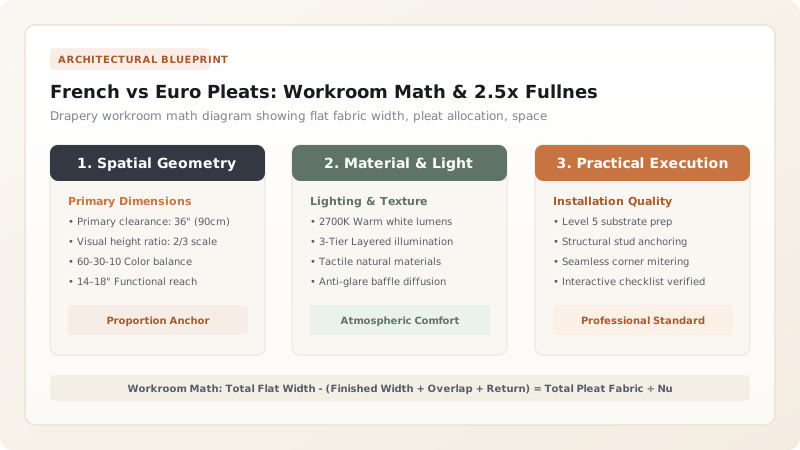
1. Workroom Trigonometry: The Pleat-and-Space Equation
Professional drapery fabrication relies on a strict mathematical formula to ensure that pleats and spaces divide evenly across the curtain panel without awkward fractional spacing at the lead or return edges.
The standard Workroom Pleat Allocation Formula:
$$\text{Total Pleat Fabric} = \text{Cut Width} - (\text{Finished Width} + \text{Return} + \text{Overlap} + \text{Side Hems})$$
Dividing total pleat fabric by the number of pleat intervals gives the exact pleat size (typically 5.25" to 6.0"), ensuring every fold across the entire window wall aligns with laser-like mathematical precision.

French Pinch vs Euro Top-Pinch Specifications
Use this reference table to calculate exact physical dimensions, ratios, and specifications before purchasing:
| Design Characteristic | Euro Top-Pinch Pleat (Parisian) | French 3-Finger Pinch Pleat | Workroom Benefit |
|---|---|---|---|
| Tack Point Location | Top 1/4" Edge of Header | 2.5" - 3.0" Below Top Edge | Euro pleat stacks tighter on rod |
| Fabric Movement Below Header | Flared waterfall column | Structured, constrained tube | Euro pleat looks more relaxed & modern |
| Fabric Fullness Requirement | 2.25x - 2.5x Fullness | 2.5x - 3.0x Fullness | Euro pleats consume slightly less yardage |
| Style Compatibility | Modern, Transitional, Organic Luxury | Traditional, Formal Georgian, Victorian | Matches interior architectural tone |
Heavy Linen Crushing Stack Constraints
Every successful decoration project must account for physical and environmental constraints:
Heavy 100% Belgian Linen Flaring Wildly at Hemlines
100% raw linen reacts to humidity and splays outward; insert 1-inch lead-free drapery corner weights inside the bottom hem corners, and hand-tack vertical lining seams to train folds.
How to Calculate and Sew Euro Pinch Pleats
Execute this professional sequence to achieve flawless results without backtracking:
Calculate Finished Width per Panel
Example: 40" Rod width + 3.5" Return + 2.5" Overlap = 46" Finished Panel Width.
Determine Flat Cut Width
Multiply 46" × 2.5 fullness = 115" Flat Fabric (2.5 widths of 54" fabric seamed together).
Calculate Total Pleat Material
115" Flat Fabric - 46" Finished = 69" Total Pleat Fabric available.
Divide into 12 Pleats (5.75" per Pleat)
69" ÷ 12 pleats = 5.75" of fabric per pleat, separated by 3.8" spaces between pleats.
Tack Folds at Top 1/4" with Heavy Thread
Fold 3-finger pleats and machine-tack or hand-stitch through buckram strictly at the top 1/4" edge.
Common Mistakes & Countermeasures
Avoid these costly errors that compromise aesthetics, ergonomics, and budget:
Spacing Pleats More Than 5 Inches Apart
Project Execution Checklist
Track your physical progress. Checkboxes persist automatically on this device:
Frequently Asked Questions
Can you sew a 2-finger Euro pleat instead of a 3-finger pleat?
Yes! A 2-finger (double Euro) pleat consumes slightly less fabric (2.25x fullness) and provides a sleeker, more minimalist profile that works wonderfully on lightweight sheer linen fabrics.


