
Size gas supply lines for outdoor fire tables using 3/4-inch pipe for runs exceeding 25 feet to prevent pressure drops and flame starvation on 65,000 to 100,000 BTU burners. Install a multi-pitch 'whistle-free' stainless steel flex line to eliminate acoustic humming caused by gas turbulence.
At a Glance: Key Takeaways
- 3/4-Inch Gas Supply Standard: Delivers 100,000+ BTUs over long yard runs without pressure loss.
- Whistle-Free Multi-Pitch Flex Lines: Varying corrugation ridge spacing cancels resonant acoustic standing waves.
- 1/4-Turn Key Ball Valve: Provides instant emergency fuel shutoff located within 6 feet of the table.
- Propane Air Mixer Requirement: Liquid propane REQUIRES a brass air-mixer orifice to prevent sooty yellow smoke.
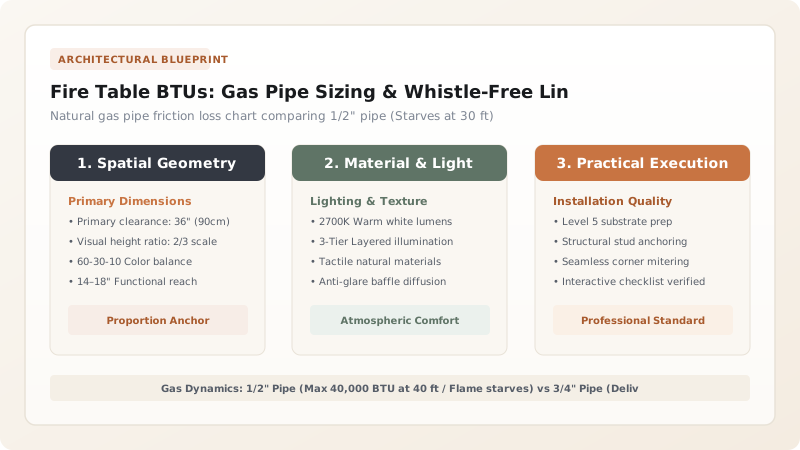
1. Fluid Dynamics: Pipe Friction Drop & Orifice Pressure
Natural gas operates at ultra-low pressure: standard residential meters deliver only 7 inches of Water Column (approx 0.25 PSI). When gas flows through a narrow 1/2-inch pipe over a 50-foot run, boundary friction against pipe walls causes severe pressure loss.
An 80,000 BTU burner connected to an undersized 1/2-inch line will only receive enough gas volume for 35,000 BTUs, resulting in a weak, 2-inch flame that blows out in light breezes. Installing a 3/4-inch or 1-inch line guarantees full gas volume, producing robust, dancing 12-inch golden flames.

Gas Pipe Diameter vs Distance & Max BTU Capacity
Use this reference table to calculate exact physical dimensions, ratios, and specifications before purchasing:
| Pipe Run Distance | 1/2" Iron Pipe Capacity | 3/4" Iron Pipe Capacity | 1.0" Iron Pipe Capacity |
|---|---|---|---|
| 10 - 20 Feet | 92,000 BTU/hr | 190,000 BTU/hr | 350,000 BTU/hr |
| 30 - 50 Feet | 56,000 BTU/hr (Starves 80K burner) | 117,000 BTU/hr | 220,000 BTU/hr |
| 60 - 100 Feet | 38,000 BTU/hr (POOR) | 81,000 BTU/hr (Optimal) | 152,000 BTU/hr |
| 100 - 150 Feet | 28,000 BTU/hr (FAILS) | 65,000 BTU/hr | 125,000 BTU/hr |
Propane Soot Smudge Staining Constraints
Every successful decoration project must account for physical and environmental constraints:
Liquid Propane Leaving Black Soot Stains on Light Glass & White Concrete
Propane burns dirty without sufficient oxygen; install a certified 1/2" brass Air Mixer Valve directly before the burner pan; the air mixer injects 10 parts air to 1 part propane, creating a clean, soot-free blue-and-gold flame.
How to Plumb an Outdoor Gas Fire Table
Execute this professional sequence to achieve flawless results without backtracking:
Size Pipe Using Total Developed Length
Calculate total pipe distance from gas meter to fire table; select 3/4" or 1" pipe accordingly.
Install Underground Polyethylene Pipe
Bury 3/4" SDR-11 gas poly pipe 18" deep with tracer wire; transition to steel risers above ground.
Perform 30 PSI Pressure Test
Pressurize line to 30 PSI with air gauge for 24 hours to prove 100% leak-free integrity for code inspection.
Install 1/4-Turn Key Valve
Mount manual 1/4-turn brass key valve in the side masonry wall of the fire table.
Connect Whistle-Free Stainless Flex Line
Connect non-whistle flexible stainless line between valve and burner, checking connections with soap bubbles.
Common Mistakes & Countermeasures
Avoid these costly errors that compromise aesthetics, ergonomics, and budget:
Using Yellow Teflon Tape for Gas Connections on Flare Fittings
Project Execution Checklist
Track your physical progress. Checkboxes persist automatically on this device:
Frequently Asked Questions
Why does my gas fire table whistle when turned on high?
Whistling is caused by gas turbulence vibrating the uniform ridges of standard corrugated flex lines. Replacing the hose with a 'Whistle-Free Flex Line' (which features staggered, non-uniform corrugations) eliminates the harmonic whistle.


