
Conservation display pedestals (plinths) prevent chemical artifact degradation by utilizing zero-formaldehyde substrates (such as Medite Tricoya Extreme or powder-coated aluminum) tested via the British Museum Oddy protocol. Internal surfaces are encapsulated in heat-sealed aluminum barrier foil (Marvelseal 360) and sealed with medical-grade silicone D-gaskets to maintain airtight envelopes with air exchange rates under 0.1 AER/day.
At a Glance: Key Takeaways
- Oddy Test Certification: All adhesives, paints, and substrates must pass the 28-day British Museum Oddy accelerated corrosion test.
- Zero-Formaldehyde Substrates: Medite Tricoya Extreme uses polyureic MDI resin binders, eliminating toxic formaldehyde emissions.
- Marvelseal 360 Foil Encapsulation: High-barrier nylon/aluminum/polyethylene foil heat-sealed over timber surfaces blocks all organic acid vapors.
- Air Exchange Rate (< 0.1 AER/day): Airtight perimeter sealing isolates artifacts from fluctuating room humidity and airborne urban pollutants.
- Medical-Grade Silicone Gaskets: Neutral-cure, platinum-cured silicone D-profiles provide long-term elasticity without taking a permanent compression set.
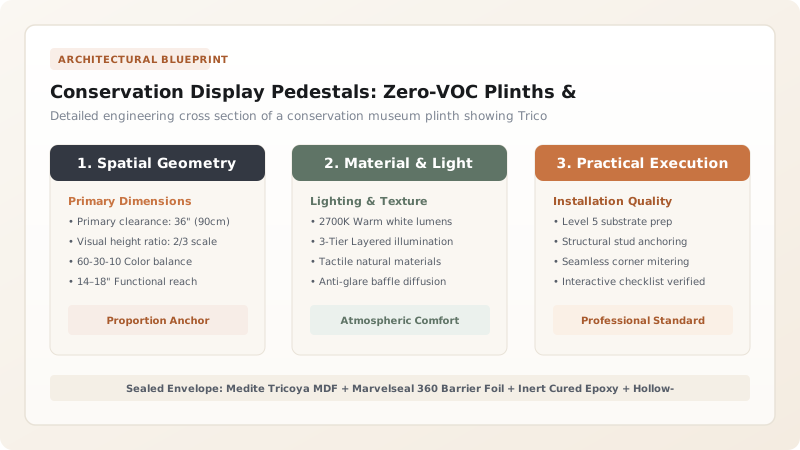
1. Chemical Degradation: The British Museum Oddy Test Standard
Inside an airtight museum vitrine, off-gassed chemicals cannot dissipate into the room; they concentrate relentlessly. Standard wood products emit Formic Acid (\(\text{HCOOH}\)) and Acetic Acid (\(\text{CH}_3\text{COOH}\)) as wood hemicellulose hydrolyzes over time.
These acidic vapors wreak havoc on museum collections:
- Lead Antiquities: Rapidly corrode into powdery white basic lead carbonate (Cérusite), completely destroying fine sculptural inscriptions within months.
- Silver and Copper Objects: Form dark sulfide and acetate tarnishes that pit the surface.
- Limestone, Shell, and Eggshell: Acetic acid reacts with calcium carbonate, causing the artifacts to effloresce and crumble into calcium acetate powder.
To eliminate this threat, all materials installed inside the case envelope must pass the Oddy Test Protocol. Polished coupons of silver, copper, and lead are sealed in airtight glass test tubes with the material sample and a water reservoir, then baked at \(140^\circ\text{F}\) (\(60^\circ\text{C}\)) for 28 days. Only materials exhibiting zero coupon tarnishing or oxidation are classified as Permanent Conservation Grade (Category P). Learn about glass bonding in our guide to UV-cured miters and Optiwhite glass.
2. Substrate Science: Medite Tricoya Extreme vs Standard MDF
Standard commercial MDF utilizes cheap urea-formaldehyde (UF) or phenol-formaldehyde (PF) resins that off-gas carcinogenic formaldehyde gas for decades. Formaldehyde oxidizes in the air into formic acid, creating an intensely corrosive acid bath inside a sealed vitrine.
Conservation plinths specify Medite Tricoya Extreme (MDF) or Powder-Coated Sheet Aluminum. Medite Tricoya is fabricated from chemically acetylated softwood fibers bonded with an inert MDI (Methylene Diphenyl Diisocyanate) Polyurethane Resin:
The acetylation process replaces wood's naturally occurring free hydroxyl groups with stable acetyl groups, rendering the wood dimensionally immune to moisture expansion (\(<0.1\%\)) and eliminating the release of volatile organic acids. Check out our museum art vitrines hub.
3. The Impenetrable Shield: Marvelseal 360 Barrier Foil
Whenever wood or timber framing must be used inside a conservation case, all exposed surfaces must be encapsulated in Marvelseal 360 Barrier Foil. Marvelseal is a 5-mil thick composite material consisting of:
- Outer Layer: Puncture-resistant nylon film.
- Core Barrier: Solid 0.00035\" thick continuous annealed aluminum foil.
- Inner Heat-Seal Layer: Low-density polyethylene (LDPE) layer that bonds under heat.
Craftsmen wrap the foil over all interior pedestal surfaces, ironing seams with a specialized sealing iron at \(350^\circ\text{F} - 400^\circ\text{F}\). The solid aluminum core provides an absolute barrier with a water vapor and gas transmission rate of \(0.0000 \text{ g/m}^2/\text{day}\), completely sealing off-gassing vapors from entering the artifact chamber. Explore passive silica systems in our guide on silica gel cassettes and fiber optic illuminators.
4. Air Exchange Rate (AER): Silicone Gasket Geometry & Tracer Gas Testing
The longevity of the internal microclimate depends on the vitrine's Air Exchange Rate (AER). Standard display cabinets have an AER of 2 to 5 air changes per day. A true museum-grade vitrine must achieve an AER of less than \(0.1 \text{ per day}\) (one complete air change every 10 to 15 days).
This airtightness is achieved through precision perimeter gasketing:
- Neutral-Cure Platinum Silicone Gaskets: Extruded hollow D-profile or P-profile gaskets made from medical-grade, platinum-cured silicone (such as Silastic). Unlike cheap rubber or neoprene gaskets, platinum-cured silicone contains zero sulfur, plasticizers, or acetic acid.
- Compression Control: Gaskets are housed in precision CNC-milled aluminum retention channels that limit gasket compression to exactly \(30\% \text{ to } 40\%\). Over-compression crushes the gasket, destroying its elasticity, while under-compression leaves microscopic air bypass fissures.
- Tracer Gas Decay Testing: Quality assurance involves injecting nitrous oxide (\(\text{N}_2\text{O}\)) or carbon dioxide tracer gas into the vitrine, then monitoring exponential gas concentration decay over 72 hours per ISO 16000 standards.
Contrast with library cabinetry in our guide to library wall bookcases.
Conservation Display Pedestals: Zero-VOC Plinths & Sealed Chambers Architectural Decision Matrix
Use this reference table to calculate exact physical dimensions, ratios, and specifications before purchasing:
| Architectural Factor | Professional Recommendation | Significance |
|---|---|---|
| Substrate Material | Medite Tricoya Extreme NAF MDF or 5052-H32 Aluminum | Formaldehyde emission < 0.01 ppm; passes 28-day Oddy Category P test |
| Vapor Barrier Lining | Marvelseal 360 Nylon/Aluminum/Poly composite foil | Water vapor and organic acid gas transmission rate = 0.0000 g/m²/day |
| Gasket Profile | Extruded hollow D-profile platinum-cured silicone | Zero sulfur, zero plasticizer migration; 35% controlled compression |
| Target Air Exchange Rate | AER ≤ 0.10 air changes per day (ISO 16000) | Maintains passive relative humidity microclimate for up to 24 months |
Execution Blueprint & Craftsmanship Sequence
Execute this professional sequence to achieve flawless results without backtracking:
Phase 1: Zero-VOC Substrate CNC Cutting
CNC-mill pedestal panels from 3/4" Medite Tricoya Extreme formaldehyde-free MDF (Benchmark: Panel dimensions held to ±0.2mm; carcass assembled with odorless PVA glue)
Phase 2: Marvelseal 360 Foil Encapsulation
Cut barrier foil to size, wrap all interior surfaces, and heat-seal seams at 375°F with tacking iron (Benchmark: Zero unsealed wood exposed; all foil seams ironed flat with continuous 1" weld overlap)
Phase 3: CNC Gasket Channel Milling
Mill precision 1/4" wide × 3/16" deep gasket retention groove into pedestal top perimeter collar (Benchmark: Groove depth uniform within ±0.005"; corners milled with smooth 1/2" radius)
Phase 4: Platinum Silicone Gasket Seating
Press hollow D-profile platinum silicone gasket into groove using nylon roller; avoid stretching (Benchmark: Gasket continuous with single glued diagonal splice joint at center back)
Phase 5: Tracer Gas AER Decay Testing
Charge closed vitrine with 1,000 ppm N2O tracer gas; record gas decay over 48 hours with infrared spectrometer (Benchmark: Measured Air Exchange Rate confirmed under 0.08 AER/day)
Common Mistakes & Countermeasures
Avoid these costly errors that compromise aesthetics, ergonomics, and budget:
Using Standard Commercial Particleboard or MDF
Using Acetoxy-Cure Hardware Store Silicone Gaskets
Stretching Silicone Gaskets During Installation
Painting Pedestals with Standard Oil-Based Alkyd Enamels
Project Execution Checklist
Track your physical progress. Checkboxes persist automatically on this device:
Frequently Asked Questions
What fabric is safe to use for wrapping museum display decks?
Only fabrics that pass the Oddy test should be used. The most trusted museum standard is 100% unbleached, scoured cotton, washed linen, or 100% polyester fabrics (such as Creation Baumann or Frank's Fabrics) adhered to the deck using heat-activated acrylic adhesives (Lascaux 360 HV) or stainless steel staples.
How do you achieve an airtight seal where cables enter the vitrine?
All cable penetrations (for fiber optic lighting or electronic alarm sensors) must pass through brass or stainless steel compression cable glands fitted with Viton or silicone grommets, sealed with conservation-grade epoxy putty to prevent air leakage.
How long should a newly painted museum pedestal air out before placing art inside?
Even when using certified zero-VOC waterborne epoxy or acrylic paints, conservation guidelines mandate that freshly painted plinths must air out in a well-ventilated, heated room (at least 70°F) for a minimum of 21 to 28 days before the glass hood is closed over artifacts.


