
Museum-grade art vitrines provide conservation-level physical security and microclimate stabilization for valuable antiquities, sculptures, and rare books. Engineered with ultra-clear low-iron glass (Optiwhite) joined with invisible UV-cured 45° miters, zero-VOC conservation plinths (tested via Oddy protocol), and concealed passive silica gel cassettes (ProSorb), they maintain 45%–50% RH with zero harmful chemical off-gassing.
At a Glance: Key Takeaways
- Optiwhite Ultra-Clear Glass: Low-iron glass eliminates green iron-oxide edge tint, delivering 99% color fidelity and optical transparency.
- UV-Cured 45° Miter Bonding: High-modulus optical adhesives cured under 365nm UV light form structural glass-to-glass bonds stronger than the glass itself.
- Zero-VOC Conservation Substrates: Oddy-tested formaldehyde-free Medite Tricoya plinths lined with vapor-barrier aluminum foil eliminate corrosive organic acids.
- Passive ProSorb Microclimate: Conditioned silica gel cassettes maintain relative humidity within ±2% without motorized fans or electrical wiring.
- Anti-Reflective Optical Coatings: Magnetron-sputtered metal oxide interference coatings reduce surface reflection from 8% down to under 0.5%.
In-Depth Guides in this Directory
Explore specialized subtopic blueprints, technical dimensions, and execution checklists:
Museum Glass Vitrines: UV-Cured Miters & Low-Iron Laminated Glass
Design invisible museum display vitrines: 45° miter UV-curing optical adhesives, low-iron Optiwhite glass, PVB anti-bandit lamination, and museum anti-reflective sputtering.
Conservation Display Pedestals: Zero-VOC Plinths & Sealed Chambers
Prevent art off-gassing degradation: Oddy-tested zero-formaldehyde Medite Tricoya Extreme plinths, inert aluminum foil laminates, and silicone O-ring gasket seals.
Vitrine Microclimate & Lighting: ProSorb Cassettes & Fiber Optics
Maintain 45%–50% RH art conservation microclimates: conditioned ProSorb silica cassettes, airtight passive breathing ports, and heat-free CRI 98+ fiber optic lighting.
1. Optical Physics: Low-Iron Optiwhite Glass & Anti-Reflective Sputtering
Standard architectural float glass contains significant traces of ferric iron oxide (\(\text{Fe}_2\text{O}_3\)). In multi-pane vitrines or laminated glass, this iron creates an objectionable green tint that alters the natural color palette of delicate paintings, illuminated manuscripts, and marble sculptures.
Museum display hoods require Ultra-Clear Low-Iron Glass (e.g., Pilkington Optiwhite or Guardian UltraClear). The iron content is slashed to less than 0.01% (\(<100 \text{ ppm}\)), achieving a color rendering index (CRI) of \(R_a = 99+\) and Light Transmission (\(T_L\)) of \(91.5\%\) for a single lite.
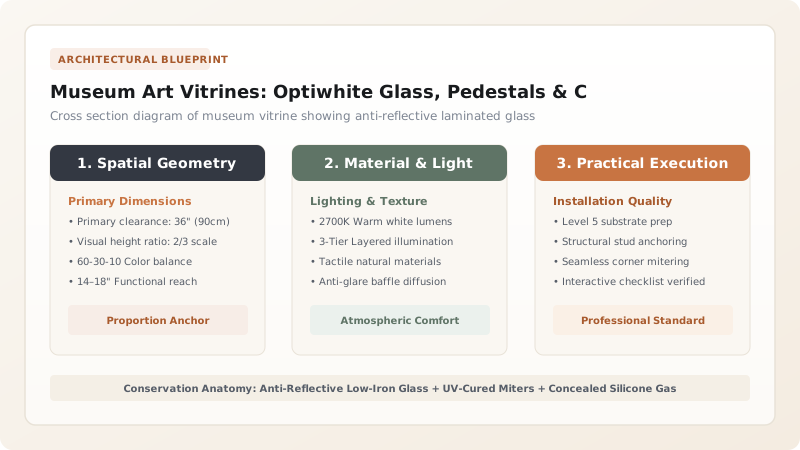
To eliminate distracting room reflections, the glass receives a Magnetron-Sputtered Multi-Layer Optical Interference Coating (such as Groglass Artglass or Tru Vue UltraVue). Alternating sub-micron layers of titanium dioxide and silicon dioxide cancel light waves via destructive interference, slashing residual surface reflection from \(8.0\%\) down to less than \(0.5\%\). The glass appears completely invisible to museum visitors. Learn about UV-cured edge bonding in our guide to UV-cured miters and Optiwhite glass.

2. Material Science: The Oddy Test Protocol & Zero-VOC Plinths
The greatest threat to enclosed museum artifacts does not come from outside bandits; it comes from the Off-Gassing of the Display Pedestal Itself. Standard commercial MDF, plywood, and contact adhesives release formaldehyde, acetic acid, and formic acid vapor into the sealed vitrine chamber:
In a sealed case, even 0.05 ppm of acetic acid will corrode lead antiquities into white dust, tarnish silver coins black, and embrittle historical parchment. Museum plinths must be constructed exclusively from materials that pass the rigorous Oddy Test Protocol (developed by the British Museum).
Pedestals are fabricated from Zero-Formaldehyde Acetylated MDF (Medite Tricoya Extreme) or powder-coated aluminum, lined internally with an impermeable barrier foil (Marvelseal 360), and painted exclusively with two-part waterborne epoxy or zero-VOC acrylic emulsions cured for 28 days. Master conservation plinth construction in our guide on zero-VOC materials and sealed plinths.
3. Passive Microclimates: Conditioned ProSorb Silica Gel Cassettes
Active motorized humidifiers or cooling fans are never installed inside museum vitrines because mechanical vibration damages fragile ceramics and electrical failures can trigger water leaks.
Museum vitrines utilize Passive Microclimate Regulation with Conditioned Silica Gel (ProSorb). ProSorb is an engineered high-capacity silica gel formulated specifically for the museum conservation range (\(40\% \text{ to } 60\% \text{ RH}\)):
- Sorption Capacity: Absorbs or desorbs five times more water vapor than standard industrial desiccants within the critical \(45\% - 55\% \text{ RH}\) window.
- Airtightness Requirement: To function effectively, the glass vitrine hood must achieve an Air Exchange Rate (AER) of less than \(0.1 \text{ AER/day}\) (one air change every 10 days) sealed with silicone D-profile O-ring gaskets.
- Concealed Cassette Wells: Perforated display fabric decks allow conditioned air to communicate with pull-out drawer cassettes beneath the artifact, providing a flatline microclimate for up to two years without maintenance.
Explore climate cassettes and lighting in our guide to silica gel cassettes and fiber optic illuminators.
4. Physical Security: Anti-Bandit Laminated Glass & Concealed Locks
A museum vitrine must withstand aggressive smash-and-grab attacks. The glass hood is fabricated from Anti-Bandit Laminated Security Glass (EN 356 Class P6B) consisting of two sheets of low-iron tempered glass bonded with a 0.060-inch (1.52mm) Structural PVB or SentryGlas (SG) Interlayer.
Even if struck repeatedly with a heavy sledgehammer, the glass fractures into spiderwebs but remains firmly bonded to the high-tensile polymer interlayer, completely preventing physical breach. Access is secured using concealed multi-point high-security lock cylinders (such as Abloy Protec2 or Camlock) flush-mounted into the pedestal reveal. Contrast with residential door security in our guide to monumental steel pivot doors.
Museum Art Vitrines: Optiwhite Glass, Pedestals & Conservation Architectural Decision Matrix
Use this reference table to calculate exact physical dimensions, ratios, and specifications before purchasing:
| Architectural Factor | Professional Recommendation | Significance |
|---|---|---|
| Glass Specification | Anti-reflective ultra-clear low-iron laminated glass (Optiwhite) | Residual reflection < 0.5%; iron content < 0.01%; EN 356 P6B security rating |
| Corner Joint Technology | 45° Miter UV-cured optical methacrylate adhesive | Tensile shear bond > 3,000 psi; zero yellowing under 1,000h UV testing |
| Plinth Conservation Grade | Medite Tricoya Extreme + Marvelseal 360 aluminum barrier | Zero formaldehyde emissions (ASTM D6007); passes British Museum Oddy test |
| Air Exchange Rate (AER) | Sealed chamber achieving AER ≤ 0.1 per day | Verified via nitrous oxide tracer gas decay testing per ISO 16000 |
Execution Blueprint & Craftsmanship Sequence
Execute this professional sequence to achieve flawless results without backtracking:
Phase 1: Glass CNC Cutting & 45° Miter Edging
Precision-cut low-iron laminated glass on CNC waterjet; bevel edges to 45° on horizontal diamond edger (Benchmark: Miter angle tolerance held to 45.0° ± 0.1°; polished to optical water-white clarity)
Phase 2: UV-Cured Miter Bonding
Assemble glass hood in 90° precision clamping jigs; wick low-viscosity optical adhesive and cure with 365nm UV lamps (Benchmark: Joint line 100% bubble-free; structural bond cured under 500 mW/cm² UV intensity)
Phase 3: Pedestal Fabrication & Barrier Foil Lining
Construct pedestal from formaldehyde-free Medite Tricoya; heat-seal Marvelseal 360 foil across interior (Benchmark: Zero exposed wood edges; all seams hermetically ironed with zero pinholes)
Phase 4: Gasketing & Passive Microclimate Cassette Loading
Install medical-grade neutral silicone D-bulb gasket in pedestal channel; insert pre-conditioned ProSorb cassette (Benchmark: Case achieves <0.1 AER/day tracer gas decay; RH stabilizes at 50% within 4 hours)
Phase 5: Artifact Decking & Security Lock Commissioning
Lay Oddy-tested linen-wrapped aluminum display deck; lower glass hood and engage Abloy high-security cam locks (Benchmark: Case locks flush; feeler gauge confirms 100% continuous perimeter gasket compression)
Common Mistakes & Countermeasures
Avoid these costly errors that compromise aesthetics, ergonomics, and budget:
Using Standard Green Architectural Glass
Building Pedestals from Standard Formaldehyde-Laden MDF
Using Silicone Sealants Containing Acetic Acid (Acetoxy Cure)
Omitting Anti-Reflective Optical Coatings
Project Execution Checklist
Track your physical progress. Checkboxes persist automatically on this device:
Frequently Asked Questions
What is the Oddy test and why is it essential for art display pedestals?
The Oddy test is an accelerated corrosion test developed by Andrew Oddy at the British Museum. A material sample is sealed in a glass flask with coupons of pure silver, copper, and lead along with water, then heated to 140°F (60°C) for 28 days. If any metal coupon tarnishes or corrodes, the material is banned from conservation display.
How do you open a heavy 300-pound museum glass vitrine hood safely?
Heavy glass vitrine hoods are raised using concealed internal pneumatic gas struts, motorized vertical screw jacks, or balanced hydraulic scissor lifts integrated into the pedestal base. This allows a single museum curator to raise the 300-lb hood effortlessly with a key switch.
Can high-CRI LED lighting be safely installed inside a museum vitrine?
Yes, provided the LEDs emit zero ultraviolet (UV) radiation below 400nm, zero infrared (heat) radiation, and possess a Color Rendering Index (CRI) of Ra > 97 with R9 (deep red) > 90. To prevent thermal buildup, heat-sink drivers are placed in an isolated, ventilated chamber beneath the pedestal.


