
Fabricating frameless museum vitrine hoods requires cutting ultra-clear low-iron laminated glass (Optiwhite) with 45° precision miters and bonding them with UV-curable optical adhesives (such as Bohle Verifix). When irradiated with 365nm UV light, the liquid adhesive undergoes rapid photo-polymerization, creating an optically clear bond with matching refractive index (n=1.52) that is stronger in shear than the glass itself.
At a Glance: Key Takeaways
- 45-Degree Precision Miters: Diamond-ground compound beveled edges eliminate visible end-grain green lines, creating seamless 90° corners.
- Refractive Index Matching (n = 1.52): Optical adhesives share the identical refractive index of float glass, making cured joint lines virtually invisible.
- 365nm Photochemical Polymerization: High-intensity ultraviolet LED lamps cure the structural acrylate resin in 60 seconds with zero thermal distortion.
- PVB & SentryGlas Interlayers: Laminated glass sandwiches structural polymer films that absorb explosive impacts and filter 99.9% of damaging UV light.
- High Tensile Shear Adhesion (>3,000 psi): UV bond strength exceeds the cohesive tensile fracture strength of the glass substrate.
1. Optical Photochemistry: Acrylate Monomers & Refractive Index Matching
Traditional structural silicone joints leave a thick, visible rubber bead (typically 1/8\" to 1/4\" wide) that creates dark, distracting vertical black lines down the corners of a display case. For museum vitrines, curators demand Invisible Glass-to-Glass Bonding.
This is accomplished using Ultraviolet-Curable Optical Methacrylate Adhesives (e.g., Bohle Verifix MV 760 or Dymax 401). These adhesives consist of solvent-free liquid urethane-acrylate oligomers blended with specialized photoinitiators:
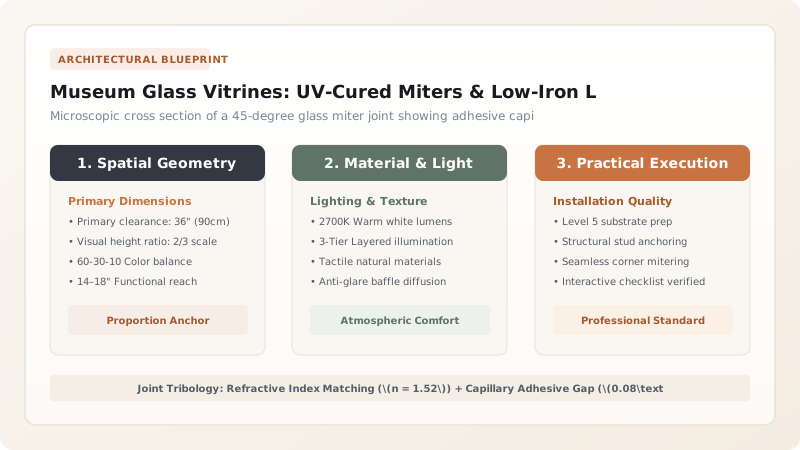
- Refractive Index Matching: Float glass has a refractive index of \(n = 1.517\). The cured optical adhesive has a refractive index of \(n = 1.520\). Because light rays pass through the glass-adhesive boundary without changing velocity or angle of refraction (Snell's Law: \(n_1 \sin \theta_1 = n_2 \sin \theta_2\)), Zero Fresnel Reflection Occurs. The joint appears completely invisible to the naked eye.
- Capillary Action: The low-viscosity liquid adhesive (\(\mu \approx 150 - 300 \text{ mPa}\cdot\text{s}\)) wicks into the microscopic 0.08mm gap between perfectly mated 45-degree glass miters via capillary suction, expelling all trapped air bubbles.
Learn more about overall vitrine design in our museum art vitrines hub.
2. Curing Kinetics: 365nm UV Irradiation & Shear Strength
Once the glass panels are clamped in high-precision 90-degree CNC suction jigs and the adhesive has wicked fully through the miter, the joint is exposed to High-Intensity 365nm Ultraviolet Light from an LED curing wand.
The UV photons activate the photoinitiator molecules, cleaving their chemical bonds to generate free radicals that trigger rapid chain-growth polymerization. The liquid monomers cross-link into a rigid three-dimensional thermoset polymer network in two controlled stages:
- Tack Cure (5–10 Seconds): Achieves \(20\%\) bond strength. The glass becomes mechanically fixed, allowing excess squeeze-out adhesive to be safely sliced off with a fresh surgical razor blade without smearing.
- Final Cure (60–120 Seconds): Full exposure at \(500 \text{ mW/cm}^2\) yields a Tensile Lap Shear Strength exceeding \(3,200 \text{ psi}\) (22 MPa). In destructive laboratory pull tests, the glass substrate fractures cohesively before the UV glue joint delaminates.
Explore conservation plinth construction in our guide to zero-VOC materials and sealed plinths.
3. Security Lamination: PVB vs SentryGlas Structural Interlayers
Monolithic tempered glass is unsuitable for museum vitrines housing high-value antiquities. While tempered glass is strong, if broken by a hardened center punch or diamond scribe, it disintegrates instantly into thousands of small pebble fragments, leaving the artifact completely exposed to immediate theft.
Museum display hoods utilize Multi-Layer Laminated Security Glass:
- Glass Make-up: Dual sheets of 4mm or 5mm low-iron annealed or heat-strengthened glass bonded under heat and autoclave pressure with a 0.060-inch (1.52mm) Structural Polymer Interlayer.
- SentryGlas (Ionoplast): Provides five times the tear strength and one hundred times the rigidity of standard PVB. If struck with a 10-pound sledgehammer, the glass remains upright and rigid, maintaining the security envelope even after extensive glass fracture.
- Photochemical Filtration: The polymer interlayer absorbs \(99.9\%\) of Ultraviolet Radiation between 280nm and 380nm, protecting sensitive organic dyes, pigments, and paper from irreversible fading.
Read about microclimate control in our guide on silica gel cassettes and fiber optic lighting.
4. Anti-Reflective Performance: Magnetron Sputtering & Maintenance
Standard museum glass reflects approximately \(8\%\) of incident room light (4% per surface). Under overhead spotlights, this reflection creates bright glare spots that make viewing dark bronzes, oil paintings, or charcoal sketches frustrating.
Anti-reflective glass undergoes Dual-Sided Magnetron Sputtered Vacuum Deposition. Nanometer-thin layers of metal oxides (\(\text{TiO}_2\) and \(\text{SiO}_2\)) are deposited onto both sides of the glass in high-vacuum plasma chambers. The thickness of each layer is precisely tuned to one-quarter the wavelength of light (\(\lambda / 4\)), causing reflected waves to cancel each other out via destructive interference.
Residual reflection is reduced to under \(0.5\%\). The glass appears completely invisible, making museum visitors feel as though they could reach out and touch the sculpture. The hard pyrolytic coating is permanently bonded into the glass surface, allowing routine cleaning with deionized water and lint-free microfiber towels. Contrast with door glazing in our guide to thermally broken steel doors.
Museum Glass Vitrines: UV-Cured Miters & Low-Iron Laminated Glass Architectural Decision Matrix
Use this reference table to calculate exact physical dimensions, ratios, and specifications before purchasing:
| Architectural Factor | Professional Recommendation | Significance |
|---|---|---|
| Glass Core Type | Low-Iron Ultra-Clear (Optiwhite / UltraClear) | Iron oxide < 0.01%; Color Rendering Index Ra ≥ 99; zero green edge tint |
| Adhesive Formulation | High-modulus optical UV methacrylate (Verifix MV 760) | Refractive index n = 1.520; tensile bond strength > 3,000 psi; non-yellowing |
| Curing Wavelength | 365nm Narrow-Band UV-A LED Arrays | Peak irradiance 500 mW/cm²; initiates rapid photoinitiator cross-linking |
| Security Interlayer | 0.060" (1.52mm) SentryGlas (SG) Ionoplast | EN 356 Class P6B anti-bandit certified; 99.9% UV absorption cutoff at 390nm |
Execution Blueprint & Craftsmanship Sequence
Execute this professional sequence to achieve flawless results without backtracking:
Phase 1: Precision CNC Miter Grinding
Grind 45-degree miters on low-iron laminated glass edges using 4-spindle diamond edging machine (Benchmark: Miter angle verified 45.0° with digital protractor; edges polished to optical 1,000-grit clarity)
Phase 2: Degreasing & 90° Jig Setup
Clean miters with pure isopropanol; mount glass in heavy aluminum suction clamp jigs at true 90° (Benchmark: Capillary gap verified at 0.08mm with feeler gauge; zero dust particles in seam)
Phase 3: Capillary Adhesive Injection
Apply bead of low-viscosity optical UV adhesive along miter seam; observe capillary wicking (Benchmark: Adhesive wicks continuously through 100% of miter with zero trapped air bubbles)
Phase 4: UV Tack Cure & Squeeze-Out Trimming
Irradiate seam for 8 seconds with 365nm UV LED wand; slice rubbery excess adhesive with razor (Benchmark: Adhesive trims flush without pulling out of joint; glass remains locked at 90°)
Phase 5: Final High-Intensity Cure & Inspection
Perform full 90-second cure pass at 500 mW/cm²; inspect under high-intensity polarized inspection light (Benchmark: Joint line optically clear and invisible from 12" viewing distance; zero stress birefringence)
Common Mistakes & Countermeasures
Avoid these costly errors that compromise aesthetics, ergonomics, and budget:
Using Standard 395nm or 405nm UV Lamps
Applying Adhesives in a Dusty Environment
Trimming Adhesive After Full Final Cure
Using High-Viscosity Epoxies for Miter Joints
Project Execution Checklist
Track your physical progress. Checkboxes persist automatically on this device:
Frequently Asked Questions
Can UV-cured glass vitrines be disassembled if a glass panel breaks?
Yes. While UV adhesives are permanent under normal conditions, the joint can be safely disassembled by applying localized radiant heat (approx. 300°F / 150°C) using a specialized hot-air nozzle. The thermal energy degrades the cured acrylate polymer, allowing clean separation of broken panels for re-edging and re-bonding.
Does anti-reflective coating on museum glass scratch easily?
Modern magnetron-sputtered anti-reflective coatings (such as Groglass Artglass AR 92) are pyrolytic hard coatings bonded into the silica surface. They achieve a Mohs hardness of 6+ and can be cleaned safely using standard ammonia-free glass cleaners and microfiber towels without scratching.
How heavy is a standard 48" × 24" × 36" museum glass vitrine hood?
A frameless five-sided glass hood of this size fabricated from 8.5mm low-iron laminated security glass weighs approximately 165 to 190 pounds (75 to 86 kg), requiring dedicated suction lifting equipment or pneumatic base struts to open safely.


