
Vitrine microclimate and illumination engineering combines pre-conditioned ProSorb silica gel cassettes concealed in lower plinth drawers with external fiber optic or remote-driver LED lighting. ProSorb buffers relative humidity to 45%–50% RH ±2% passively through perforated deck plates, while fiber optic harnesses project zero heat and zero UV radiation into the sealed conservation chamber.
At a Glance: Key Takeaways
- Engineered ProSorb Silica Gel: Pre-conditioned to target relative humidity (typically 45% or 50% RH), absorbing or releasing moisture dynamically.
- Independent Maintenance Access: Pull-out sub-plinth cassette drawers allow curators to exchange silica gel without lifting the heavy glass hood.
- Perforated Air Diffusion Deck: Precision micro-perforated linen-wrapped decks allow convective moisture equalization between cassette and artifact.
- Remote Fiber Optic Illuminators: High-intensity LED light engines located outside the case eliminate thermal heat buildup inside the display chamber.
- Zero UV & Infrared Radiation: Glass fiber optic strands transmit only pure visible light, eliminating photochemical degradation and thermal drying.
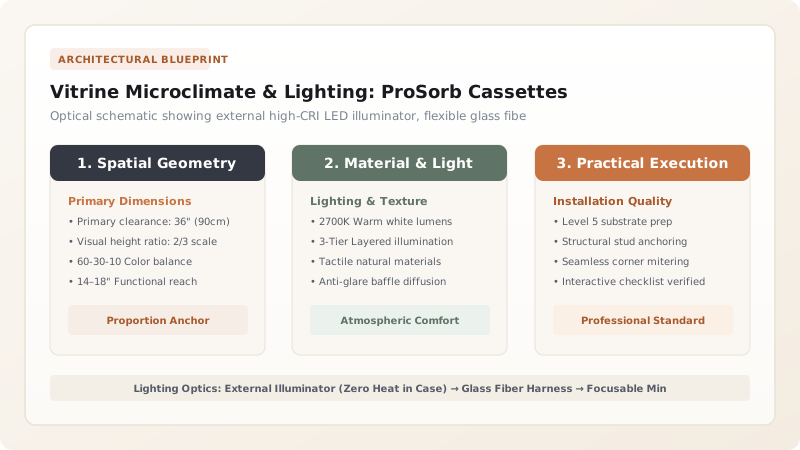
1. Microclimate Chemistry: ProSorb Sorption Capacity & Reversibility
Standard industrial desiccants (white silica gel beads) are engineered to pull relative humidity down to \(0\% \text{ RH}\). In an art vitrine containing wooden panel paintings, parchment manuscripts, or antique ivory, drying the air to 0% RH is catastrophic—it causes rapid cell shrinkage, warping, and irreversible structural cracking.
Museum curators utilize ProSorb Pre-Conditioned Silica Gel. ProSorb is formulated with an engineered pore-size distribution that maximizes Moisture Buffering Capacity (\(B\)) specifically within the museum conservation target zone (\(40\% \text{ to } 60\% \text{ RH}\)):
Within the \(45\% - 55\% \text{ RH}\) range, ProSorb has a buffering capacity five times higher than ordinary silica gel. If ambient building humidity drops, ProSorb desorbs water vapor to keep the case at \(50\%\); if room humidity spikes, it absorbs excess moisture. In a vitrine with an air exchange rate under \(0.1 \text{ AER/day}\), 2.0 to 4.0 kg of ProSorb per cubic meter of case volume maintains target relative humidity within \(\pm 2\%\) for up to two full years without reconditioning. Learn about plinth sealing in our guide to zero-VOC materials and sealed plinths.
2. Maintenance Engineering: Concealed Drawers & Diffusion Decks
A major operational flaw in early vitrine design was placing silica gel directly under the display floor, requiring two curators to crane-lift the 200-pound glass hood every time the silica needed weighing or re-conditioning. Lifting the hood exposes the artifact to dust, thermal shock, and potential accidental drops.
Modern vitrines incorporate an Independent Sub-Plinth Cassette Drawer:
- A heavy-duty gasketed drawer located in the pedestal base slides open via a concealed key lock, allowing curators to remove and weigh the ProSorb cassette in 60 seconds without ever disturbing the sealed glass hood above.
- The artifact rests on a Micro-Perforated Aluminum Display Deck covered in Oddy-tested linen. The tiny 1/8-inch perforations (providing 15% open area) allow moisture vapor to circulate freely between the lower cassette well and the upper artifact chamber via natural thermal convection.
Check out our museum art vitrines hub.
3. Lighting Optics: Remote Illuminators & Glass Fiber Bundles
Placing standard light bulbs, halogen lamps, or even standard LED fixtures inside a sealed vitrine creates severe conservation hazards. The lamps emit heat, driving temperatures up by \(10^\circ\text{F} - 25^\circ\text{F}\), which plummets relative humidity and bakes the artifact.
The gold standard for museum illumination is Remote Fiber Optic Lighting (such as systems by Roblon or Universal Fiber Optics):
- External Light Engine: A high-power LED illuminator engine is housed in a separate, ventilated cabinet or plinth sub-base completely outside the sealed display chamber.
- Glass Fiber Optic Harness: Light is channeled into flexible bundles of multi-strand optical glass fibers. Because glass fibers only transmit visible electromagnetic wavelengths (\(400\text{nm} - 700\text{nm}\)), 100% of Infrared Heat Radiation is Excluded. The light emerging inside the vitrine is completely cold.
- Miniature Ferrule Lenses: Inside the vitrine hood, micro-sized articulated brass or aluminum ferrule fittings focus the light precisely onto the sculpture with adjustable beam angles (10° to 45°), creating dramatic chiaroscuro modeling without glare.
Explore UV bonding in our guide on UV-cured miters and Optiwhite glass.
4. Photochemical Conservation: CRI 98+ & Strict Lux Thresholds
Delicate historical pigments (such as natural madder lake or lapis lazuli) and organic materials (silk, watercolor paper, bird feathers) undergo permanent photochemical degradation when exposed to excessive light energy (measured in Lux-Hours):
Conservation lighting guidelines mandate strict operational limits:
| Artifact Sensitivity Class | Examples | Maximum Lux Limit | Annual Dose Limit |
|---|---|---|---|
| Highly Sensitive | Watercolors, textiles, silk, manuscripts, feathers | 50 Lux | 150,000 Lux-Hours/yr |
| Moderately Sensitive | Oil paintings, polychrome wood, leather, ivory | 150 to 200 Lux | 450,000 Lux-Hours/yr |
| Low Sensitivity | Stone, marble, bronze, ceramics, gold, jewelry | 300 to 500 Lux | Unrestricted |
Fiber optic illuminators are paired with precision DMX or 0–10V digital dimmers, dialling illuminance to exact lux limits while maintaining a Color Rendering Index of \(R_a \ge 98\) and \(R_9 \ge 95\) (deep red), ensuring the artifact's authentic colors are revealed with breathtaking vividness. Contrast with library lighting in our guide to library wall bookcases.
Vitrine Microclimate & Lighting: ProSorb Cassettes & Fiber Optics Architectural Decision Matrix
Use this reference table to calculate exact physical dimensions, ratios, and specifications before purchasing:
| Architectural Factor | Professional Recommendation | Significance |
|---|---|---|
| Silica Gel Media | Pre-conditioned ProSorb Cassettes (45% or 50% RH) | Buffering capacity 5× higher than standard silica; ±2% RH control |
| Cassette Dosing Ratio | 2.0 to 4.0 kg ProSorb per cubic meter case volume | Ensures 18–24 month passive buffer duration in cases with AER ≤ 0.1/day |
| Lighting Technology | Remote LED Fiber Optic Illuminator (CRI ≥ 98) | Zero heat inside case; zero UV (<400nm); zero infrared (>700nm) |
| Illuminance Control | Digital DMX / 0–10V dimming calibrated to artifact sensitivity | Maintains precise 50–200 Lux thresholds to prevent photochemical fading |
Execution Blueprint & Craftsmanship Sequence
Execute this professional sequence to achieve flawless results without backtracking:
Phase 1: ProSorb Cassette Conditioning & Weighing
Weigh ProSorb cassette on digital laboratory balance; log initial factory weight and RH certification (Benchmark: Weight verified within ±2 grams of target 50% RH calibration curve)
Phase 2: Sub-Plinth Drawer Installation
Slide cassette into lower pedestal drawer; verify airtight silicone perimeter seal around drawer face (Benchmark: Drawer latches with continuous gasket compression; zero air bypass around faceplate)
Phase 3: Fiber Optic Illuminator Mounting
Mount 50W high-CRI LED illuminator in ventilated pedestal base; route fiber harness to ceiling (Benchmark: Illuminator heat vented cleanly out pedestal toe-kick; zero thermal transfer to case)
Phase 4: Focusable Ferrule Lens Aiming
Adjust articulated ferrule lenses on vitrine ceiling to frame artifact in uniform, soft-edged light (Benchmark: Lenses focused; beam cutoffs eliminate harsh glare reflections on glass walls)
Phase 5: Digital Lux Meter Calibration
Measure light intensity on artifact surface using calibrated digital illuminance spectrophotometer (Benchmark: Light level dialed to exact conservation threshold (e.g., 50.0 Lux for paper; 150 Lux for bronze))
Common Mistakes & Countermeasures
Avoid these costly errors that compromise aesthetics, ergonomics, and budget:
Using Standard Industrial Desiccant Beads
Placing LED Drivers and Fixtures Inside the Sealed Vitrine
Requiring Glass Hood Removal for Routine Silica Re-Conditioning
Over-Illuminating Organic Artifacts Beyond 50 Lux
Project Execution Checklist
Track your physical progress. Checkboxes persist automatically on this device:
Frequently Asked Questions
How do you know when a ProSorb silica gel cassette needs reconditioning?
ProSorb cassettes are weighed every 6 to 12 months on a calibrated digital balance. Because the dry weight and target water content are known, any weight gain indicates moisture absorption (humid room), while weight loss indicates desorption (dry room). If weight drifts past calibrated limits, the cassette is exchanged with a freshly conditioned spare.
What is the advantage of fiber optics over low-voltage miniature LED spotlights inside the vitrine?
Even miniature LEDs generate localized heat on their circuit boards (raising air temperatures around the artifact) and contain electronic driver components that can off-gas traces of chemical vapors. Fiber optics transmit purely cold, filtered visible light—all electrical power, heat, and electronics remain isolated outside the case.
Can wireless digital data loggers be placed inside the vitrine to monitor RH?
Yes. Museum conservators frequently place miniature Bluetooth or Zigbee data loggers (such as Onset HOBO or Testo) inside the vitrine or directly in the lower silica cassette drawer. These transmit real-time temperature and relative humidity readings wirelessly through the glass to curator tablets without opening the case.


