
Mudéjar polychromy combines traditional animal-glue gesso preparation, water gilding with 23.75-karat gold leaf on Armenian red bole, and vibrant mineral pigments (lapis lazuli, azurite, and vermilion). Applied directly to the alerce and cypress timber elements, this stratified finish enhances the three-dimensional geometry of the ceiling while protecting the wood from atmospheric oxidation.
At a Glance: Key Takeaways
- Stratified Gesso Grounds: Multi-layer rabbit-skin glue and slaked gypsum ground (gesso grosso and gesso sottile) providing an inert surface.
- Armenian Red Bole: Fine aluminosilicate clay cushion providing warmth and enabling agate-stone burnishing of delicate gold leaf.
- Water Gilding Technique: Pure gold beaten to 0.1 microns floated onto dilute alcohol/water mixtures for mirror-like metallic reflectivity.
- Historical Mineral Pigments: Ground azurite, lapis lazuli ultramarine, cinnabar vermilion, and malachite green suspended in egg tempera.
- Cypress Tie-Beam Finishing: Transverse tirantes adorned with epigraphic kufic inscriptions, heraldic escutcheons, and carnauba wax seals.
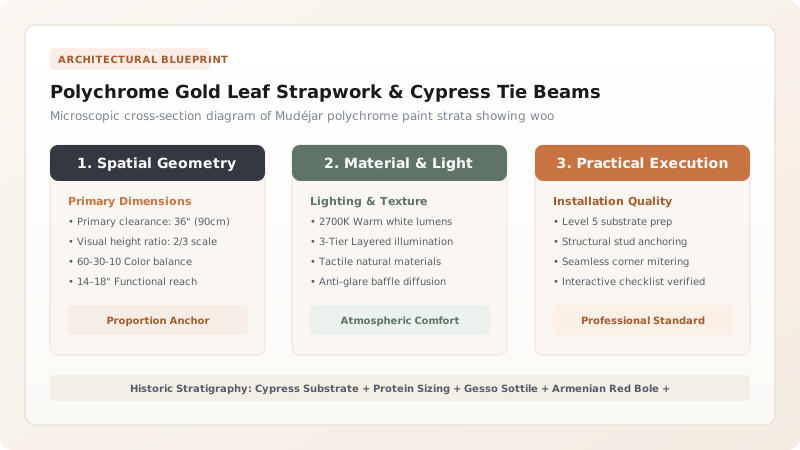
1. Ground Layer Preparation: Sizing, Gesso & Armenian Bole
Applying gold leaf and mineral tempera directly to raw wood is impossible due to the timber's porous, hygroscopic nature. Mudéjar artisans followed a rigorous medieval Italian-Islamic recipe of stratified ground preparation:
- Sizing (Colletta): The raw cypress timber is saturated with a hot \(7\%\) solution of purified rabbit-skin collagen glue to seal cellular pores and stabilize surface fibers.
- Gesso Grosso & Gesso Sottile: Two coarse coats of slaked calcium sulfate mixed with glue are applied, followed by four ultra-fine coats of gesso sottile. Each coat is smoothed with horsehair and horsetail rush (Equisetum).
- Armenian Red Bole (Bol d’Arménie): The areas destined for gilding receive three coats of micro-fine red volcanic clay mixed with egg white (glair). The red iron oxide underlayer imparts rich warm undertones to the gossamer-thin gold leaf.
2. Water Gilding & Agate Stone Burnishing
Unlike oil gilding—which produces a matte, unburnishable sheen—traditional water gilding allows the gold to be compressed into a brilliant mirror finish.
Sheets of 23.75-karat gold leaf (beaten to an astonishing thickness of approximately \(0.1\text{ to }0.2\ \mu\text{m}\)) are transferred using a badger-hair gilder's tip onto the bole, which is activated with a light brush of water and ethanol. Once the moisture evaporates to the precise critical tackiness, the artisan compresses the gold using a polished dog-tooth agate stone burnisher, locking the metal physically into the clay matrix.
3. Mineral Distempers & Tie-Beam Heraldry
The recessed tabicas and deep relief profiles of the ceiling are saturated with pure mineral pigments bound in egg yolk or parchment glue:
- Ultramarine / Azurite: Deep celestial blues sourced from lapis lazuli or copper carbonate minerals create infinite depth behind the gilded star ribs.
- Cinnabar Vermilion: Natural mercuric sulfide delivers an incandescent ruby red that resists darkening under indoor chapel lighting.
- Tirante Inscriptions: The long horizontal faces of the cypress tie-beams are painted with decorative strapwork, Christian heraldic shields, or stylized kufic calligraphy celebrating peace and majesty.
Mudéjar Polychrome Materials & Layer Specifications
Use this reference table to calculate exact physical dimensions, ratios, and specifications before purchasing:
| Stratum Layer | Material Composition | Application Method | Curing & Longevity Standard |
|---|---|---|---|
| Substrate Sealer | Rabbit-skin glue (7% w/v aqueous) | Hot brush application at 50°C | 24h air dry; seals wood resin |
| Gesso Ground | Slaked plaster / chalk in collagen glue | 6–8 cross-brushed layers, scraped flat | Sand smooth to 600-grit; zero pinholes |
| Gilding Cushion | Armenian red bole with whipped glair | 3 wet coats, smoothed with silk cloth | Ready for burnishing when leather-dry |
| Metallic Leaf | 23.75K genuine gold leaf (loose leaf) | Water-gilding via gilder's tip and badger brush | Burnish with agate stone at 4–6 hours |
| Color Pigments | Lapis lazuli, azurite, vermilion in tempera | Delicate sable brush fill on recessed panels | Non-yellowing matte finish; lightfast Class 1 |
Environmental & Conservation Constraints
Every successful decoration project must account for physical and environmental constraints:
Relative Humidity Stability
Water-gilded gesso is hygroscopic; shifts beyond 35%–65% RH will cause blister delamination (flaking) of the gesso ground.
Surface Abrasion Vulnerability
Agate-burnished gold leaf has no protective lacquer; wiping with harsh cleaning chemicals will rub the micron-thin gold down to the red bole.
Direct Sunlight Exposure
While inorganic mineral pigments like lapis lazuli and vermilion are lightfast, organic glues degrade under sustained UV radiation.
Artesonado Water-Gilding Execution Workflow
Execute this professional sequence to achieve flawless results without backtracking:
Substrate Dewaxing & Sizing
Clean carved timber surfaces with isopropyl alcohol and apply warm rabbit-skin glue sizing at 50°C.
Gesso Application & Leveling
Layer six coats of gesso sottile, allowing each to flash before applying the next; scrape with cabinet scrapers until glass-smooth.
Bole Laying & Silk Buffing
Brush three coats of warm red bole over the strapwork ribs, buffing with a soft silk cloth to create a flawless foundation.
Gold Leaf Placement
Wet the bole with water-ethanol activator, lift 23.75K gold leaf with a gilder's tip, and float it seamlessly onto the damp surface.
Agate Burnishing
Test the firmness of the bole and burnish with a contoured agate stone in long, sweeping strokes to achieve high specular brilliance.
Mineral Egg Tempera Detailing
Paint recessed background panels with vermilion and ultramarine distemper, feathering clean boundaries against the gilded ribs.
Common Mistakes & Countermeasures
Avoid these costly errors that compromise aesthetics, ergonomics, and budget:
Using modern acrylic gold paint or synthetic Dutch gold imitation leaf
Burnishing gold leaf before the underlying bole has reached leather-hard state
Sealing genuine burnished gold leaf with clear polyurethane varnish
Project Execution Checklist
Track your physical progress. Checkboxes persist automatically on this device:
Frequently Asked Questions
Why is red bole used under gold leaf instead of white or yellow?
Armenian red bole contains iron oxides that radiate a warm, rich tone through micro-porosities in the 0.1-micron-thick gold leaf. Furthermore, when natural wear exposes small high spots over centuries, the warm red clay enhances the vintage patina rather than showing stark white plaster.
How long do authentic water-gilded Mudéjar ceilings last?
In humidity-controlled interior spaces protected from roof leaks, water-gilded Mudéjar ceilings remain in pristine condition for well over 500 years, as demonstrated by the 14th-century ceilings of the Alcázar of Seville and the Alhambra in Granada.
What is the best way to clean historic polychrome timber ceilings?
Cleaning should only be performed by conservators using dry vulcanized latex sponge pads or micro-swabs dampened with saliva or triammonium citrate solutions to avoid dissolving animal-glue binders.


