
Mudéjar lacería is an advanced system of geometric timber strapwork formed by interlocking wooden ribs (lazos) that weave over and under one another to generate infinite star-polygon networks. Based on Euclidean circle subdivisions (typically 8, 10, 12, or 16 points), the ribs are joined with precision half-lap halving joints and backed by beveled panels (peinazos), creating a rigid, self-stiffening diaphragm.
At a Glance: Key Takeaways
- Euclidean Circle Division: Modular layout based on repeating 8-point (octagram) or 12-point (dodecagram) geometric radial centers.
- Half-Lap Halving Joinery: Each rib intersection is notched to exactly 50% depth, ensuring a continuous flush top plane without face fasteners.
- Alternating Over-Under Weave: Visual illusion of endless interlacing ribbons achieved through micro-chiseled step bevels.
- Peinazo & Tabica Infill: Polygonal wooden panels nestled into rib recesses to lock the assembly and seal the ceiling envelope.
- Dimensional Tolerances: Joinery tolerances maintained below 0.25mm to accommodate seasonal humidity cycles without buckling.
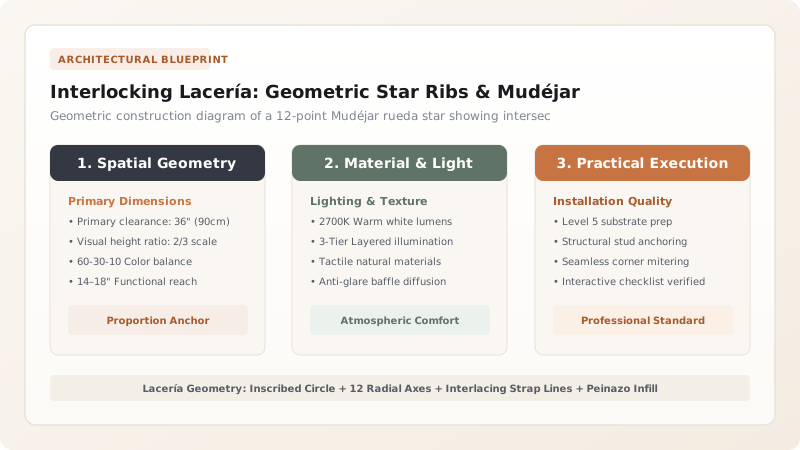
1. Mathematical Foundations: The Rueda Star Polygons
The hallmark of authentic Mudéjar craftsmanship is the rueda (wheel)—a radiating geometric constellation that serves as the generative tile for the entire ceiling. In classical Iberian treatises, notably Diego López de Arenas’s 1619 Breve compendio de la carpintería de lo blanco, every design begins with an inscribed circle partitioned by radial vectors.
For an eight-pointed star (rueda de ocho), the circle is divided into eight equal \(45^\circ\) angles, followed by chords connecting alternating vertices. The intersecting angle \(\alpha\) between strap lines is defined by:
Where \(n\) is the number of star points. For \(n=8\), \(\alpha = 135^\circ\); for \(n=12\), \(\alpha = 150^\circ\). These exact angular intersections dictate the miter cuts for every piece of wooden strapwork in the ceiling field.
2. Joinery Mechanics: Half-Lap Splines & Interlocking Lap Joints
Unlike modern glued moldings, authentic lacería functions as an interconnected timber net. Ribs are typically milled from quarter-sawn alerce or Spanish cedar with dimensions of \(35\text{ mm}\) width by \(45\text{ mm}\) depth.
At each intersection, the wood is notched using fine hand saws and paring chisels to exactly half its thickness. When two ribs cross, the half-lap joint locks them mechanically against lateral twisting while allowing minute longitudinal expansion along the wood grain.
3. The Infill System: Peinazos, Olivas & Rosettes
Between the interlocking ribs lie residual geometric polygons—rhombuses, trapezoids, and miniature triangles. In Mudéjar terminology, these spaces are sealed with peinazos (shaped wooden infill blocks) and olivas (almond-shaped center medallions).
These infill pieces are grooved into the underside of the ribs using tongue-and-groove or rebated joints, preventing daylight and dust from falling through while creating three-dimensional shadow relief across the ceiling plane.
Lacería Star Geometry & Timber Sizing Specifications
Use this reference table to calculate exact physical dimensions, ratios, and specifications before purchasing:
| Star Geometry Type | Subdivision Angles | Standard Rib Cross-Section | Typical Application & Room Scale |
|---|---|---|---|
| Rueda de Ocho (8-Point) | 45.0° intervals | 32 x 45 mm quarter-sawn cedar | Corridors, residential salons, small chapel bays (spans < 6m) |
| Rueda de Diez (10-Point) | 36.0° intervals | 35 x 48 mm Spanish cypress | Banqueting rooms, library chambers, intermediate bays (6–8m) |
| Rueda de Doce (12-Point) | 30.0° intervals | 40 x 55 mm old-growth alerce | Monumental halls, throne rooms, cathedral transepts (8–12m) |
| Rueda de Dieciséis (16-Point) | 22.5° intervals | 45 x 65 mm select alerce | Imperial palatial almizates (spans > 10m with dual tier ribs) |
Fabrication & Environmental Tolerances
Every successful decoration project must account for physical and environmental constraints:
Grain Direction Alignment
All long ribs must run parallel to timber grain; cross-grain carving in primary straps leads to sudden shear failure under load.
Cumulative Angular Error
A 0.2° deviation per cut across a 16-point star accumulates to over 3.2° of misalignment, preventing the final star point from closing.
Wood Stabilization
Stock must be conditioned to the building's operating relative humidity (40-50% RH) for at least 4 weeks prior to precision cutting.
Step-by-Step Lacería Panel Fabrication
Execute this professional sequence to achieve flawless results without backtracking:
Geometric Template Layout
Draft the full-scale rueda layout onto 1:1 birch plywood drafting boards using high-precision metal dividers and steel straightedges.
Quarter-Sawn Timber Milling
Rip alerce or cedar planks into uniform rib stock, dressing all four faces to within 0.1mm tolerance on a thickness planer.
Miter & Half-Lap Notching
Cut angular miters and rebate half-lap halving joints using precision miter sleds and hand paring chisels.
Dry-Fit Pre-Assembly
Assemble the complete star cluster on the workshop floor without glue to verify that all joint faces close tightly without forced racking.
Peinazo Panel Inset
Insert carved polygonal infill panels and central olivas into rear rebated channels, securing with fine copper brads.
Soffit Edge Chamfering
Hand-chamfer visible rib edges with a 2mm 45-degree bevel to enhance light refraction and emphasize the interlacing ribbon effect.
Common Mistakes & Countermeasures
Avoid these costly errors that compromise aesthetics, ergonomics, and budget:
Surface-pinning decorative ribs with exposed steel brads or modern screws
Failing to account for cumulative angular tolerance error in star layout
Using flat-sawn lumber with wild tangential grain orientation
Project Execution Checklist
Track your physical progress. Checkboxes persist automatically on this device:
Frequently Asked Questions
What tools did historic Mudéjar carpenters use to lay out lacería?
Master carpenters (carpinteiros de lo blanco) used the cartabón—a series of specialized wooden right-angle triangles tailored to specific geometric polygons (such as the cartabón de ochocientas for octagonal work)—along with compasses, plumb bobs, and chalked twine.
Can CNC routers be used to replicate historic lacería accurately?
Yes. 5-axis CNC machining centers can mill the intricate half-lap splines and compound miters with sub-millimeter precision, provided the toolpaths respect traditional joinery architecture and visible surfaces receive final hand-chisel cleanup.
How are lacería panels fastened to the ceiling rafters?
Historically, prefabricated lacería modules (paños) were hoisted into position and secured from behind using hand-forged iron spikes and wooden wedges driven into the primary armadura rafters.


