
Polychromatic Egg Tempera and Gold Leaf Gilding (known in Morocco as Zouaq) represent the decorative pinnacle of Islamic architectural woodcraft. Applied across carved cedar muqarnas, door leaves, and beamed ceilings (tatir), zouaq combines micro-thin gesso grounds, natural mineral pigments emulsified in egg yolk or animal size, and water-gilded 24-karat gold leaf. Laid over iron-rich Armenian red bole clay and burnished with agate stones, the gilded facets catch flickering natural light, transforming dark ceiling vaults into radiant architectural heavens.
At a Glance: Key Takeaways
- Micro-Thin Gesso Grounds: Rabbit-skin glue and fine gypsum slaked into smooth gesso sottile to seal wood pores.
- Traditional Mineral Pigments: Cinnabar, lapis lazuli, malachite, orpiment, and lampblack ground on porphyry slabs.
- Egg-Tempera Emulsion: Egg yolk, vinegar, and pure water providing a flexible, fast-drying, lightfast binder matrix.
- Armenian Red Bole Cushion: Silky, iron-oxide-rich clay providing an elastic, warm-toned bedding layer for pure gold leaf.
- Agate Stone Burnishing: Friction polishing compressing pure gold into a mirror-like, high-luminance architectural finish.
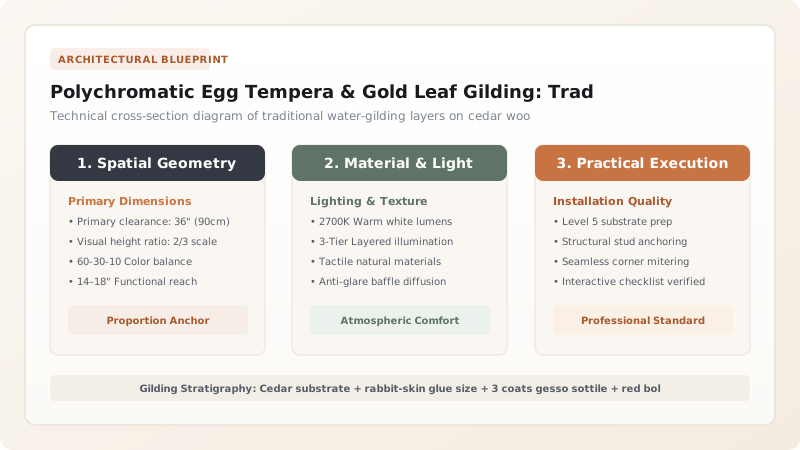
1. Gesso Sottile Priming & Substrate Preparation
Before paint or gold leaf can be applied to raw cedar, the porous wood must be sealed without obscuring the delicate carved geometry. Artisans prepare gesso sottile—a mixture of slaked fine gypsum plaster and rabbit-skin collagen glue (colle de peau).
Unlike thick modern gesso, Moroccan architectural gesso is applied in three translucent, watercolor-thin layers (total dry thickness < 0.2mm). The glue size penetrates deep into the cedar tracheids, sealing aromatic oils while leaving every carved leaf edge and knife facet razor-sharp.
2. Mineral Pigment Formulations & Egg Tempera Chemistry
The luminous colors of historic Zouaq ceilings derive from raw natural minerals pulverized on porphyry grinding stones:
- Cinnabar / Vermilion (\(\text{HgS}\)): Intense, radiant vermilion red.
- Azurite / Lapis Lazuli (\(2\text{CuCO}_3\cdot\text{Cu(OH)}_2\)): Deep celestial blue.
- Malachite (\(\text{CuCO}_3\cdot\text{Cu(OH)}_2\)): Vibrant mineral emerald green.
- Yellow Orpiment / Ochre (\(\text{As}_2\text{S}_3\) / \(\text{Fe}_2\text{O}_3\cdot\text{H}_2\text{O}\)): Rich golden ochre tones.
The pigments are bound using egg tempera (fresh egg yolk mixed with distilled water and a drop of natural vinegar). The natural lecithin in egg yolk acts as an emulsifier, while the drying proteins cross-link into an insoluble, flexible, matte polymer film that never yellows or cracks with seasonal timber movement.
3. Water Gilding & Agate Burnishing over Red Bole
Gold gilding on muqarnas stalactite tips was achieved via traditional water gilding (dorure à l'eau). A specialized bedding clay called Armenian red bole (assiette rouge)—a fine, greasy, aluminosilicate clay rich in hematite iron oxide—was brushed over the gesso in four smooth layers.
The gilder wets the dried bole with a mixture of water and alcohol, which reactivates the underlying collagen glue. Using a gilder's tip made of badger hair, a sheet of beaten 24-karat gold leaf (0.1 microns thick) is placed onto the wet surface. Capillary suction pulls the gold flat. Once the moisture reaches the exact leather-hard stage, the gold is vigorously rubbed with a polished agate stone. The burnisher compresses the soft gold into the elastic bole, creating a mirror-like optical shine that reflects ambient light throughout the hall.
Zouaq Pigments, Binders & Conservation Compatibility
Use this reference table to calculate exact physical dimensions, ratios, and specifications before purchasing:
| Decorative Element | Historic Formulation | Binding Medium | Lightfastness | Modern Restoration Equivalent |
|---|---|---|---|---|
| Vermilion Red | Natural pulverized cinnabar (HgS) | Egg yolk + Vinegar | High (Avoid sulfur pollution) | Synthetic cadmium red in egg tempera |
| Cobalt / Sky Blue | Crushed smalt or azurite | Rabbit-skin glue size | Permanent (Immune to light) | Natural azurite in methylcellulose |
| Leaf Gilding | 24-karat beaten gold leaf | Armenian red bole + Fish glue | Infinite (Pure elemental gold) | Certified 23.75k double-weight gold leaf |
| Black Linework | Vine charcoal or lampblack soot | Gum arabic / Egg white | Permanent (Carbon-based) | Carbon ivory black in egg tempera |
Environmental & Humidity Constraints
Every successful decoration project must account for physical and environmental constraints:
Relative Humidity Sensitivity
Collagen glue in gesso softens if room relative humidity exceeds 80%, requiring climate control in restored palace halls.
Gold Leaf Fragility
Beaten gold leaf is so extraordinarily thin that even a gentle breath of air will tear it; gilding requires draft-free enclosures.
Protocol for Executing Water Gilding and Zouaq Painting on Cedar Vaults
Execute this professional sequence to achieve flawless results without backtracking:
Rabbit-Skin Glue Size Impregnation
Warm 7% rabbit-skin glue solution to 50°C; brush onto raw cedar to seal wood pores; dry for 12 hours.
Gesso Sottile Application
Apply 3 micro-thin coats of slaked gypsum and glue size; smooth with fine horsehair cloth without rounding carved edges.
Armenian Red Bole Bedding
Brush 4 coats of refined red bole clay over areas designated for gold leaf; sand with 1000-grit paper to glass-like smoothness.
Gold Leaf Laying
Wet bole with water-alcohol mix; pick up 24k gold leaf with gilder's tip and float onto wet surface; allow 3 hours drying.
Agate Stone Burnishing
Burnish gold firmly using curved canine-tooth agate stones to achieve mirror-reflective metallic luster.
Egg-Tempera Zouaq Inpainting
Paint polychromatic floral and geometric borders using mineral pigments in egg-tempera emulsion with fine sable brushes.
Common Mistakes & Countermeasures
Avoid these costly errors that compromise aesthetics, ergonomics, and budget:
Using modern oil-based gold leaf sizing (mixte) instead of water-gilding over bole
Applying synthetic alkyd enamels or aerosol paints for restoration zouaq touch-ups
Project Execution Checklist
Track your physical progress. Checkboxes persist automatically on this device:
Frequently Asked Questions
Why is red clay used beneath gold leaf instead of white plaster?
Armenian red bole provides a warm, rich undertone that enriches the golden hue. Additionally, because the gold leaf is microscopic in thickness, tiny hairline breaks or micro-wear reveal the warm terracotta red below, creating an aesthetically pleasing vintage glow rather than harsh white plaster spots.
How do conservators clean centuries of soot off painted zouaq ceilings?
Conservators use non-aqueous dry sponges (Wishab sponges) and enzymatic cleaning gels (triammonium citrate or saliva-analogous gels) at neutral pH to dissolve smoke resin without solubilizing the delicate egg-tempera paint or gold leaf.


