
Stabilized Rammed Earth (SRE) combines geotechnical soil mixes with 5% to 8% chemical binders (natural hydraulic lime NHL 5 or Portland cement) and pozzolans to permanently lock clay minerals against water erosion. Exterior durability is finalized with penetrating breathable silane-siloxane sealers that induce high surface hydrophobicity while preserving complete moisture vapor permeability.
At a Glance: Key Takeaways
- Natural Hydraulic Lime (NHL 5): Sustainable, low-carbon mineral binder that reacts with clay and moisture to form insoluble calcium silicate hydrates.
- Pozzolanic Fly Ash / Slag Blends: Industrial pozzolans reacting with free calcium hydroxide to boost 28-day compressive strength up to 12 MPa.
- Water Erosion Resistance: Stabilized earth passes ASTM D559 wet-dry durability brushing tests with less than 1% mass loss.
- Penetrating Alkylalkoxysilane: 100% active monomeric silane that penetrates 6 to 12mm into porous earth, lining capillaries with hydrophobic siloxanes.
- Vapor-Permeable Water Barrier: Liquid water beads off with a contact angle > 120°, while internal wall vapor escapes freely (Class I vapor permeable).
- Non-Altering Natural Aesthetics: Transparent impregnation that protects against wind-driven rain without creating artificial plastic sheen or yellowing.
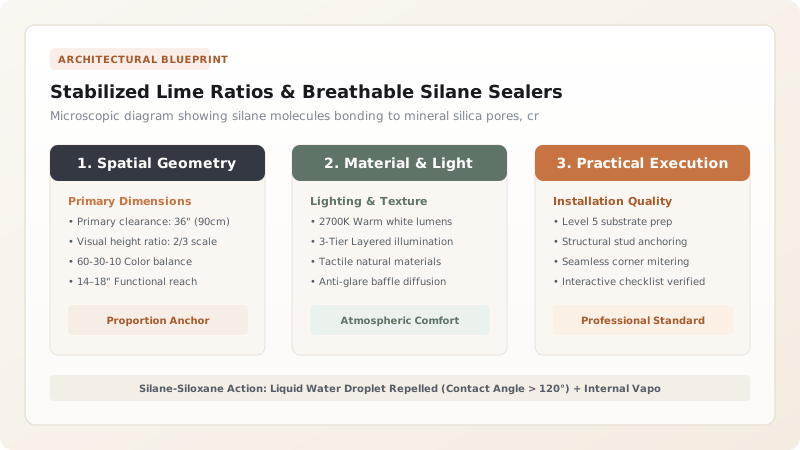
1. Chemical Stabilization: Natural Hydraulic Lime & Pozzolans
While raw unstabilized earth relies on dry density for strength, contact with driving rain can soften unbonded clay particles on exterior facades. Chemical stabilization permanently neutralizes clay water-sensitivity.
Modern sustainable engineering favors Natural Hydraulic Lime (NHL 5) and volcanic pozzolans (pumice, metakaolin) over high-carbon Portland cement. When blended at \(5\%\text{ to }8\%\) by weight, two chemical reactions take place:
- Cation Exchange & Flocculation (Immediate): Calcium ions (\(\text{Ca}^{2+}\)) replace sodium/potassium ions in clay minerals, collapsing expansive clay lattices and eliminating shrink-swell movement.
- Pozzolanic Hydration (Long-Term): Lime reacts with amorphous silica and alumina in the soil to precipitate insoluble calcium silicate hydrate (C-S-H) gels:
This transforms the compacted soil into an artificial sedimentary sandstone with compressive strength exceeding \(10\text{ MPa}\).
2. Hydrophobic Protection: The Silane-Siloxane Molecular Shield
Coating rammed earth with film-forming sealers (acrylics, polyurethanes, epoxies) is disastrous: trapped moisture behind the impermeable plastic film causes freeze-thaw spalling. The professional standard is penetrating oligomeric silane-siloxanes.
Silanes are tiny molecules (under \(1\text{ nanometer}\)) that penetrate deep into the microscopic capillary pores of the earth (\(6\text{ to }12\text{ mm}\) depth). They chemically bond to the hydroxyl groups of the quartz sand and clay minerals, pointing hydrophobic alkyl organic tails outward into the pore space.
Surface tension forces water droplets to bead up and roll away harmlessly. Crucially, the pore capillaries remain open, allowing water vapor molecules (diameter \(0.28\text{ nm}\)) to transpire freely without building hydraulic pressure.
3. Application Protocols & RILEM Tube Testing
Silane sealers must be applied to fully cured rammed earth walls (minimum 28 days after construction) when internal moisture drops below \(4\%\). Application is executed using low-pressure sprayers in a continuous flood coat with a \(300\text{ mm}\) rundown.
Efficacy is verified on-site using RILEM Karsten tube water absorption tests. A water-filled column is sealed to the wall; properly treated stabilized earth exhibits zero measurable water absorption over a 60-minute test period.
Rammed Earth Stabilization & Sealing Specifications
Use this reference table to calculate exact physical dimensions, ratios, and specifications before purchasing:
| Treatment Type | Chemical Composition / Dose | Penetration / Bond Mechanism | Performance Standard |
|---|---|---|---|
| Lime Stabilization | 5% to 7% Natural Hydraulic Lime (NHL 5) | Cation exchange + pozzolanic C-S-H | Compressive strength > 6.0 MPa; low shrinkage |
| Cement Stabilization | 5% to 8% Portland cement (CEM I/II) | Rigid hydraulic silicate crystalline matrix | Compressive strength > 10.0 MPa; higher carbon |
| Silane Penetrating Sealer | 100% active alkyltrialkoxysilane | Chemical covalent bond to pore walls | Penetration depth > 8mm; contact angle > 120° |
| Silane-Siloxane Micro-Emulsion | 15% to 20% silane-siloxane water-borne | Water-carrier penetrates dense clay matrices | Zero VOC; suitable for interior eco-residences |
| Film-Forming Clear Acrylic | 100% acrylic copolymer emulsion | Surface plastic film (Prohibited) | FAILS: Traps moisture, blisters, and peels within 3 yrs |
Chemical & Environmental Constraints
Every successful decoration project must account for physical and environmental constraints:
Curing Moisture Requirements
Lime-stabilized earth requires continuous damp curing under plastic sheeting for at least 7 days; premature desiccation stops pozzolanic crystal growth.
Substrate Dryness for Silanes
Silane sealers must never be applied to damp walls; moisture in pores blocks silane penetration and causes premature surface polymerization (white haze).
Re-Application Lifespan
High-quality penetrating silane sealers provide 10 to 15 years of water repellency before requiring a simple spray-applied refresher coat.
Stabilization Batching & Silane Sealing Protocol
Execute this professional sequence to achieve flawless results without backtracking:
Dry Binder Weighing
Weigh dry natural hydraulic lime (NHL 5) or pozzolan at exactly 6% of dry soil weight using digital batching scales.
Dry-Blending in Pan Mixer
Blend soil aggregate and dry lime in a forced-action pan mixer for 2 minutes to achieve uniform binder distribution before adding water.
Water Dosing & Compaction
Add gauged water to reach OMC and compact into formwork within 45 minutes of mixing before hydraulic setting begins.
Damp Plastic Sheet Curing
Cover struck wall panels with polyethylene sheets for 7 days, misting with water if ambient humidity drops below 50%.
28-Day Dry-Out Inspection
Allow the wall to dry for 28 days until moisture meters register under 4% internal moisture across all elevations.
Silane Flood Coat Spraying
Apply penetrating silane sealer with low-pressure spray wand in overlapping horizontal sweeps, maintaining a 300mm continuous rundown.
Common Mistakes & Countermeasures
Avoid these costly errors that compromise aesthetics, ergonomics, and budget:
Adding chemical stabilizer to soil hours before ramming it into formwork
Applying water-repellent sealers while the earth wall is still wet from construction
Using film-forming acrylic clear sealers to give the wall a 'wet look'
Project Execution Checklist
Track your physical progress. Checkboxes persist automatically on this device:
Frequently Asked Questions
Does chemical stabilization change the natural color of rammed earth?
Natural hydraulic lime (NHL) causes virtually zero color change, maintaining warm earth tones. Portland cement slightly cools the hue, imparting a faint grayish cast. Silane sealers are optically transparent and dry completely invisible without gloss.
Is stabilized rammed earth recyclable at the end of building life?
Raw unstabilized rammed earth can be broken down, moistened, and re-rammed indefinitely. Stabilized rammed earth (with 6% lime or cement) cures into weak sandstone; it cannot be re-slaked, but can be crushed into high-grade structural aggregate for road bases or new concrete.
How do you test if a silane-sealed wall is still waterproof after 10 years?
Spray the wall with a garden hose or splash a cup of water against the surface. If the water beads into distinct droplets and rolls off without darkening the earth, the silane shield is intact. If the earth immediately darkens, a maintenance refresher coat is required.


