
Install mid-century modern indoor-outdoor ceilings by selecting 2x6 Clear Vertical Grain (CVG) Douglas fir tongue-and-groove planks with a subtle V-match edge. Fasten planks continuously across exposed steel roof beams, running uninterrupted through the glass wall line to form 4-foot deep exterior sunshade overhangs.
At a Glance: Key Takeaways
- Clear Vertical Grain (CVG) Douglas Fir: 100% edge-grain softwood with tight, straight pencil-line growth rings (zero knots).
- Uninterrupted Indoor-Outdoor Horizon: Wood planks extend through glass walls to make living rooms feel twice their actual size.
- 2x6 Structural Roof Decking vs 1x4 Paneling: 2-inch solid timber decking serves as both the finished ceiling and the structural roof substrate.
- Blind Nailing Through the Tongue: Conceals all nail heads, leaving a pristine, fastener-free natural wood ceiling plane.
- Marine-Grade Exterior UV Protective Sealers: Protects exterior eaves from graying while maintaining identical amber color to interior.
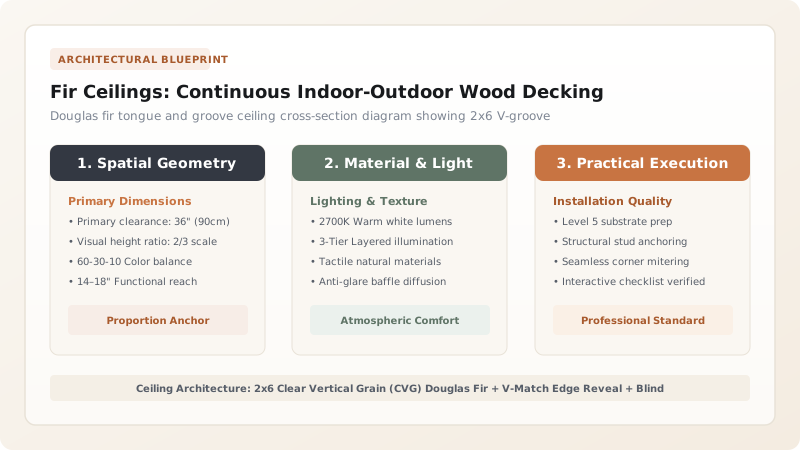
1. Wood Science: Clear Vertical Grain (CVG) Douglas Fir Stability
Cheap flat-sawn fir develops wild cathedral grain that checks, splinters, and cups when exposed to outdoor weather. Mid-century masterworks strictly specify Clear Vertical Grain (CVG) Douglas Fir (*Pseudotsuga menziesii*).
CVG lumber features 100% vertical growth rings (minimum 12 to 20 rings per inch). It shrinks radially at less than half the rate of flat-sawn lumber, ensuring that tongue-and-groove joints stay locked tight without seasonal gaping. Review overall layouts in Case Study architecture.

2. Glass Penetration Detailing & Exterior Marine UV Finishing
To create the illusion that the glass does not exist, the wood planks must not stop at the wall. The ceiling planks run continuously past the structural glass pocket.
To prevent the exterior overhang from turning weathered gray while the inside stays golden, coat both interior and exterior with Non-Yellowing Matte Hardwax Oil or Marine UV Urethane with UV Absorbers. Explore terrazzo floors in cast-in-place terrazzo flooring.
Douglas Fir Ceiling Decking Grades Comparison
Use this reference table to calculate exact physical dimensions, ratios, and specifications before purchasing:
| Lumber Grade Spec | Grain Orientation | Knot Allowance | Architectural Suitability |
|---|---|---|---|
| Clear Vertical Grain (CVG - Optimal) | 100% Vertical Edge-Grain | Zero Knots (Pristine pencil grain) | Iconic Mid-Century Case Study ceiling |
| C & Better Mixed Grain | 70% Vertical / 30% Flat-Grain | Occasional pin knots | High-end contemporary residential |
| Select Structural Douglas Fir | Flat-Sawn (Wild grain arches) | Sound tight knots up to 1.0" | Rustic timber frame / Cabin look |
| Knotty Pine Decking (Avoid) | Flat-Sawn with black knots | Frequent loose black knots | FAILS: Clashes with modern minimalism |
Exterior Eave Water Stain Rot Constraints
Every successful decoration project must account for physical and environmental constraints:
Wind-Driven Rain Seeping into Exterior Eave Tongue-and-Groove Joints Rotting Fir
Rainwater blowing onto exterior roof overhangs wicks into unsealed tongue-and-groove joints; coat all four sides (top, bottom, tongue, and groove) with penetrating marine wood preservative (Sikkens Cetol) BEFORE nailing planks into place.
How to Install and Seal a Continuous Douglas Fir Ceiling
Execute this professional sequence to achieve flawless results without backtracking:
Acclimate CVG Douglas Fir Planks on Jobsite
Stack 2x6 CVG fir planks with stickers in the conditioned living space for 7 days to reach 8% moisture.
Pre-Finish All 4 Sides with Penetrating UV Oil
Roll two coats of Osmo UV-Protection-Oil Extra over face, back, tongue, and groove of all boards.
Laser-Align Starter Board Parallel to Glass Line
Project laser line; face-screw starter board at far wall with countersunk plugged trim screws.
Blind-Nail Through Tongue at 45° Angle
Drive 2-1/2" stainless steel finish nails or flooring cleats at 45° through the tongue into roof beams.
Run Planks Continuously Past Glass Pocket
Pass boards continuously through the glass wall line out to the 4-foot exterior roof fascia.
Install Recessed Aluminum Glass Pocket Flashing
Fasten concealed aluminum glazing channel directly to underside of wood ceiling with silicone gasket.
Common Mistakes & Countermeasures
Avoid these costly errors that compromise aesthetics, ergonomics, and budget:
Face-Nailing Fir Ceiling Planks with Heavy Framing Nails
Project Execution Checklist
Track your physical progress. Checkboxes persist automatically on this device:
Frequently Asked Questions
What edge profile is best for mid-century fir ceilings: V-match or square edge?
A subtle 1/8-inch V-match (V-groove) edge is ideal. It highlights the linear direction of each board while forgiving microscopic seasonal expansion and contraction between adjacent planks.


