
Pour authentic mid-century monolithic terrazzo floors by laying 1/8-inch solid brass divider strips in a 4ft × 4ft geometric grid over a concrete subfloor. Pour a 3/8-inch thick resinous or cementitious matrix seeded with 70% natural marble chips, wet-grind with diamond planetary polishers to 800-grit, and seal with breathable lithium silicate.
At a Glance: Key Takeaways
- Cast-in-Place Monolithic Continuity: Eliminates grout joints, creating an expansive seamless stone plane that extends outdoors.
- Solid Brass Heavy-Top Divider Strips: 1/8" thick architectural brass strips absorb subfloor expansion and create geometric luxury lines.
- 70% Natural Marble Aggregate Density: Crushed Carrara white, Botticino beige, and Nero Marquina black marble chips.
- Planetary Diamond Wet-Grinding: Multi-head rotary grinders cut marble chips flat, revealing cross-sectional crystalline stones.
- Underfloor Radiant Heating Integration: Exceptional thermal conductivity (\(k = 1.8\text{ W/mK}\)) distributes gentle radiant warmth.
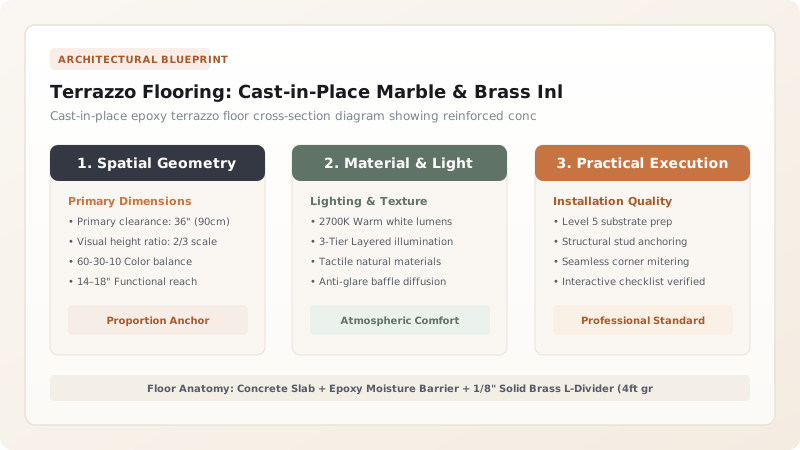
1. Material Science: Epoxy vs Cementitious Terrazzo & Brass Grids
Terrazzo flooring was brought to mid-century California from Venice, Italy. While historical terrazzo used Portland cement, modern master installations utilize 100% Solids Epoxy Terrazzo (NTMA Standard).
Epoxy terrazzo is poured at just 3/8-inch (10mm) thickness, weighs only \(4.5\text{ lbs/sq.ft}\), and cures within 24 hours. Installers adhere 1/8-inch Thick Solid Brass Heavy-Top Divider Strips in 4-foot or 6-foot square geometric grids to control substrate movement while imparting warm metallic rhythm. Master steel pavilion details in steel post-and-beam glass connections.

2. Marble Aggregate Seeding & Multi-Stage Diamond Polishing
To ensure maximum stone density, the epoxy matrix is seeded with loose marble aggregate until stone chips occupy over 70% of the surface area.
Once cured, the floor is ground with Planetary Diamond Grinders (starting at 24-grit metal bond, advancing through 80-grit, 200-grit, 400-grit, and 800-grit resin bond). Seal with Lithium Silicate Densifier. Explore wood ceilings in Douglas fir ceilings.
Epoxy vs Cementitious Terrazzo Comparison
Use this reference table to calculate exact physical dimensions, ratios, and specifications before purchasing:
| Terrazzo System | Installed Thickness | Cure Time Before Grinding | Cracking Resistance |
|---|---|---|---|
| Thin-Set Epoxy Terrazzo (Optimal) | 3/8" (10mm) Thickness | 24 Hours (Fast turnaround) | Maximum (Flexible polymer matrix) |
| Sand-Cushion Cementitious Terrazzo | 2-1/2" (65mm) Thickness | 7 to 14 Days (Slow cure) | High (Heavy floating bed) |
| Monolithic Cementitious Terrazzo | 1/2" (13mm) Thickness | 7 Days | Moderate (Prone to hairline cracks) |
| Large Format Terrazzo Tile (Alternative) | 1/2" Pre-cast tiles | Ready for grouting immediately | Moderate (Shows grout seam grid) |
Subfloor Concrete Crack Reflection Constraints
Every successful decoration project must account for physical and environmental constraints:
Concrete Subfloor Cracking Transmitting Through Seamless Terrazzo Floor
Settling cracks in concrete telegraph through terrazzo topping; apply a full-coverage elastomeric epoxy crack-isolation membrane (100% elongation) reinforced with fiberglass scrim over the entire concrete slab before laying brass divider strips.
How to Pour, Seed, Grind, and Polish Terrazzo Floors
Execute this professional sequence to achieve flawless results without backtracking:
Shotblast Concrete Subfloor and Apply Moisture Barrier
Shotblast concrete to CSP-3 profile; roll 100% solids epoxy moisture vapor barrier (MVEP).
Layout Brass Divider Strips with Epoxy
Adhere 1/8" solid brass divider strips in 4ft × 4ft grid aligned with architectural columns.
Mix and Trowel Resinous Matrix
Blend pigmented epoxy resin with Carrara white marble chips; trowel evenly to 3/8" thickness.
Seed Surface with Dry Marble Aggregate
Broadcast dry marble chips across wet matrix, rolling with 150-lb steel roller to pack chips tight.
Planetary Diamond Wet-Grind (24 to 200-Grit)
Wet-grind cured floor with heavy diamond planetary grinder to cut chips flush with brass strips.
Grout Pores and Polish to 800-Grit
Trowel color-matched epoxy grout over floor to fill pinhole voids; polish through 800-grit diamonds.
Apply Penetrating Lithium Silicate Sealer
Burnish penetrating lithium silicate sealer with high-speed propane buffer for permanent stain resistance.
Common Mistakes & Countermeasures
Avoid these costly errors that compromise aesthetics, ergonomics, and budget:
Using Acidic Floor Cleaners on Marble Terrazzo
Project Execution Checklist
Track your physical progress. Checkboxes persist automatically on this device:
Frequently Asked Questions
Can cast-in-place terrazzo be used outdoors in freezing climates?
For freezing exterior climates, specify Polyacrylate or Sand-Cushion Cementitious Terrazzo rather than epoxy terrazzo, as cementitious matrix breathes and tolerates outdoor freeze-thaw cycles.


