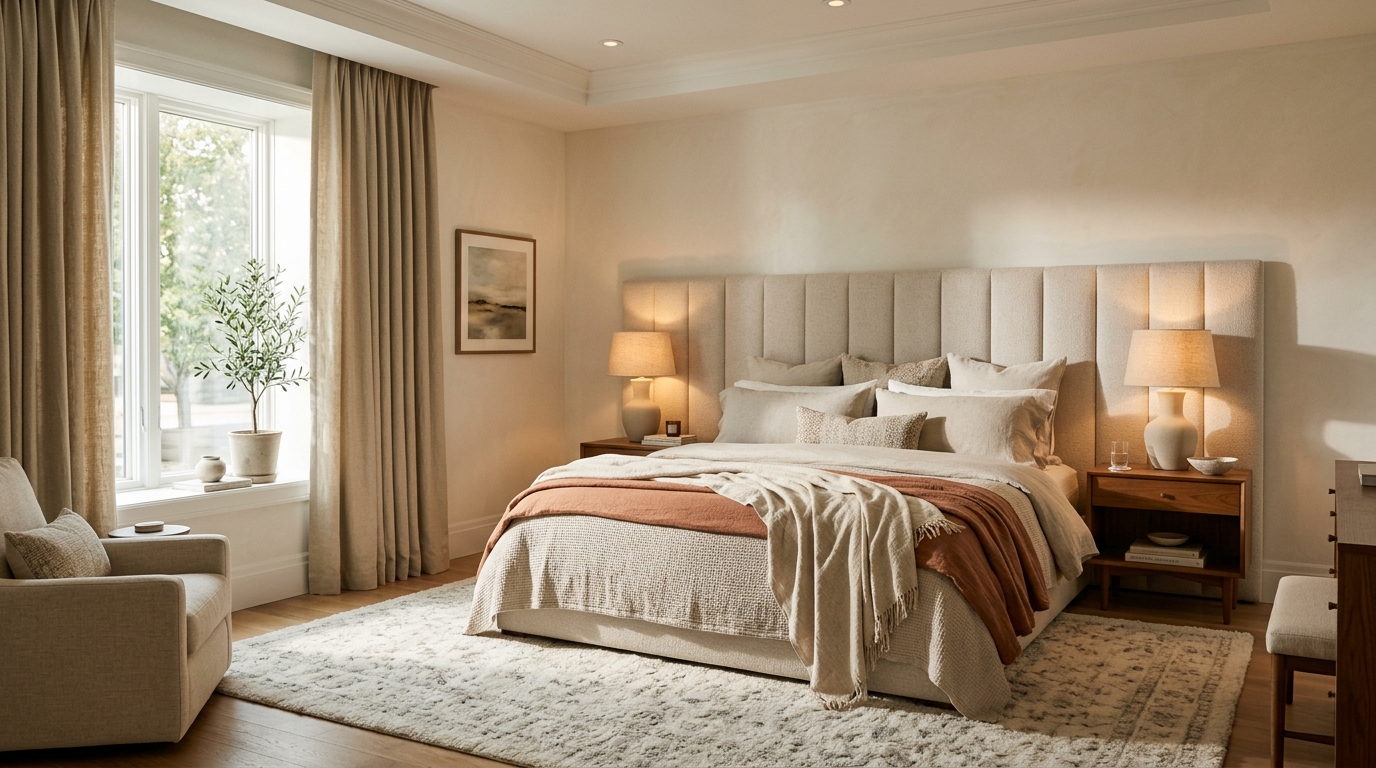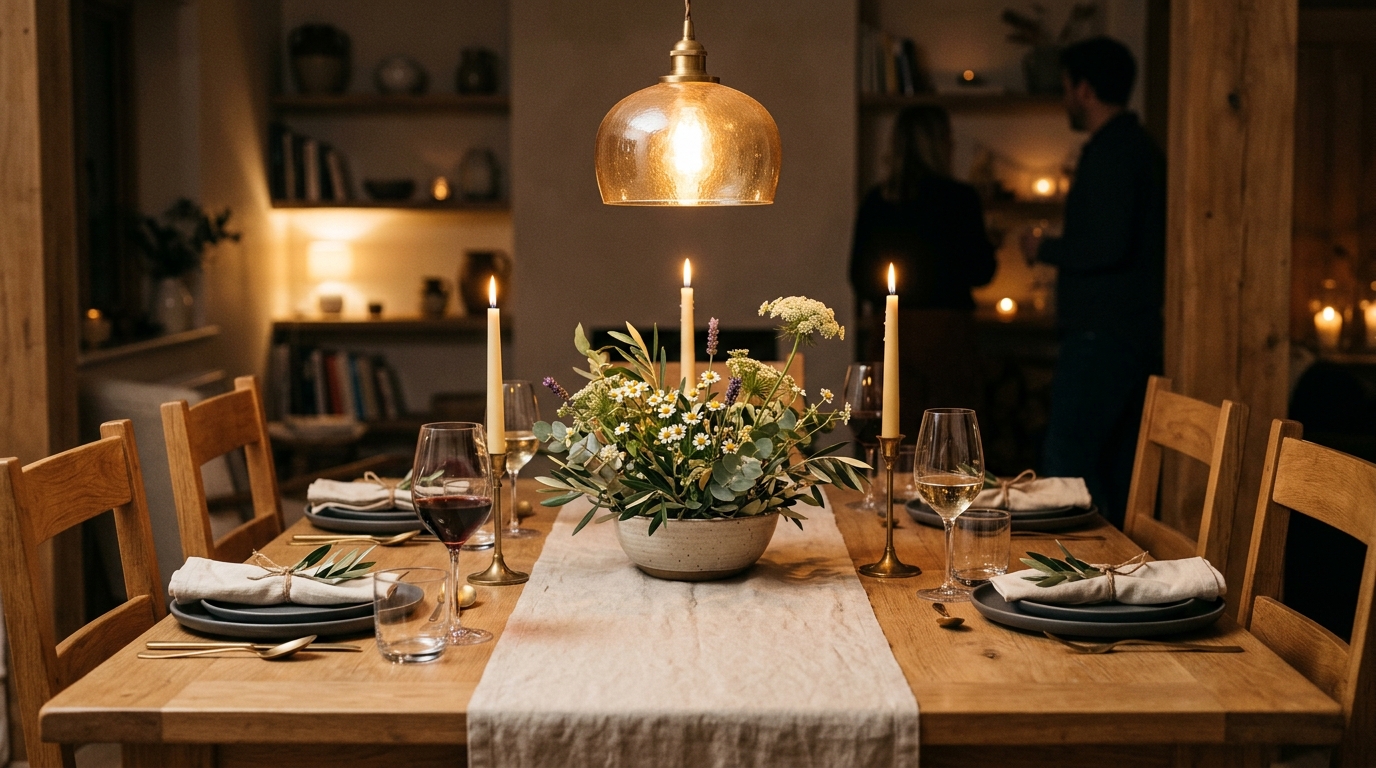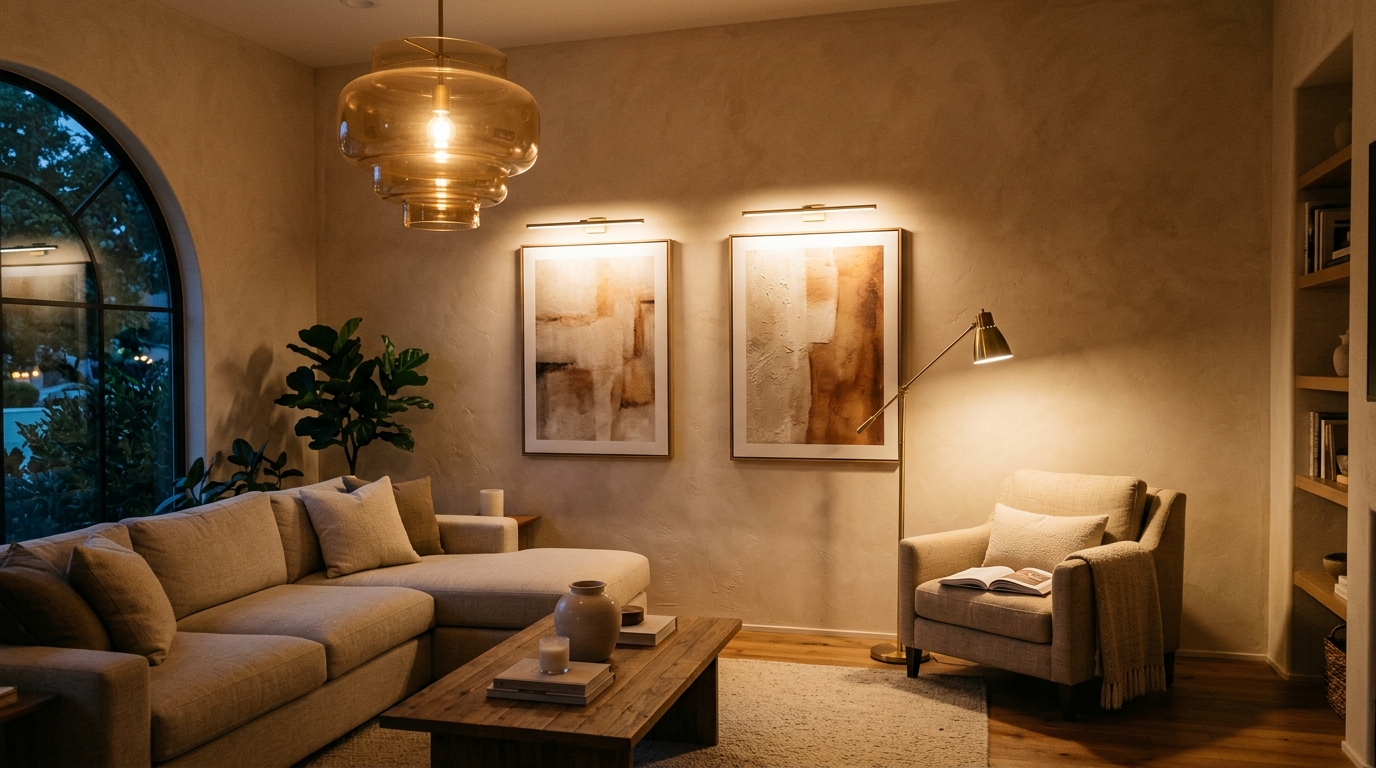
To choose decorative lighting, calculate room square footage to determine total lumens required (Sq.Ft. × 20–30 lm/sq.ft. for living/dining; 15 lm/sq.ft. for bedrooms). Standardize on 2700K Warm White with a Color Rendering Index (CRI) of 90+ to replicate the comforting spectrum of incandescent light, distribute across 3 heights (overhead, eye-level, low accent), and install dimmers on every circuit.
At a Glance: Key Takeaways
- Calculate total room lumens: Living/Dining = Sq.Ft. × 20–30 lm; Bedroom = Sq.Ft. × 15 lm.
- Standardize residential living areas at 2700K warm white; avoid cold 4000K-5000K commercial daylight LEDs.
- Always verify Color Rendering Index (CRI >90) so wood grains, fabrics, and skin tones render richly.
- Distribute fixtures across 3 distinct vertical heights: ceiling ambient, eye-level task, and low surface accent.
1. The Kelvin Color Temperature Scale & Emotional Psychology
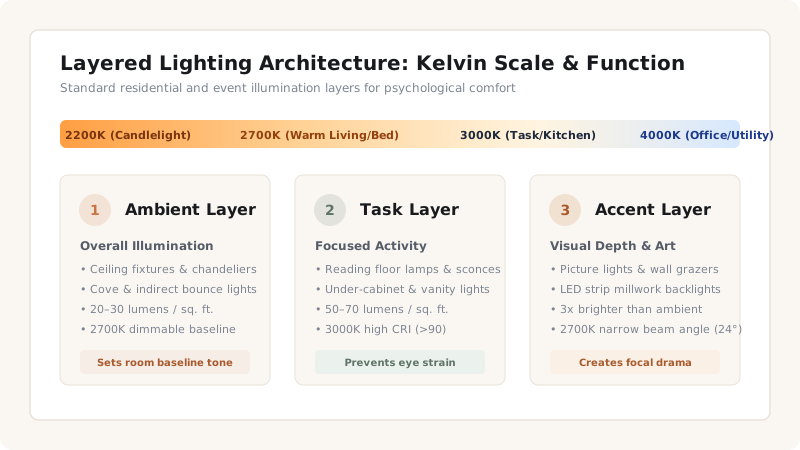
Light color temperature is measured in degrees Kelvin (K) on a scale from 1,000K to 10,000K. The Kelvin rating dictates the biological and emotional atmosphere of a space:
- 2200K – 2400K (Candlelight Amber): Emits warm, golden, low-lumen light with zero blue spectrum. Perfect for bedside reading sconces, decorative filament bulbs in dining chandeliers, and evening mood lamps.
- 2700K (Warm White — The Universal Residential Standard): Replicates the comforting spectral output of classic incandescent tungsten bulbs. The mandatory standard for living rooms, master bedrooms, dining rooms, and lounges. Softens facial features and brings out warm undertones in wood and textiles.
- 3000K (Soft White): Clean, crisp white light with subtle warmth. Ideal for kitchen countertops, bathroom grooming vanities, and home offices where high visual clarity is required without clinical glare.
- 4000K – 5000K (Cool White / Daylight): Commercial office and surgical spectrum; suppress melatonin and trigger alertness. Never install in residential living, dining, or sleeping areas.
2. Color Rendering Index (CRI) & Visual Fidelity
Have you ever painted a room a rich warm terracotta, only for it to look dull, grayish-brown under your newly installed LED bulbs? That failure is caused by low Color Rendering Index (CRI):
- CRI measures on a scale from 0 to 100 how accurately an artificial light source reveals true object colors compared to natural sunlight (CRI 100).
- Cheap Commercial LEDs (CRI <80): Lack red and warm spectral wavelengths (specifically the R9 metric). They wash out vibrant fabrics, make hardwood floors look dead, and make human skin appear sallow and sickly.
- High-CRI Architectural LEDs (CRI >90 or CRI >95): Contain full-spectrum phosphor coatings that render rich reds, deep wood grains, and vibrant artwork with museum-grade brilliance. Always verify CRI >90 on product packaging.
3. The Lumens Calculation Formula & Fixture Proportions
Determine exact lighting output and physical fixture sizing using mathematical rules:
Total Lumens = Room Length (ft) × Room Width (ft) × Recommended Foot-Candles (Lumens/Sq.Ft.)
- Foot-Candle Targets: Living Room = 20 lm/sq.ft.; Dining Room = 30 lm/sq.ft.; Bedroom = 15 lm/sq.ft.; Kitchen Prep = 50–70 lm/sq.ft.
- Fixture Sizing Formula: Chandelier Diameter (inches) = Room Length (ft) + Room Width (ft). (e.g., 14x16 ft room = 30-inch fixture diameter).
- Hanging Clearance: Maintain at least 7 feet (84 inches) of clearance from the floor in walking zones, or 30 to 36 inches above dining tabletop surfaces.
Decorative Lighting Kelvin, CRI & Lumens Blueprint
Use this reference table to calculate exact physical dimensions, ratios, and specifications before purchasing:
| Room / Space | Target Kelvin | Min CRI Rating | Target Lumens / Sq.Ft. | Primary Fixture Types |
|---|---|---|---|---|
| Living Room | 2700K (Warm White) | CRI >90 | 20–25 lm / sq.ft. | Dimmable Chandelier + 3 Table/Floor Lamps |
| Dining Room | 2700K (Warm White) | CRI >95 | 25–30 lm / sq.ft. | Central Chandelier (30–36" above table) + Sconces |
| Primary Bedroom | 2200K–2700K | CRI >90 | 12–15 lm / sq.ft. | Diffused Drum Ceiling + Bedside Sconces |
| Kitchen Island / Prep | 3000K (Soft White) | CRI >95 | 50–70 lm / sq.ft. | Island Pendants (30–34" above counter) + Under-cab |
| Bathroom Vanity | 3000K (Soft White) | CRI >95 | 50–60 lm / sq.ft. | Flanking Mirror Sconces at 60" face height |
Lighting Practical Constraints
Every successful decoration project must account for physical and environmental constraints:
LED Dimmer Incompatibility (Buzzing)
Pairing older forward-phase incandescent dimmers with modern LED bulbs causes annoying high-pitched buzzing and strobing; always install electronic trailing-edge LED dimmers (e.g., Lutron Diva LED+).
Clear Glass Bare Bulb Glare
Trendy exposed clear glass globe pendants create blinding, eye-straining filament glare at seated eye levels; install silver-bowl dipped bulbs or warm frosted LED filaments.
Drop Ceiling Junction Box Weight Limits
Standard plastic ceiling junction boxes hold only 25 lbs; fixtures over 50 lbs require a fan-rated steel expanding brace bar anchored directly between ceiling joists.
10-Step Decorative Lighting Selection Protocol
Execute this professional sequence to achieve flawless results without backtracking:
Calculate Room Square Footage and Total Lumens
Multiply length by width by recommended foot-candles for the space.
Determine Fixture Diameter Using Length+Width Formula
Add room length and width in feet to get chandelier diameter in inches.
Establish 2700K Warm White Baseline for Living/Bed
Verify all ambient bulbs maintain 2700K warm color temperature.
Select 3000K High-CRI (>95) for Kitchen & Vanity
Equip task and grooming areas with clean, shadowless 3000K light.
Ensure All LED Bulbs are Labeled 'Dimmable'
Never buy non-dimmable LED bulbs for residential living spaces.
Install Electronic Trailing-Edge Dimmer Switches
Replace simple toggle switches with LED-compatible slide dimmers.
Position Eye-Level Light Sources Around Perimeter
Place table and floor lamps so shades conceal bulbs at seated eye level (38–42").
Mount Dining Chandelier 30–36 Inches Above Table
Ensure chandelier hangs low enough to anchor the table without head bumps.
Mount Bathroom Vanity Sconces at 60-Inch Face Height
Flank mirror symmetrically to eliminate downward facial shadows.
Conduct Nighttime Glare and Shadow Audit
Sit in all seating positions after dark to verify zero unshielded bare bulb glare.
Common Mistakes & Countermeasures
Avoid these costly errors that compromise aesthetics, ergonomics, and budget:
Mixing 2700K and 5000K Bulbs in the Same Room
Buying Low-CRI (<80) Budget LED Bulbs
Relying Exclusively on Overhead Recessed Can Lights
Project Execution Checklist
Track your physical progress. Checkboxes persist automatically on this device:
Frequently Asked Questions
What is the difference between Lumens and Foot-Candles?
Lumens measure the total light output emitted by a bulb in all directions. Foot-candles measure the actual light intensity that lands on a specific one-square-foot surface area (1 Foot-Candle = 1 Lumen/Sq.Ft.).
Why do 2700K bulbs feel cozier than 4000K bulbs?
2700K light mimics sunset and firelight. Biologically, the lack of blue wavelengths signals the human brain to relax, lower cortisol, and prepare for sleep.
How high should a floor lamp be next to a sofa?
A reading floor lamp should measure 58 to 64 inches in total height, with the bottom of the shade sitting at 42 to 48 inches from the floor (slightly above seated shoulder level).