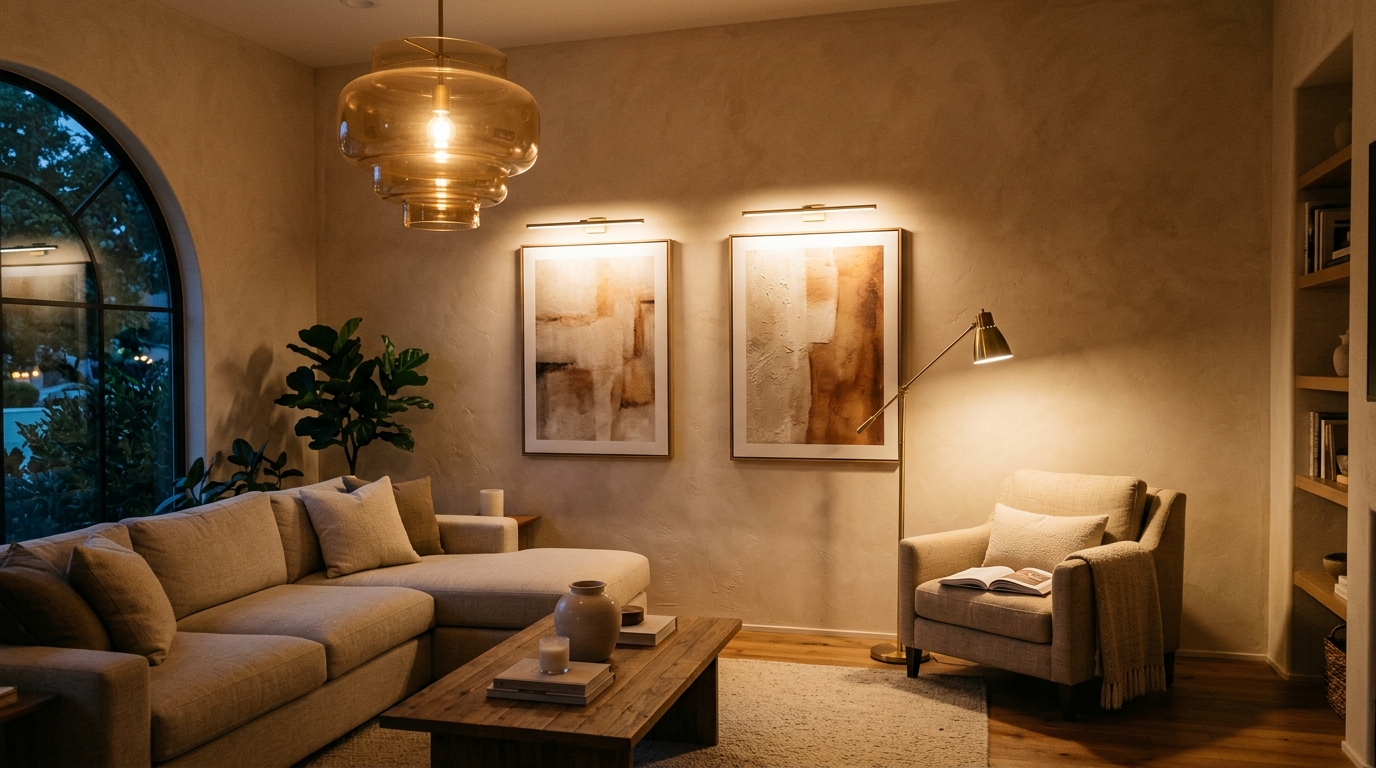
To choose bedroom lighting, establish a soft 3-layer system providing 10 to 15 lumens per square foot. Standardize all bulbs at 2200K–2700K Warm White with CRI >90 to protect circadian sleep cycles. Mount reading sconces 22 to 26 inches above the mattress with independent directional switches, use fabric-shaded fixtures to eliminate bare-bulb glare, and put all circuits on dimmers.
At a Glance: Key Takeaways
- Standardize on 2700K (or 2200K candlelight) warm white; avoid blue-heavy 4000K+ bulbs that ruin sleep.
- Mount bedside reading sconces 22–26 inches above the mattress with narrow-beam directional shades.
- Install three-way dimmer switches accessible directly from the bed so you never get up to turn off lights.
- Choose fabric drum shades, frosted glass, or uplighting to prevent direct line-of-sight bare bulb glare.
1. Circadian Biology & The 2200K–2700K Bedroom Standard
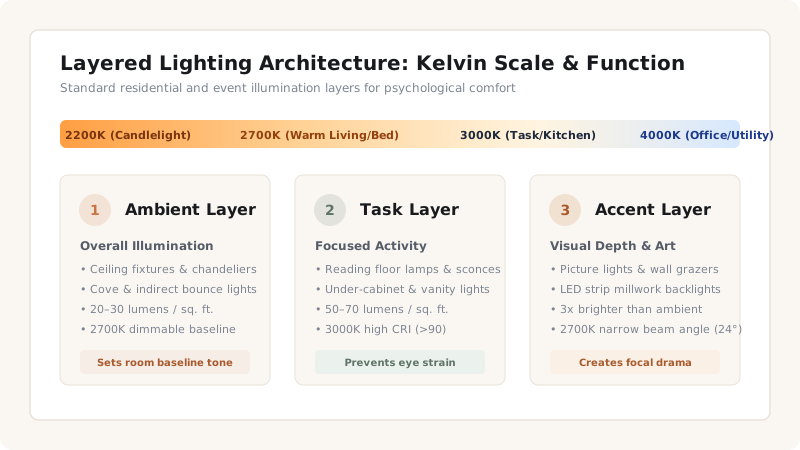
Bedroom lighting is not merely decorative; it directly governs your hormonal biology. Exposure to cool blue-spectrum light (4000K–6500K) after sunset suppresses the pineal gland's production of melatonin, delaying sleep onset by up to 90 minutes. For deep, restorative sleep, follow these strict spectral guidelines:
- 2700K Warm White (The Master Baseline): Use for overall ambient ceiling chandeliers and closet illumination. Replicates the soothing spectrum of sunset.
- 2200K – 2400K Candlelight Glow (Bedside Night Mode): Use for bedside reading sconces and late-night accent lamps. Emits virtually zero blue light wavelengths, allowing melatonin synthesis to proceed unimpeded.
- High CRI (>90): Ensures that wood textures, linen weaves, and paint colors appear warm and natural rather than sickly gray.
2. Bedside Sconce Mounting Heights & Directional Control
Bedside lighting must provide focused illumination for reading without shining into a sleeping partner's eyes:
- Mounting Height Standard (22 to 26 inches above mattress top): When sitting propped up against your pillows in bed, the bottom of the sconce shade should sit at shoulder height (approximately 24 inches above the mattress). This casts light downward onto your book without casting head shadows.
- Independent Switching: Each bedside sconce must feature its own independent on/off and rotary dimmer switch reachable from under the covers.
- Directional Articulating Arms: Choose swing-arm sconces with opaque metal or heavy linen conical shades that direct light in a tight 30-degree cone onto your book pages, leaving the other half of the bed dark.
3. Dressing Closets, Wardrobes & Shadowless Mirrors
While sleeping zones require low-lumen warmth, dressing zones require high-clarity shadowless illumination:
- Wardrobe & Closet Lighting (3000K, CRI >95): Inside walk-in closets and wardrobes, use 3000K high-CRI LED strip lighting (50 lumens/sq.ft.) so you can accurately distinguish between black and navy garments.
- Dressing Vanity Mirrors: Place vertical linear sconces on either side of the mirror at face height (60 inches from the floor). This illuminates the face symmetrically from left and right, completely eliminating harsh downward eye-socket shadows cast by overhead ceiling pot lights.
Bedroom Lighting Layer Specification Matrix
Use this reference table to calculate exact physical dimensions, ratios, and specifications before purchasing:
| Fixture Location | Target Lumens | Color Temperature | Mounting Height | Control Type |
|---|---|---|---|---|
| Central Ceiling Chandelier | 1,500–2,200 lm | 2700K (Warm) | Min 7 ft clearance from floor | Wall dimmer + Bedside 3-way |
| Bedside Reading Sconces | 400–600 lm each | 2200K–2700K | 22–26" above top of mattress | Individual rotary dimmer at bed |
| Dresser / Credenza Lamp | 600–800 lm | 2700K | Eye level seated (38–42" from floor) | Plug-in slider dimmer |
| Walk-In Closet Overhead | 50 lm / sq.ft. | 3000K (CRI >95) | Flush to ceiling | Motion sensor / Wall switch |
| Vanity Mirror Flanking Lights | 800 lm each | 3000K (CRI >90) | Centered at 60" eye level | Dedicated dimmer |
Bedroom Lighting Constraints
Every successful decoration project must account for physical and environmental constraints:
No-Hardwire Rental Walls
Renters can install plug-in wall sconces with decorative brass tubing or fabric cord raceways, plugged into smart dimmer wall plugs controlled via wireless remote on the nightstand.
Light Leaks Under Bedroom Doors
Hallway nightlights leaking under bedroom doors disrupt sleep; install a low-profile felt draft/light door sweep on the bottom of the bedroom door.
Overhead Ceiling Fan Wobble
When combining light with a ceiling fan, choose DC-motor integrated LED units with solid balancing kits to prevent distracting flickering shadows caused by fan blade strobing.
10-Step Bedroom Lighting Installation Protocol
Execute this professional sequence to achieve flawless results without backtracking:
Calculate Total Bedroom Lumens
Multiply room square footage by 12–15 lumens/sq.ft. to establish your total ambient budget.
Select Central Shaded Fixture
Choose a diffused fabric drum chandelier or frosted glass semi-flush mount to conceal bare bulbs.
Position Bedside Sconce Mounting Points
Mark wall anchor locations 22–26 inches above the top surface of the mattress.
Install Dimmable 2700K Reading Sconces
Mount directional swing-arm fixtures with independent on/off rotary switches.
Place Accent Table Lamp on Dresser
Add a warm ceramic base lamp on the primary dresser to illuminate dark room corners.
Standardize All Bulbs to 2700K CRI >90
Inspect all bulbs to verify matching warm color temperature and rich color rendering.
Install Bedside Three-Way Dimmer Controls
Wire switch controls so the main ambient light can be turned off directly from bed.
Install LED Strip Lighting Inside Wardrobes
Add 3000K high-CRI tape lights with magnetic door sensors inside closets.
Position Flanking Vanity Mirror Sconces
Mount dual sconces at 60-inch eye level on either side of the dressing mirror.
Test Nighttime Glare from Pillow Position
Lie down in bed and verify that no direct unshielded bulbs are visible from your resting gaze.
Common Mistakes & Countermeasures
Avoid these costly errors that compromise aesthetics, ergonomics, and budget:
Relying on Recessed Downlights Over the Pillow
Using White Plastic Translucent Shades
Having to Get Out of Bed to Turn Off the Lights
Project Execution Checklist
Track your physical progress. Checkboxes persist automatically on this device:
Frequently Asked Questions
What wattage bulb is best for bedside reading?
Use a 5W to 7W LED bulb producing approximately 450 to 600 lumens at 2700K (equivalent to a traditional 40W–50W incandescent bulb) on a dimmer switch.
Are smart color-changing bulbs good for bedrooms?
Yes. High-quality smart bulbs can be scheduled to automatically transition from crisp 3000K morning wake-up light to ultra-warm 2200K candlelight at 9:00 PM, reinforcing natural circadian rhythms.
How high should a bedroom ceiling chandelier hang?
If positioned in an open walking corridor, maintain at least 7 feet of clearance from the floor. If suspended directly over the foot of the bed, it can hang down to 6.5 feet from the floor without obstructing sightlines.