
Hot-rolled steel profiles and tenon-welded muntin bars form the structural skeleton of authentic Crittall fenestration. Manufactured by passing heated steel billets through precision roller dies at 1,100°C, these dense solid steel shapes are notched with mechanical interlocking half-lap tenons and welded solid, achieving ultra-slender sightlines with unmatched torsional rigidity.
At a Glance: Key Takeaways
- Hot-Rolled Billets at 1,100°C: Solid steel shaped through specialized rolling mills, creating sharp external radiuses and high structural density.
- Slender Profile Sightlines: 28mm to 36mm face widths providing over 85% glass-to-frame daylight ratios.
- Mechanical Tenon Interlocking: Glazing bars notched with half-lap tenons that mechanically lock horizontal and vertical muntins before welding.
- Continuous TIG/MIG Welding: Full-penetration welded joints hand-ground completely flush, eliminating visible exterior corner seams.
- True Divided Lights vs. Stick-On Grids: Individual glass panes glazed into separate structural steel apertures for authentic architectural depth.
- Integral Putty-Look Chamfers: Sloped exterior flanges mimicking historic linseed oil putty lines on traditional heritage casements.
1. Steel Metallurgy: Hot-Rolled vs. Cold-Formed Steel
In architectural fenestration, the method of steel manufacturing dictates the aesthetic and mechanical quality. Cheap imitation 'steel look' windows use cold-formed hollow box tubing (bent sheet metal), which has rounded, bulbous corners and visible seam welds.
Authentic Crittall windows utilize solid hot-rolled steel sections. Steel billets are heated to \(1,100^\circ\text{C}\) and passed through contoured rolling dies. The process creates solid, sharp-cornered shapes with an average wall thickness of \(3.5\text{ to }5.0\text{ mm}\):
- W20 & W40 Profiles: Hot-rolled T-sections, Z-sections, and angle bars designed specifically for overlapping weather seals.
- Internal Flange Chamfer: Rolled with a \(15^\circ\) exterior chamfer that replicates the traditional triangular profile of hand-applied glazing putty while providing a self-draining watershed.
2. True Divided Lights: Tenoned Muntin Bar Joinery
Modern cheap windows use faux stick-on plastic or aluminum grids taped to a single piece of glass. Authentic Crittall architecture is built upon True Divided Lights, where each small glass pane is framed by structural steel.
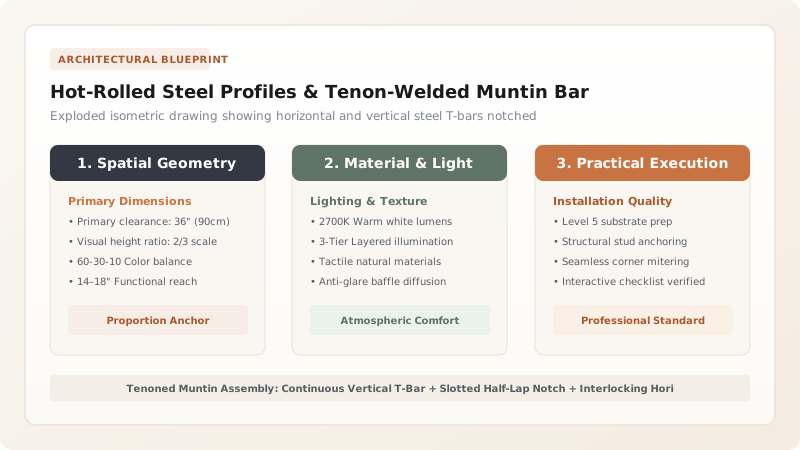
The intersection of horizontal and vertical T-bars is a masterclass in metal stereotomy. One bar has its web notched out with a precision punch, while the crossing bar has its flange cut away to form an interlocking half-lap tenon. When pressed together, the bars lock mechanically, resisting racking forces even before welding. Master welders then execute full-penetration TIG welds on both faces, grinding the joint flush with pneumatic ceramic disc sanders.
3. Torsional Rigidity: Wind-Load Physics in Tall Screens
Because hot-rolled steel has an elastic modulus of \(210\ \text{kN/mm}^2\), a slender \(32\text{ mm}\) steel muntin deflects less under wind pressure than a \(60\text{ mm}\) aluminum mullion.
When wind gusts strike a 4-meter glass screen, positive pressure is transferred through the welded grid matrix. The fully welded interlocking grid acts as a continuous Vierendeel truss, dissipating lateral wind moments across all perimeter masonry anchor points simultaneously.
Hot-Rolled Steel vs. Cold-Formed Aluminum Profiles
Use this reference table to calculate exact physical dimensions, ratios, and specifications before purchasing:
| Technical Metric | Hot-Rolled Solid Steel (Crittall) | Extruded Architectural Aluminum | Cold-Rolled Hollow Steel |
|---|---|---|---|
| Modulus of Elasticity (E) | 210 GPa (Extremely rigid) | 70 GPa (1/3 the stiffness of steel) | 200 GPa (Rigid but thin-walled) |
| Minimum Sightline Width | 28 to 34 mm | 50 to 75 mm (Bulky frames) | 40 to 55 mm |
| Corner Joint Method | Full-penetration TIG welded solid | Mechanical corner chevrons & crimp | Miter welded thin sheet |
| Tensile Yield Strength | 355 MPa (Structural Grade) | 160 to 200 MPa | 235 MPa |
| Glazing Style | True Divided Light structural grids | Applied surface tape grilles | Applied stick-on grilles |
| Recycled Material Base | 100% recycled scrap steel billets | Bauxite ore / virgin aluminum | Recycled steel strip |
Fabrication & Welding Constraints
Every successful decoration project must account for physical and environmental constraints:
Heat Distortion Control
Excessive heat input during TIG welding can warp slender steel muntin bars; fabricators use water-cooled copper heat sinks and sequential skip-welding patterns.
Galvanizing Drainage Holes
Every enclosed steel profile chamber must have pre-drilled 8mm vent and drain holes to prevent explosive pressure buildup during molten zinc immersion.
Flush Joint Grinding
Welds must be ground flush to within ±0.1mm tolerance; any proud weld bead will prevent the double-glazed unit from seating flat on its gasket.
Muntin Bar Tenoning & Grid Fabrication Sequence
Execute this professional sequence to achieve flawless results without backtracking:
Steel Billet Slicing & Straightening
Cold-saw hot-rolled T-bar profiles to cut lengths, checking straightness on precision granite surface plates.
Hydraulic Tenon Punching
Punch interlocking half-lap tenons and mortise slots into horizontal and vertical muntin bars using specialized hydraulic tooling.
Grid Jig Assembly
Interlock muntins into a rigid steel welding jig, verifying squareness and corner-to-corner diagonal tolerances to within 1mm.
TIG Penetration Welding
Weld all four quadrant corners of each muntin intersection using TIG with argon shielding gas and ER70S-6 filler wire.
Pneumatic Flush Grinding
Grind weld crowns dead-flat using 80-grit followed by 120-grit ceramic flap discs, maintaining the sharp rolled profile radius.
Pre-Galvanizing Inspection
Check frame for planarity and drill 8mm venting holes at all enclosed corners prior to chemical pickling and zinc dipping.
Common Mistakes & Countermeasures
Avoid these costly errors that compromise aesthetics, ergonomics, and budget:
Using cold-rolled hollow steel tubes with sharp sheet-metal corners instead of hot-rolled solid bars
Grinding welded corner joints too aggressively with hard grinding wheels
Overheating thin steel muntins during welding without clamping jigs
Project Execution Checklist
Track your physical progress. Checkboxes persist automatically on this device:
Frequently Asked Questions
What is the difference between Crittall W20 and W40 profiles?
The W20 profile (32mm depth) is the historic standard designed for single glazing or slimline double glazing (up to 16mm DGU). The W40 profile (40mm depth) was engineered to accommodate thicker, high-performance double-glazed units (up to 28mm DGU) with enhanced acoustic and thermal insulation while maintaining the same slender sightline.
Are true divided lights less thermally efficient than a single large glass pane with stick-on grilles?
Thermally, individual glass panes introduce more perimeter edge spacer area. However, modern warm-edge composite spacers and thermally broken steel profiles minimize this effect, while true divided lights offer superior acoustic damping, individual pane replacement ease, and authentic architectural depth.
Can arched or circular Crittall windows be manufactured?
Yes. Solid hot-rolled steel profiles can be cold-curved on 3-roll section bending machines to create Gothic four-centered arches, Roman semi-circles, or circular bulls-eye (oeil-de-boeuf) windows.


