
Modern Crittall steel windows achieve high energy efficiency without compromising their historic slender sightlines by integrating structural polyamide thermal breaks and high-performance argon-filled double-glazed units (DGUs). Operating sashes are fitted with authentic solid cast gunmetal or unlacquered brass hardware, featuring traditional cockspur handles and adjustable indexing peg stays.
At a Glance: Key Takeaways
- Polyamide Thermal Barrier: High-density glass-fiber reinforced polyamide (PA66 GF25) crimped between interior and exterior steel sections.
- Energy Performance (Uw < 1.4 W/m²K): Drastic reduction in thermal conductance, eliminating interior condensation and winter chill.
- Argon-Filled Low-E Double Glazing: 24–28mm DGUs with soft-coat Low-E glass and warm-edge silicone foam spacer bars.
- Solid Cast Gunmetal / Brass Hardware: Hand-finished unlacquered brass, aged bronze, or gunmetal fittings that develop natural patina.
- Adjustable Peg Stay Ventilation: Classic perforated stay bar allowing the window sash to be securely pinned open at varying angles.
- Concealed Multi-Point Security: Modern perimeter multi-point shootbolt locking systems meeting PAS 24 / RC2 forced-entry standards.
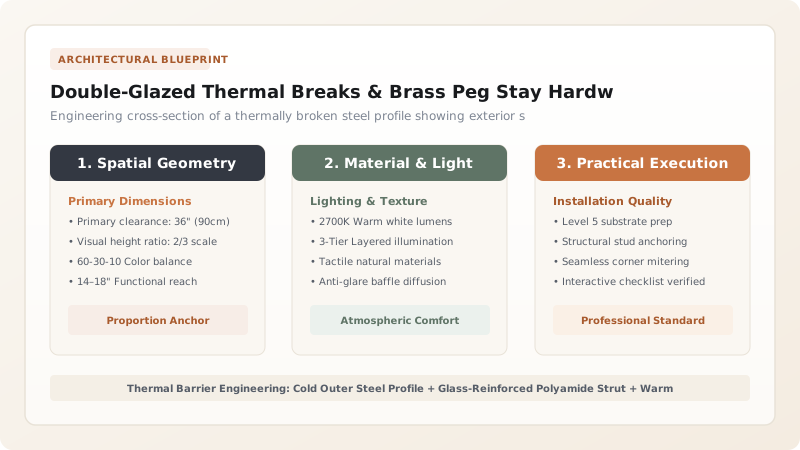
1. Thermal Physics: The Polyamide Composite Profile
Steel is an exceptional structural material, but its thermal conductivity (\(\lambda = 50\ \text{W/m}\cdot\text{K}\)) is high compared to wood (\(\lambda = 0.13\)) or PVC (\(\lambda = 0.19\)). Historically, this made steel windows susceptible to interior condensation in cold climates.
Modern architectural steel solves this through polyamide thermal breaks. Structural steel profiles are manufactured in two separate halves. A specialized 25% glass-fiber reinforced polyamide strip (PA66 GF25) with low conductivity (\(\lambda = 0.30\ \text{W/m}\cdot\text{K}\)) is mechanically knurled and crimped into receiver channels in the steel:
The thermal break completely halts conductive heat bridging between the freezing outdoor steel and the warm interior room, enabling steel windows to achieve overall U-values under \(1.4\ \text{W/m}^2\text{K}\).
2. Insulated Glazing Units: Warm-Edge Spacers & Acoustic Laminae
Within the slender steel glazing rebate, modern Crittall windows host advanced high-performance insulated glass units (DGUs):
- Soft-Coat Low-E Glass: Microscopic silver coating reflects interior radiant heat back into the living space while transmitting maximum natural light.
- 90% Argon Gas Fill: Heavy noble gas fill in the cavity reduces convective heat circulation between glass panes.
- Composite Warm-Edge Spacers: Polypropylene/stainless steel hybrid spacers replace conductive raw aluminum spacer bars, keeping the glass perimeter warm and preventing edge condensation.
3. Hardware Craftsmanship: The Authentic Cast Brass Peg Stay
Nothing defines the sensory experience of a traditional Crittall window like its solid metal hardware. Casement sashes are operated using solid cast brass or bronze peg stays:
- The Peg Stay Bar: A heavy, forged brass bar perforated with 5 to 7 precision-reamed holes, pivoting on a knurled brass sash bracket.
- The Indexing Peg: A vertical turned brass post mounted to the lower sill frame. Dropping a hole over the peg locks the casement at ventilation openings from \(10^\circ\text{ to }75^\circ\).
- The Locking Cockspur Handle: A cam-action handle that engages a brass strike plate on the frame, pulling the sash tightly against twin continuous EPDM perimeter acoustic seals.
Thermally Broken Steel Window Hardware & Glazing Matrix
Use this reference table to calculate exact physical dimensions, ratios, and specifications before purchasing:
| System Component | Standard Heritage Spec | High-Performance Luxury Spec | Performance Metric |
|---|---|---|---|
| Thermal Break Strut | 14mm Polyamide PA66 GF25 | 24mm Multi-Cavity Polyamide | Uf reduced from 6.0 to 1.8 W/m²K |
| Double Glazing Makeup | 4mm Low-E / 10mm Ar / 4mm Clear | 6mm Acoustic Lam / 14mm Ar / 6mm Low-E | Acoustic attenuation Rw = 38–42 dB |
| Glass Cavity Gas | 90% Argon gas filled | 90% Krypton gas filled (slimline) | Center of glass Ug < 1.1 W/m²K |
| Hardware Metallurgy | Cast brass (Polished / Satin) | Solid forged gunmetal / aged bronze | Salt-spray tested to 1,000 hrs (ASTM B117) |
| Perimeter Weatherseal | Single EPDM bulb gasket | Dual continuous EPDM bubble seals | Air permeability Class 4; Water Class 9A |
| Locking Mechanism | Single-point cockspur latch | Concealed multi-point perimeter gearbox | Meets PAS 24 burglar resistance security |
Thermal & Mechanical Constraints
Every successful decoration project must account for physical and environmental constraints:
Bimetallic Bowing Effect
High temperature differences between hot exterior steel and air-conditioned interior steel can cause minor bowing in tall sashes; polyamide struts must have balanced shear crimping.
Glazing Unit Thickness Limits
Crittall rebates are compact; DGUs exceeding 28mm thickness require specialized offset stepped-edge units or wider frame series.
Unlacquered Brass Maintenance
Genuine unlacquered brass will naturally oxidize and darken over time; owners who prefer a bright polished look must apply microcrystalline Renaissance wax semi-annually.
Hardware Fitting & DGU Glazing Sequence
Execute this professional sequence to achieve flawless results without backtracking:
Hardware Mortising & Tapping
Drill and tap mounting holes into the reinforced steel sash stiles using high-speed cobalt drill bits and M5 machine taps.
Solid Brass Hardware Mounting
Fasten brass cockspur handles and peg stay brackets using counter-sunk solid brass machine screws with thread-locking compound.
EPDM Gasket Insertion
Press continuous dual EPDM perimeter weatherseals into the dedicated frame grooves, mitering corners at 45 degrees.
DGU Setting Block Placement
Position high-density neoprene setting blocks at the quarter points of the sash rebate to support the glass weight squarely.
Glass Unit Dropping & Beading
Lower the insulated glass unit into the frame, pressing snap-in steel glazing beads into spring clips to clamp the glass uniformly.
Friction & Cam Calibration
Adjust friction hinge screws and cockspur handle strikes until the casement pulls closed with a positive, airtight compression seal.
Common Mistakes & Countermeasures
Avoid these costly errors that compromise aesthetics, ergonomics, and budget:
Using aluminum spacers inside double-glazed units for Crittall steel windows
Lacquering brass window hardware with cheap nitrocellulose lacquer
Omitting neoprene setting blocks beneath double-glazed units
Project Execution Checklist
Track your physical progress. Checkboxes persist automatically on this device:
Frequently Asked Questions
Can thermally broken Crittall windows meet strict modern energy building codes?
Yes. With polyamide thermal breaks, argon-filled soft-coat Low-E double glazing, and warm-edge spacers, contemporary Crittall windows achieve overall U-values between 1.3 and 1.5 W/m²K, easily surpassing Part L of UK Building Regulations and US Energy Star criteria.
What is the purpose of a peg stay pin locking collar?
A locking collar is a threaded brass cylinder fitted with an Allen key or knurled screw that clamps over the indexing pin above the stay bar, preventing wind gusts from lifting the bar and preventing burglars from opening the window from outside.
Can motorized electric actuators be fitted to Crittall casements?
Yes. For high transom or clerestory windows, concealed 24V electric chain actuators can be integrated into the steel frame, wired to wall switches, rain sensors, or building home automation systems.


