
The extreme longevity of modern Crittall steel windows (60+ years maintenance-free) is achieved through a multi-barrier finishing process: hot-dip galvanizing (submersion in 450°C molten zinc to BS EN ISO 1461), chemical zinc phosphate passivation to promote adhesion, and electrostatic application of an 80-micron architectural polyester powder coating baked at 200°C.
At a Glance: Key Takeaways
- 450°C Molten Zinc Immersion: Liquid zinc reacts with steel to form four distinct metallurgical alloy layers (Gamma, Delta, Zeta, and Eta).
- Cathodic Sacrificial Protection: Even if scratched through to bare steel, the surrounding zinc sacrifices itself galvanically to prevent rust creep.
- Complete Cavity Shielding: Liquid zinc penetrates inside every weld fold and hollow channel where paint sprays cannot reach.
- Zinc Phosphate Passivation: Multi-stage chemical wash removing surface oxides and etching a crystalline conversion coating.
- 80-Micron Architectural Polyester: Electrostatic powder coating baked in curing ovens at 200°C to create an impact-resistant polymer armor.
- ISO 12944 Durability Class C5: Rated for severe coastal, marine, and industrial atmospheric corrosion environments.
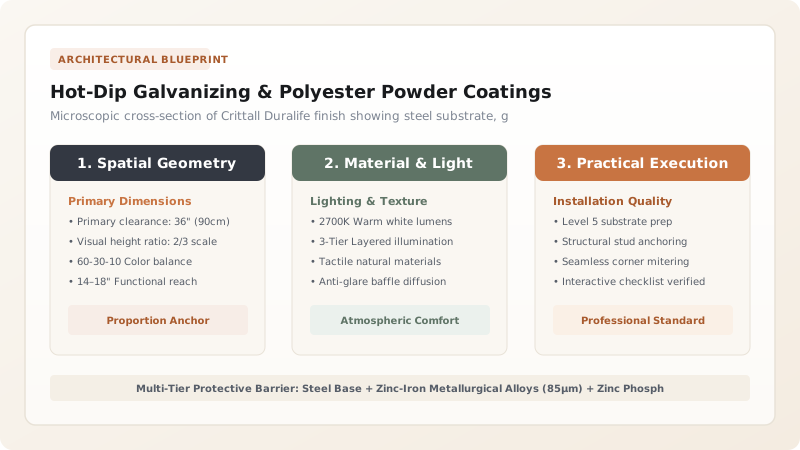
1. Metallurgical Chemistry: The 4-Layer Zinc-Iron Matrix
Unlike electro-galvanizing or zinc spray painting—which merely lay a weak, porous zinc dust film on the surface—hot-dip galvanizing is a high-temperature metallurgical fusion process.
Cleaned steel frames are submerged into a kettle of molten zinc maintained at \(450^\circ\text{C}\). Iron atoms from the steel diffuse into the liquid zinc, precipitating a series of intermetallic alloy layers:
- Gamma Layer (\(75\%\) Zn, \(25\%\) Fe): An ultra-thin crystalline base layer with Vickers hardness exceeding the base steel.
- Delta Layer (\(90\%\) Zn, \(10\%\) Fe): Dense columnar crystals providing supreme abrasion resistance.
- Zeta Layer (\(94\%\) Zn, \(6\%\) Fe): Feathery crystals that absorb mechanical impact.
- Eta Layer (\(100\%\) Zn): Pure ductile zinc outer skin that forms a self-healing patina of zinc hydroxycarbonate upon exposure to atmospheric carbon dioxide.
2. Pre-Treatment Chemistry: Zinc Phosphate Conversion
Applying powder coating directly over fresh galvanizing often results in paint peeling because the zinc surface is chemically slick and can form zinc oxide powdery blooming. The critical bridge is chemical pre-treatment.
The galvanized frames pass through a multi-stage automated wash tunnel:
- Alkaline degreasing to strip surface grease and oils.
- Acid de-oxidation etch to remove micro-oxides.
- Application of a crystalline zinc phosphate conversion coating, which microscopically etches the zinc and creates millions of microscopic anchor teeth that lock the polyester powder mechanically and chemically.
3. The Duralife Finish: Electrostatic Powder Curing
In the final stage, an electrostatically charged dry polyester powder is sprayed onto the grounded steel frames. The charged particles cling uniformly around every complex rolled flange and welded corner.
The frames pass into a convection curing oven heated to \(190^\circ\text{C to }210^\circ\text{C}\) for 20 minutes. The powder melts, cross-links, and flows into an unbroken, non-porous \(80\text{ to }100\ \mu\text{m}\) polymer shield. Available in matte, satin, or fine-textured finishes (such as iconic Crittall Matt Black RAL 9005), it resists UV chalking, acid rain, and impact chipping.
Industrial Steel Window Finishing Systems Comparison
Use this reference table to calculate exact physical dimensions, ratios, and specifications before purchasing:
| Finishing Process | Zinc Coating Thickness | Corrosion Resistance Lifespan | Maintenance Requirement |
|---|---|---|---|
| Historic Wet Paint on Raw Steel | 0 μm (No zinc barrier) | 3 to 7 years before rust blisters | Scrape, prime, and repaint every 4 years |
| Electro-Galvanized + Wet Paint | 10 to 15 μm zinc | 10 to 15 years | Touch up paint scratches immediately |
| Crittall Duralife (Hot-Dip + Powder) | 85 μm zinc + 80 μm polyester | 60+ years maintenance-free | Wash with water and mild detergent annually |
| Marine Grade Coastal Spec | 100 μm zinc + epoxy primer + powder | 75+ years in harsh sea spray | Bi-annual fresh water rinse to clear sea salts |
Finishing & Coating Constraints
Every successful decoration project must account for physical and environmental constraints:
Zinc Dross Removal
Any zinc ash or dross pimples forming on the steel during galvanizing must be hand-filed dead smooth prior to powder coating, or they will telegraph through the paint.
Oven Outgassing Pinhole Prevention
Galvanized coatings can trap microscopic air pockets that outgas during oven baking, creating pinholes in powder coating; degreasing and pre-heating cycles must be strictly timed.
Silicone Contamination Hazard
No silicone sprays or lubricants may be used anywhere inside the powder coating workshop; airborne silicone causes catastrophic cratering (fish-eyes) in the powder film.
Industrial Galvanizing & Powder Coating Sequence
Execute this professional sequence to achieve flawless results without backtracking:
Caustic Degreasing & Acid Pickling
Submerge welded steel frames in hot alkaline bath to strip oils, followed by dilute hydrochloric acid bath to dissolve mill scale down to bare white metal.
Fluxing & Drying
Dip frames into zinc ammonium chloride flux tank to prevent flash oxidation, followed by air drying in pre-heating ovens.
Hot-Dip Molten Zinc Submersion
Lower frames into the 450°C molten zinc kettle, holding until boiling ceases and intermetallic alloy growth completes.
Hand Dressing & De-Spiking
After water quenching, dress all zinc drips, wire marks, and sharp spikes with fine hand files to ensure crisp profiles.
Zinc Phosphate Pre-Treatment
Spray frames with hot zinc phosphate conversion chemistry to deposit microscopic crystalline anchor teeth.
Electrostatic Powder & 200°C Bake
Spray architectural polyester powder at 80μm thickness and bake in curing ovens at 200°C for 20 minutes.
Common Mistakes & Countermeasures
Avoid these costly errors that compromise aesthetics, ergonomics, and budget:
Applying powder coating directly over raw un-passivated hot-dip galvanizing
Inadequate venting holes during hot-dip galvanizing
Using soft decorative indoor powder coatings for exterior architectural fenestration
Project Execution Checklist
Track your physical progress. Checkboxes persist automatically on this device:
Frequently Asked Questions
What is 'cathodic sacrificial protection'?
Zinc has a lower electrochemical potential than iron. If the outer powder coat and zinc layer are gouged by a sharp tool, the surrounding zinc oxidizes preferentially, creating a microscopic electrical current that protects the exposed bare iron from rusting.
Can powder-coated Crittall windows be repainted in a different color in the future?
Yes. While the factory powder coating lasts for decades, if a homeowner wishes to change the building color scheme, the surface can be scuffed with 320-grit abrasive pads, primed with a two-part epoxy bonding primer, and recoated with high-grade polyurethane enamel.
How do you clean and maintain powder-coated steel windows?
Maintenance is minimal: wash frames twice a year with a soft sponge, warm water, and mild dish soap (pH 5 to 8). Abrasive pads, scouring powders, and aggressive chemical solvents (acetone, thinner) must never be used.


