
Yakisugi Triangular Chimney Pyrolysis and Flame Thermodynamics represents the thermal mastery behind authentic Japanese charred cedar. By lashing three quartersawn Sugi planks face-inward into a vertical hollow triangular prism (sankaku-yaki), artisans create a self-ventilating thermal chimney. Convective air draft sucks oxygen into the base, accelerating internal combustion temperatures beyond 1,100°C in under 90 seconds. This intense, starved-oxygen pyrolysis pyrolyzes hemicellulose and lignin into a thick, crystalline carbon carapace without incinerating the structural wood core.
At a Glance: Key Takeaways
- Sankaku-Yaki Flue Geometry: Equilateral triangular prism concentrating radiant heat across all three board faces.
- Thermal Convective Draft: Stack effect sucking cold air into base vents, accelerating burn velocity exponentially.
- 1,000°C to 1,200°C Core Temperatures: Delivering intense flash pyrolysis that vitrifies surface wood fibers in minutes.
- Sub-Millimeter Timer Control: Quapping chimney open at precisely 180 to 240 seconds to freeze char depth.
- Rapid Water Quench Shock: Flooding glowing planks with cold water to halt combustion and temper the carbon crust.
- Uniform Edge-to-Edge Char: Achieving consistent carbon thickness across entire 4-meter board lengths.
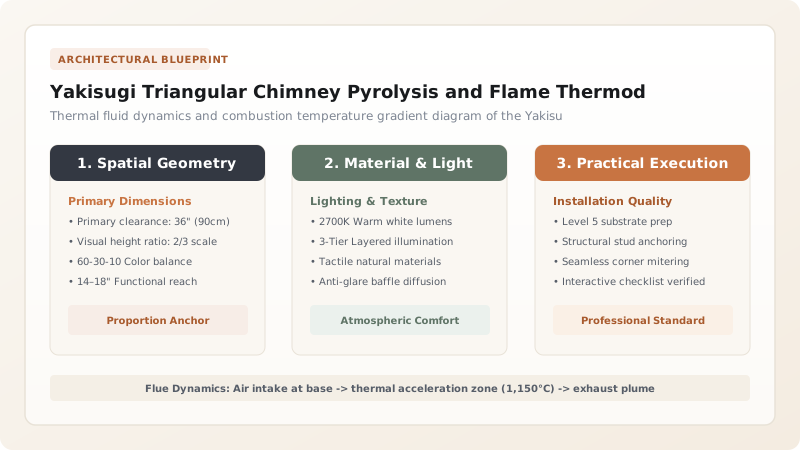
1. Convective Fluid Dynamics: The Chimney Effect
Unlike open-air bonfire burning, which suffers from turbulent wind cooling and irregular oxygen starvation, the sankaku-yaki (triangular chimney) is an optimized thermodynamic reactor. By binding three 4-meter planks into a hollow vertical triangle with a narrow internal cross-section, hot combustion gases rise rapidly toward the top opening.
This upward gas rush creates a severe pressure drop (draft vacuum) at the base of the flue. Cold atmospheric air is violently drawn into the bottom vent, feeding the fire with fresh oxygen and creating an intense, roaring blast-furnace environment that burns uniformly along all three timber faces simultaneously.
2. Thermal Pyrolysis Zones: From Steam to Carbonization
During the 200-second burn cycle, the wood passes through three distinct thermodynamic phases:
- 0 to 45 Seconds (Drying Phase - 100°C to 200°C): Bound moisture within the timber flashes into steam, venting white vapor plumes from the chimney apex.
- 45 to 120 Seconds (Active Pyrolysis - 200°C to 600°C): Hemicellulose decomposes into combustible volatiles (methane, carbon monoxide, and wood tars), which ignite into roaring orange flames.
- 120 to 220 Seconds (High-Heat Vitrification - 800°C to 1,150°C): Lignin melts and carbonizes, forming the thick, crackled alligator carbon blocks (kurokawa).
3. The Quenching Shock: Halting the Burn
The single most dangerous phase of Yakisugi production is the transition from burning to quenching. A delay of just 30 seconds can cause the fire to burn through the board's structural core, rendering the plank weak and brittle.
At the exact 200-second mark, the master craftsman severs the binding ropes with a single slash of a machete. The three planks fall open flat onto the ground, and two assistants immediately flood the glowing, smoking faces with pressurized cold water. The sudden thermal shock freezes the carbonization reaction, consolidating the molten carbon into an impact-resistant, glass-hard protective skin.
Yakisugi Pyrolysis Burn Time vs. Char Performance
Use this reference table to calculate exact physical dimensions, ratios, and specifications before purchasing:
| Burn Duration (Seconds) | Internal Flue Temp (°C) | Char Crust Depth (mm) | Core Residual Strength | Recommended Application |
|---|---|---|---|---|
| 120 - 150 Seconds | 700°C - 850°C | 1.0mm - 1.5mm | 95% of original timber | Brushed interior paneling & furniture |
| 180 - 210 Seconds | 950°C - 1,100°C | 2.0mm - 2.8mm | 88% of original timber | Standard exterior siding & rainscreens |
| 220 - 260 Seconds | 1,100°C - 1,200°C | 3.0mm - 4.0mm (Heavy) | 80% of original timber | Harsh marine coastal & typhoon zones |
| > 300 Seconds (Overburn) | > 1,200°C (Burn-through) | > 5.0mm (Excessive) | < 60% (Brittle failure) | Defective cull timber (discarded) |
Environmental & Safety Constraints
Every successful decoration project must account for physical and environmental constraints:
Severe Smoke Plumes
Chimney burning discharges thick wood-tar smoke; operations require rural agricultural zoning away from flight paths.
Water Supply Volume
Rapid quenching consumes at least 40 to 60 liters of clean pressurized water per 3-board burn cycle.
Protocol for Operating a Traditional Sankaku-Yaki Burning Cycle
Execute this professional sequence to achieve flawless results without backtracking:
Timber Sorting & Quartersawn Pairing
Inspect 3 Sugi planks for straight grain; arrange with heartwood faces inward to form the interior burn chamber.
Wet Straw Rope Chimney Lashing
Lash planks together at five points using wet rice-straw ropes; wedge bottom corners open 50mm to form air draft vents.
Vertical Staging & Starter Loading
Elevate chimney onto fireproof brick staging; insert ignited wood-shaving starter into base; monitor convective chimney draw.
Pyrolysis Timer & Flame Color Monitoring
Start digital timer; observe smoke transition from white moisture steam to clear roaring blue flame; burn for 195 seconds.
Rope Severing & Rapid Ground Spread
At 195 seconds, slice binding ropes with billhook knife; let planks kick open flat onto wet grass with charred faces up.
Pressurized Water Quenching Flood
Immediately deluge glowing planks with cold water hose spray until steaming ceases; brush off standing pools of water.
Common Mistakes & Countermeasures
Avoid these costly errors that compromise aesthetics, ergonomics, and budget:
Lashing boards with synthetic nylon or polypropylene twine
Quenching boards unevenly with a garden watering can
Project Execution Checklist
Track your physical progress. Checkboxes persist automatically on this device:
Frequently Asked Questions
Can boards longer than 4 meters be burned using the chimney method?
In traditional practice, 4 meters is the optimal limit. Taller chimneys create such extreme draft velocity that the top 1 meter burns far hotter than the bottom, resulting in uneven charring. Industrial manufacturers use computer-controlled horizontal gas roller furnaces for boards up to 6 meters.
Does quenching hot wood in cold water cause boards to warp?
If flat-sawn boards with tangential grain are used, they will cup severely. However, quartersawn Sugi timber has vertical grain lines that expand and contract symmetrically, allowing it to withstand the thermal shock of water quenching with minimal distortion.


