
Yakisugi Natural Oil Finishing and Rainscreen Sub-Framing represents the modern architectural installation protocol for charred cedar siding. While authentic unbrushed alligator Yakisugi requires zero finish, brushed varieties and interior panels are dressed with natural penetrating drying oils—principally pure tung oil and cold-pressed perilla oil—to lock loose carbon dust and enhance satin luster. Installed over a back-ventilated timber rainscreen sub-frame with stainless steel fixings, the assembly ensures lifetime drainage, ventilation, and moisture defense.
At a Glance: Key Takeaways
- Natural Drying Oils: Pure Chinese tung oil and perilla oil polymerizing into a durable, non-toxic satin carbon binder.
- Zero Carbon Soot Transfer: Oil treatment locking carbon particles so clothes remain spotless upon surface contact.
- Back-Ventilated Rainscreen Cavity: 20mm-25mm continuous vertical airflow cavity dissipating cavity moisture.
- Stainless Steel Grade 316 Fasteners: Corrosion-proof ring-shank nails preventing black tannin bleeding on charred timber.
- Continuous Bug-Screen Flashing: Perforated stainless insect mesh guarding cavity bases against pest ingress.
- Thermal Expansion Fastening: Pre-drilling pilot holes to accommodate seasonal board width expansion.
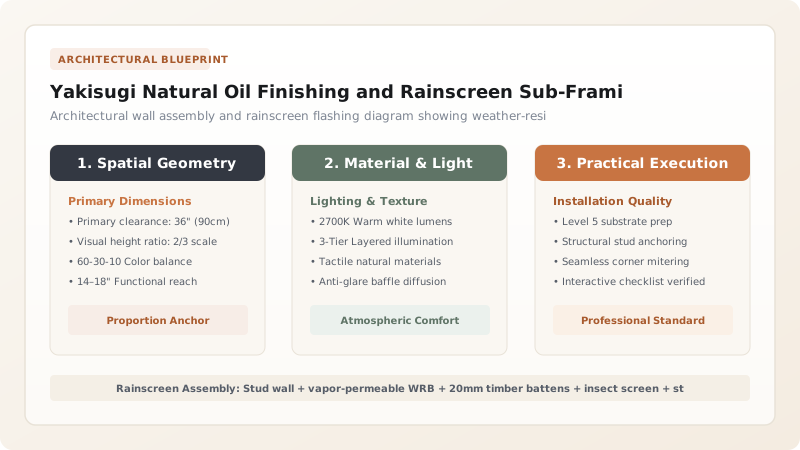
1. Natural Drying Oil Chemistry: Tung and Perilla Oils
For interior spaces, residential entryways, or brushed Yakisugi styles (such as Gendai and Pika-Pika), loose surface carbon dust must be bound. Master craftsmen avoid synthetic polyurethane or acrylic varnishes, which peel and blister under solar UV rays.
Instead, they dress the charred timber with pure tung oil (vernice di legno) or cold-pressed perilla oil. Rich in eleostearic and linolenic polyunsaturated fatty acids, these natural plant oils penetrate deep into the carbon pores and polymerize via atmospheric oxidation into a flexible, water-repellent linoxyn glaze. The oil fixes loose soot, imparts a rich graphite-black satin luster, and never flakes.
2. The Ventilated Rainscreen Sub-Framing Principle
Yakisugi must never be nailed directly against flat plywood sheathing or waterproof building paper. Moisture trapped behind siding causes structural framing rot. Modern installation mandates a ventilated rainscreen system.
A high-performance, vapor-permeable weather-resistive barrier (WRB) is applied over the exterior sheathing. Vertical preservative-treated timber battens (minimum 20mm thick by 50mm wide) are fastened directly into the structural wall studs at 400mm or 600mm centers. This creates a continuous chimney cavity that drains wind-driven rainwater downward while allowing wall vapor to escape harmlessly through top soffit vents.
3. Fastener Selection: Stainless Steel Grade 316
Sugi (Japanese cedar) contains natural wood tannins, and charred wood has high electrical conductivity that accelerates galvanic corrosion in standard metals. Using common electro-galvanized or steel nails is a fatal error; they rust within 3 years, leaving unsightly black mineral stains weeping down the charred facade.
Installers must use exclusively Grade 316 (marine-grade) or Grade 304 stainless steel ring-shank nails or star-drive screws. Fasteners are driven through pre-drilled pilot holes at the board centers, seating the nail head flush with the carbon crust without crushing or cracking the alligator scales.
Yakisugi Wall Rainscreen Assembly Component Specifications
Use this reference table to calculate exact physical dimensions, ratios, and specifications before purchasing:
| Assembly Component | Material Specification | Minimum Dimension | Fastening / Anchorage | Functional Performance Role |
|---|---|---|---|---|
| Weather-Resistive Barrier | Breathable spun-bonded polyolefin | Vapor Permeance > 50 Perms | Cap-stapled & taped seams | Continuous water & air barrier |
| Vertical Cavity Battens | Treated Douglas fir / Larch | 20mm x 50mm cross-section | Stainless screws into studs | Continuous 20mm air drainage cavity |
| Base Bug-Screen Flashing | Perforated stainless steel (316) | 0.8mm mesh (corrosion-proof) | Screwed to bottom batten | Vents cavity while blocking insects/rodents |
| Siding Fasteners | Grade 316 Stainless ring-shank | 50mm length x 2.8mm dia | Driven flush with carbon face | Corrosion-free wind-load retention |
| Top Soffit Exhaust Vent | Continuous screened shadow gap | 15mm continuous opening | Concealed beneath eaves | Exhausts rising warm cavity vapor |
Installation & Environmental Constraints
Every successful decoration project must account for physical and environmental constraints:
Tung Oil Drying Duration
Natural pure tung oil requires 5 to 7 days of warm, dry weather to cure fully before boards can be stacked or packaged.
Handling Care on Scaffolding
Alligator char can be chipped by careless ladder impact or scaffold rail rubbing; workers must pad staging equipment.
Protocol for Oiling, Pre-Drilling, and Installing Yakisugi Rainscreen Siding
Execute this professional sequence to achieve flawless results without backtracking:
Surface De-Dusting & Air Blowing
Blow loose carbon soot off charred boards using compressed air; whisk face lightly with soft horsehair bench brush.
Tung Oil Flood & Wipe Dressing
Brush raw pure tung oil thinned 20% with natural citrus solvent over charred face; allow 30 minutes to soak; buff off excess with clean rags.
Weather-Resistive Barrier & Batten Setting
Install vapor-permeable WRB over sheathing; fasten 20mm treated vertical timber battens aligned with wall studs at 400mm OC.
Insect Screen & Starter Ledger Mounting
Mount perforated stainless steel bug-screen along bottom batten line; snap chalk line for level starter board alignment.
Pilot Hole Pre-Drilling & Board Seating
Pre-drill 3mm pilot holes through Yakisugi boards to prevent grain splitting; seat boards maintaining 3mm expansion gaps at vertical joints.
Stainless Steel Fastener Driving
Drive 316 stainless ring-shank nails through pilot holes into battens; seat heads flush with char without fracturing carbon blocks.
Common Mistakes & Countermeasures
Avoid these costly errors that compromise aesthetics, ergonomics, and budget:
Over-driving nails deep into the charred wood with a pneumatic nail gun
Omitting the bottom perforated insect screen on the rainscreen cavity
Project Execution Checklist
Track your physical progress. Checkboxes persist automatically on this device:
Frequently Asked Questions
How often does an oil-finished Yakisugi exterior need to be re-oiled?
For exterior rainscreens in full sun, re-applying a light wipe coat of natural tung oil every 7 to 10 years will maintain the deep satin-black luster. If left un-oiled, the timber will simply weather naturally into a dignified silver-gray charcoal patina without rotting.
Can Yakisugi boards be installed horizontally as well as vertically?
Yes. While traditional Japanese cladding is installed vertically, modern architects frequently install Yakisugi horizontally. When installed horizontally, double counter-battens must be used to ensure continuous vertical drainage behind the siding.


