
Yakisugi Alligator Char Depth and Lignin Vitrification represents the fundamental chemical transformation of wood into an indestructible mineral-like shield. The characteristic crackled 'alligator skin' (kurokawa) formed during high-temperature burning is composed of polygonal blocks of pure elemental carbon. By pyrolyzing biological cellulose into carbon while thermally transforming underlying lignin into a vitrified, glass-like hydrophobic barrier, Yakisugi strips timber of the nutrients required by fungi and wood-boring pests while creating an impenetrable UV barrier.
At a Glance: Key Takeaways
- Alligator Skin Carbon Carapace (Kurokawa): 2.5mm-3.5mm thick polygonal carbon blocks shielding unburned heartwood.
- Cellulose Nutrient Elimination: Incinerating digestible sugars, starches, and hemicellulose, leaving zero food for fungal spores.
- Lignin Vitrification Barrier: High heat melting lignin into a dense, hydrophobic, water-impermeable transition zone.
- 100% UV Radiation Immunity: Pure elemental carbon reflecting and absorbing solar ultraviolet rays without molecular breakdown.
- Micro-Expansion Joints: Natural polygonal cracks between alligator scales allowing timber to expand and contract without cracking the core.
- Zero Chemical Biocides: Completely non-toxic, food-safe, and environmentally benign wood preservation.
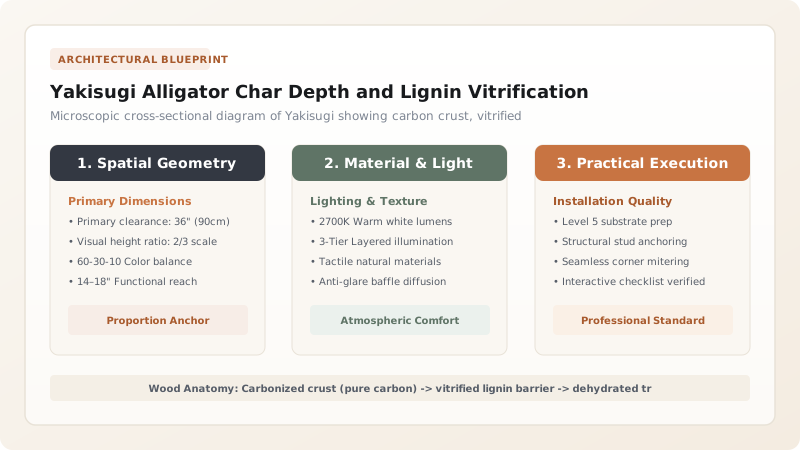
1. Anatomy of the Alligator Carbon Crust (Kurokawa)
Under a scanning electron microscope, raw wood consists of hollow cellulose tubes (tracheids) glued together with lignin. When roasted at 1,100°C, the wood cells lose hydrogen and oxygen through thermal dehydration, converting into pure elemental graphitic carbon.
As the carbon shrinks during cooling, it fractures along natural stress lines, creating the iconic alligator-skin polygonal mosaic (kurokawa). Far from being a structural flaw, these millions of microscopic fissures act as natural expansion joints, allowing the underlying timber to expand and contract with seasonal humidity without shearing the protective carbon crust off the board.
2. Why Insects and Wood-Rot Fungi Starve
Wood-decay fungi (such as brown rot and white rot) and wood-boring insects (like termites and powderpost beetles) do not consume wood because they enjoy timber; they consume it to extract hemicellulose sugars, glucose, and nitrogenous starches.
High-temperature pyrolysis incinerates 100% of these organic nutrient molecules in the outer 3mm of the timber. To a fungus spore or a termite, a Yakisugi board tastes exactly like a lump of pure coal. Lacking moisture and digestible organic fuel, fungal hyphae cannot germinate, and termites refuse to burrow through the abrasive, tooth-dulling carbon layer.
3. The Vitrified Lignin Zone and Total UV Defense
Immediately behind the 2.5mm black carbon crust lies a microscopic vitrified transition zone (approx. 0.5mm thick). In this zone, temperatures reached 280°C to 400°C—hot enough to melt natural wood lignin without consuming it.
Upon rapid water quenching, this molten lignin solidified into an amorphous, glass-like resin that glues the cellular tracheids into a dense, water-impervious boundary. Furthermore, while sunlight rapidly degrades the surface lignin of raw wood (causing it to turn gray and chalky within 12 months), elemental carbon is completely impervious to solar ultraviolet photon radiation, ensuring 80+ years of maintenance-free exterior color stability.
Wood Component Thermal Degradation & Pyrolysis Thresholds
Use this reference table to calculate exact physical dimensions, ratios, and specifications before purchasing:
| Wood Constituent | Chemical Formula | Pyrolysis Temp (°C) | Thermal Transformation | Protective Contribution |
|---|---|---|---|---|
| Moisture / Sap | H2O + volatile terpenes | 100°C - 150°C | Vaporizes into steam | Purges sap pockets; sterilizes wood core |
| Hemicellulose | (C5H8O4)n | 200°C - 260°C | Decomposes into gas & char | Eliminates primary food source for rot fungi |
| Cellulose | (C6H10O5)n | 240°C - 350°C | Pyrolyzes into pure carbon | Forms structural alligator carbon crust |
| Lignin Matrix | [C9H9O2(OCH3)]n | 280°C - 500°C | Melts and recrystallizes | Vitrified water-repellent subsurface barrier |
| Graphitic Carbon | C (Elemental) | Stable to > 1,500°C | Inert elemental shell | 100% UV proof and fire-retardant shield |
Structural & Aesthetic Constraints
Every successful decoration project must account for physical and environmental constraints:
Dimensional Loss During Pyrolysis
Charring burns away approx. 2mm to 3mm of board thickness; initial rough lumber must be milled oversized.
Wabi-Sabi Weathering Variation
Facades exposed to prevailing coastal winds weather to slate gray faster than sheltered north-facing walls.
Protocol for Measuring and Verifying Yakisugi Char Depth and Vitrification
Execute this professional sequence to achieve flawless results without backtracking:
Batch Sample Selection & Cross-Cutting
Select 3 sample boards per 100-board production run; saw clean 50mm cross-sections using fine Japanese pull-saw.
Depth Micrometer Calibration
Calibrate optical measuring microscope or digital vernier depth gauge with needle probe to 0.01mm accuracy.
Carbon Crust Depth Measurement
Measure char depth at 5 points across board face; verify carbon thickness is consistently between 2.2mm and 3.2mm.
Cellular Core Soundness Testing
Inspect unburned timber core under 40x magnification; confirm wood cells remain unstained, uncharred, and structurally intact.
Adhesion & Scratch Resistance Check
Perform cross-hatch scratch test on carbon crust using brass stylus; confirm carbon blocks do not flake off or spall.
Water Droplet Contact Angle Test
Place water droplets on charred face; verify high contact angle (> 110°) demonstrating hydrophobic water-beading.
Common Mistakes & Countermeasures
Avoid these costly errors that compromise aesthetics, ergonomics, and budget:
Accepting boards with char depths less than 1.5mm for exterior cladding
Pressure-washing freshly charred Yakisugi boards with high-pressure water
Project Execution Checklist
Track your physical progress. Checkboxes persist automatically on this device:
Frequently Asked Questions
Does Yakisugi char continue to smell like burnt wood forever?
During the first 2 to 4 weeks after installation, Yakisugi emits a pleasant, smoky cedar campfire aroma. Once rinsed by natural rains and aerated, the scent dissipates completely, leaving zero residual odor on exterior facades.
How does the alligator char layer behave in freezing winter climates?
Exceptionally well. Because elemental carbon and the vitrified lignin zone have near-zero water absorption, winter rain and snow cannot penetrate deep into the pores, preventing freeze-thaw spalling that destroys paint or raw uncharred wood.


