
Layout traditional Japanese tea houses around the sacred 4.5-tatami mat pinwheel grid (*shugijiki*), placing a half-mat in the center surrounded by four full mats so four corners never meet at a single point. Install a low 26" × 26" sliding crawl door (*nijiriguchi*) 18" above the exterior garden stepping stone (*fumi-ishi*).
At a Glance: Key Takeaways
- 4.5-Tatami Mat Swirl Layout (*Shugijiki*): Central half-mat (\(0.5\text{ jo}\)) surrounded by 4 full mats in counter-clockwise pinwheel.
- The 4-Corner Avoidance Rule: Four mat corners must never touch at one intersection, preventing spiritual bad luck and physical floor buckling.
- Nijiriguchi Dimensions (26" High × 26" Wide): Sliding cedar plank hatch mounted 18" above exterior stepping stone.
- Host Mat (*Tsume-za*) & Guest Mat (*Kyaku-za*): Strict spatial demarcation governing seating hierarchy and tea utensil placement.
- Sunken Hearth (*Ro*) Integration: 14" square iron brazier box set into the floor joists flush with the central tatami mat.
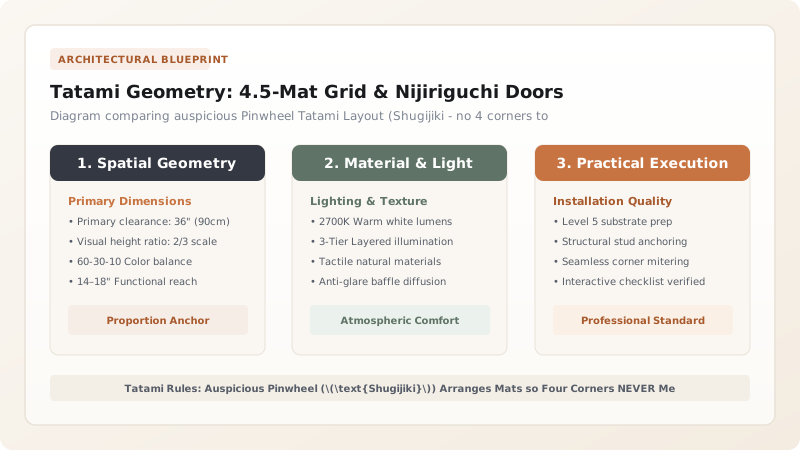
1. Spatial Geometry: The 4.5-Mat Pinwheel (*Shugijiki*) & Corner Rules
In Japanese spatial modularity (*Ki-wari*), room dimensions are strictly determined by the tatami mat module (1:2 aspect ratio). In a 4.5-mat tea room (*yo-jo-han*), mats must never be laid in a cross-grid pattern (*Fushugijiki*), as four corners meeting at one point creates bad luck and structural buckling.
The mats are arranged in an Auspicious Swirl Pattern (*Shugijiki*) with a central half-mat surrounded by four full mats rotating counter-clockwise. Master natural timbers in natural cedar log poles and bamboo.

2. The Nijiriguchi Crawl Door & Roji Garden Integration
Guests approach the tea room through a moss garden path (*roji*), washing hands at a stone water basin (*tsukubai*). They enter through the Nijiriguchi (26" High × 26" Wide Crawl Hatch).
The opening is framed 18 Inches Above the Granite Stepping Stone (*Fumi-ishi*). Review tokonoma art alcoves in shoji screens and tokonoma alcoves and explore Sukiya tea house hub.
Tea Room Mat Counts vs Spatial Atmosphere
Use this reference table to calculate exact physical dimensions, ratios, and specifications before purchasing:
| Tea Room Size | Mat Layout & Floor Area | Intimacy & Seating Capacity | Ceremonial Classification |
|---|---|---|---|
| 4.5-Tatami (Yo-jo-han - Optimal) | 9.18 sq. meters (9.8ft × 9.8ft) | 3 to 4 Guests (Peak intimacy) | Koma (Small / Sacred Wabi-cha) |
| 3-Tatami (San-jo) | 6.12 sq. meters | 2 Guests (Ultimate minimalist) | Extreme Wabi rustic retreat |
| 8-Tatami (Hachi-jo) | 16.3 sq. meters | 6 to 8 Guests (Spacious) | Hiroma (Large formal aristocratic) |
| 2-Tatami (Ni-jo - Rikyu's Taian) | 4.08 sq. meters | Host + 1 Guest only | National Treasure micro-space |
Subfloor Moisture Rotting Tatami Igusa Constraints
Every successful decoration project must account for physical and environmental constraints:
Damp Subfloor Underneath Trapping Moisture and Molding Natural Rush Tatami Mats
Natural rush tatami mats absorb rising ground humidity, turning black with mold and attracting mites; frame subfloor with a continuous breathable air plenum raised 18 inches above grade with operable foundation screened vents.
How to Layout Tatami Joists and Frame a Nijiriguchi Entrance
Execute this professional sequence to achieve flawless results without backtracking:
Frame Floor Joists to Exact Tatami Mat Dimensions
Set floor joists on 12" centers; verify inside room dimensions match exact multiple of Kyo-ma mat size (1910mm × 955mm).
Mortise Floor Framing for Sunken Ro Hearth Box
Frame 14" × 14" square opening in floor joists directly adjacent to host mat for the copper-lined ro firebox.
Frame Nijiriguchi Rough Opening in Exterior Wall
Frame 26" wide × 26" high opening in exterior timber wall; set lower threshold sill 18" above ground.
Craft Sliding Cedar Plank Door with Top Hanging Track
Build solid Japanese cedar plank door with mortised sliding track and hand-carved recessed finger pull.
Place Granite Stepping Stone (*Fumi-ishi*) Outside Door
Set large natural flat-topped granite boulder 18" below door threshold so guests can step and crawl in comfortably.
Install Natural Igusa Tatami in Auspicious Pinwheel Grid
Lay central half-mat; place four full mats in counter-clockwise spiral, verifying joints form clean 'T' junctions (never '+').
Common Mistakes & Countermeasures
Avoid these costly errors that compromise aesthetics, ergonomics, and budget:
Laying Mats with Four Corners Meeting at One Cross Intersection
Project Execution Checklist
Track your physical progress. Checkboxes persist automatically on this device:
Frequently Asked Questions
Can synthetic tatami mats be used instead of natural woven igusa rush?
While synthetic polypropylene or washi paper tatami mats are stain-resistant, authentic tea ceremony masters insist on natural woven igusa rush with rice straw cores (*hon-tatami*) for its calming herbaceous aroma and natural moisture buffering.


