
Fabricate authentic Sukiya-zukuri timber structures using Kyoto Kitayama cedar logs (*Kitayama-sugi maruta*). Prevent face cracking by cutting a stress-relief saw kerf (*sewari*) 1/3 deep into the hidden back of the log before seasoning. Pair columns with smoked bamboo (*susudake*) ceiling lattices and woven Japanese cedar bark (*sugi-kawa*) panels.
At a Glance: Key Takeaways
- Kitayama Cedar (*Kitayama-sugi Maruta*): Grown in northern Kyoto; prized for ultra-dense growth rings and silky natural grain.
- The Hidden Back Kerf (*Sewari*): Relieves tangential wood shrinkage drying stresses, guaranteeing a crack-free front display face.
- Smoked Antique Bamboo (*Susudake*): Centuries-old roof thatch bamboo naturally caramelized to a rich mahogany-brown from hearth smoke.
- Woven Cedar Bark Ceilings (*Sugi-kawa Ajiro*): Thin strips of aromatic cedar bark woven into herringbone patterns for tea room canopies.
- Traditional Joinery (*Kigumi*): Interlocking sliding dovetails and scarf joints assembled with zero metal fasteners or screws.
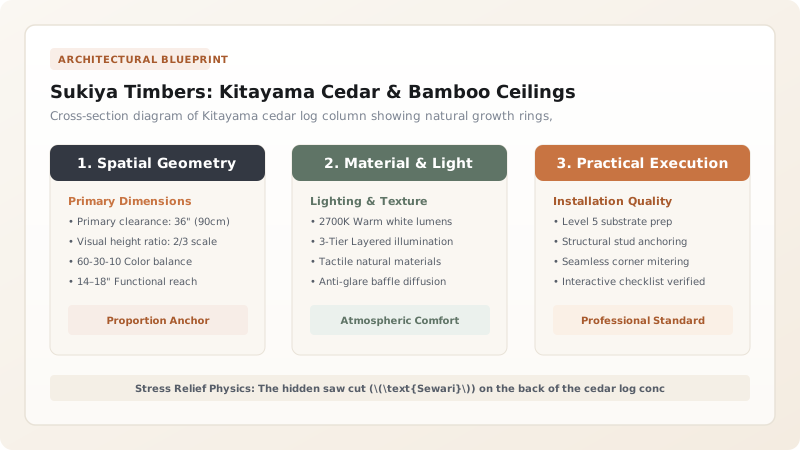
1. Timber Physics: Kitayama Cedar Selection & The Sewari Expansion Kerf
Round solid timber logs naturally develop deep longitudinal radial cracks as the outer sapwood dries faster than the dense heartwood.
Japanese master carpenters (*daiku*) prevent random cracking by cutting a Hidden Longitudinal Kerf (*Sewari*) into the backside of the column (the side facing the wall). The kerf cuts halfway to the center pith, concentrating 100% of the natural shrinkage opening on the hidden face while leaving the visible front face 100% flawless and crack-free. Learn tatami layout in tatami module grids.

2. Ceiling Engineering: Susudake Bamboo & Sugi-Kawa Bark Weaves
Sukiya ceilings (*tenjo*) are deliberately asymmetrical, divided into a low flat guest canopy and an open sloped bamboo rafter section (*kesho-yane-ura*).
Rafters feature Smoked Bamboo (*Susudake*) secured with Black Hemp Twine (*Kuro-nawa*) over Woven Cedar Bark (*Sugi-kawa Ajiro*) panels. Review shoji detailing in shoji screens and tokonoma alcoves and explore Sukiya tea house hub.
Sukiya-Zukuri Wood Materials Specifications
Use this reference table to calculate exact physical dimensions, ratios, and specifications before purchasing:
| Wood Element | Species / Material | Surface Finish | Application in Tea Room |
|---|---|---|---|
| Main Corner Columns (Optimal) | Kitayama Cedar (Kitayama-sugi) | Peeled Natural Silk Sheen (*Migaki*) | Structural Posts with Sewari Kerf |
| Tokonoma Corner Pillar | Kobushi Magnolia / Aged Bog Oak | Natural Bark (*Shibokawa*) | Asymmetrical Tokonoma Focal Pillar |
| Ceiling Rafters & Lattices | Smoked Antique Bamboo (Susudake) | Natural Smoked Caramel Brown | Sloped Exposed Ceiling Rafters |
| Ceiling Canopy Infill Panels | Japanese Cedar Bark (Sugi-kawa) | Herringbone Woven (*Ajiro*) | Low Guest Seating Ceiling Canopy |
Bamboo Splitting from Dry Heat Constraints
Every successful decoration project must account for physical and environmental constraints:
Fastening Bamboo Rafters with Screws Splitting Bamboo Tubes Lengthwise
Driving drywall screws into hollow bamboo causes the fibrous culm to immediately split from end to end; pre-drill oversized clearance holes using high-speed brad-point bits and lash bamboo joints using traditional oiled black hemp cord (*kuro-nawa*) tied with square clove hitches.
How to Prepare Kitayama Cedar Columns and Build Bamboo Ceilings
Execute this professional sequence to achieve flawless results without backtracking:
Inspect Cedar Log for Natural Curvature and Grain Alignment
Examine log; choose the most expressive side for the front display face facing the tea room interior.
Cut Longitudinal Sewari Stress Kerf Down Backside
Make continuous straight saw cut 1/3 into core down full length of hidden rear face using circular saw.
Drive Wooden Wedges into Sewari Kerf During Curing
Insert small hardwood wedges in the kerf to relieve internal drying stresses as moisture drops to 12% MC.
Hand-Plane Visible Pole Faces with Curved Kanna Plane
Use Japanese curved-sole hand plane to burnish wood fibers to a natural silky shine (zero chemical lacquer).
Weave Cedar Bark Strips into Herringbone Ajiro Ceiling
Weave thin strips of saturated cedar bark into diamond or herringbone patterns over plywood backing.
Install Susudake Smoked Bamboo Rafters on 6" Centers
Lay smoked bamboo rafters across ceiling joists; lash intersecting points with black hemp cord (*kuro-nawa*).
Common Mistakes & Countermeasures
Avoid these costly errors that compromise aesthetics, ergonomics, and budget:
Applying High-Gloss Polyurethane Varnish to Cedar Poles
Project Execution Checklist
Track your physical progress. Checkboxes persist automatically on this device:
Frequently Asked Questions
What makes Kitayama cedar maruta poles unique?
Grown in Kyoto for over 600 years, Kitayama cedar trees are pruned by hand to remove side branches, creating perfectly straight, knot-free trunks. Some varieties are tied with wooden splints to produce distinct natural vertical surface ripples (*shibokawa*).


