
Massive zelkova (Keyaki) and red pine (Akamatsu) bentwood beams (ushibari) are organic structural members chosen for their natural upward curvature, functioning as natural compression arches that carry extreme snow loads across 8 to 12-meter clear spans. Dressed with the traditional Japanese adze (chona) to create rhythmic scalloped surface textures (naguri), they are joined with mortise-and-tenon lap joints secured with hardwood wedges, eliminating straight-grain tension weaknesses.
At a Glance: Key Takeaways
- Organic Arch Camber: Utilizing natural mountain slope tree curvature to create structural arching resistance against downward bending moments.
- Traditional Chona Dressing: Carving rhythmic, scalloped wave facets (naguri finish) that compress surface wood fibers and hide seasonal shrinkage cracks.
- Keyaki & Akamatsu Superiority: Zelkova serrata (density 0.68 g/cm³, MOR 120 MPa) and Pinus densiflora offering exceptional flexural toughness.
- Wedge-Locked Lap Splices: Kanawa-tsugi and okake-tsugi timber scarf joints locking curved sections without weakening beam cross-sections.
- Grain Integrity: Zero cross-grain saw cutting, preserving 100% of continuous longitudinal wood fibers throughout the curved span.
1. Forest Selection & Organic Grain Mechanics
Unlike Western heavy timber framing which mills logs into straight rectangular chords, Japanese carpenters practice Ki no Mikata (The Way of Reading the Tree):
When straight timber is sawn from curved logs, the saw blade severs diagonal wood fibers (slope of grain defect), severely reducing allowable flexural strength. By utilizing the Entire Intact Organic Log:
- Reaction Wood Strength: Trees growing on steep mountain ridges or exposed windswept slopes develop dense compression wood (on the underside of conifers) or tension wood (on the upper side of hardwoods). This wood possesses up to 30% higher fiber toughness than valley-grown trees.
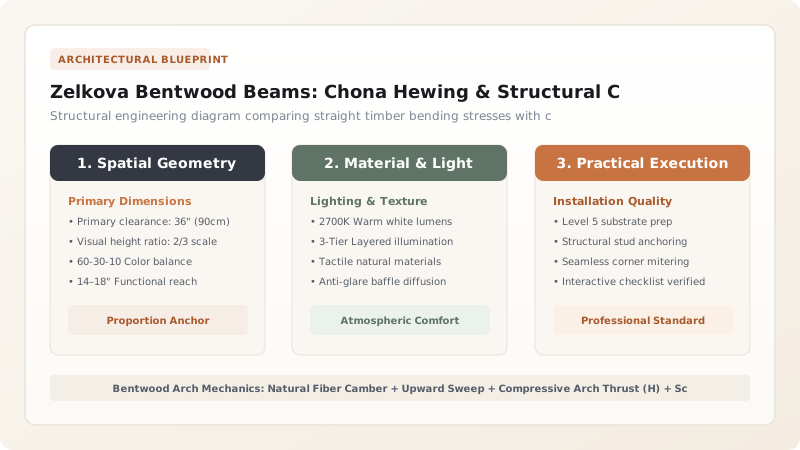
- Arch Thrust Physics: When placed with the natural camber arching upward, snow weight pushing down on the center is partially converted into horizontal thrust directed into the outer timber columns. The effective bending moment is reduced by \(\Delta M = H \cdot y\), allowing slender logs to support monumental winter snow depths.
- Species Hierarchy: Keyaki (Zelkova serrata) is favored for primary interior tie beams due to its spectacular golden-brown feather grain and extreme shear strength (\(\tau_{\parallel} \ge 12.5\text{ MPa}\)). Akamatsu (Japanese red pine) is preferred for long-span curved roof beams due to its resinous elasticity. Explore overall minka engineering in our minka architecture hub.

2. The Chona Adze: Ergonomics, Blade Geometry & Naguri Facets
Dressing large timber members without power planers relies on the master carpenter's mastery of the Chona (釿, Hand Adze):
- Anatomy of the Tool: The chona features a heavy, hand-forged laminated carbon steel blade (100mm to 130mm wide) with a curved cutting sweep. It is set into an elbow-curved natural hardwood handle (typically bent white oak or evergreen witch-hazel) at an acute angle of 70° to 75°.
- The Standing Hewing Posture: The carpenter stands straddling the log, swinging the adze rhythmically downward between their feet with sweeping pendulum arcs. The curved blade bites 2mm to 4mm into the wood, scooping out a clean wood chip with every strike.
- Naguri Finishing: The resulting finish—known as naguri—consists of thousands of uniform, scalloped concave facets. Beyond its exquisite visual texture, the compressive slicing action of the razor-sharp chisel blade seals the wood pores, reducing moisture absorption and preventing surface splintering over centuries. Learn column connection details in Daikokubashira load distribution.
3. Joinery of Curved Members: Shiguchi & Kanawa-Tsugi Splices
Connecting two curved, organic logs with non-parallel surfaces requires advanced three-dimensional layout (sumitsuke):
- Sumisashi Bamboo Pen & Water-Leveling: Artisans establish a horizontal datum plane around the curved log using water levels and indigo ink snapped stringlines (sumitsubo). Joinery tenons are cut referenced to the imaginary internal centerline of the log, not its irregular outer bark.
- Kanawa-Tsugi (Pinned Scarf Splice): When spanning across multiple bays, two curved beams are spliced over a supporting column using a double-keyed, blind lap scarf joint. The joint is locked from the side with a hardwood key (sen). It resists bending, tension, and compression simultaneously.
- Saddle Notching Over Pillars: Where the curved beam crosses the top of a vertical pillar, the underside is hollowed in a delicate saddle notch (hige-kiri). Hardwood oak dowels or blind tenons prevent lateral sliding while allowing minor rotational flexure during seismic shocks. Review hearth smoke effects in irori hearth smoke conservation.
Bentwood Timber Species & Chona Dressing Matrix
Use this reference table to calculate exact physical dimensions, ratios, and specifications before purchasing:
| Wood Species | Typical Log Diameter | Natural Curvature Span | Modulus of Rupture (MOR) | Drying Shrinkage (Rad/Tang) | Primary Structural Role |
|---|---|---|---|---|---|
| Keyaki (Zelkova serrata) | 450 - 700 mm | 4 - 8 meters | 115 - 130 MPa | 4.8% / 8.8% | Primary Tie Beams & Central King Posts |
| Akamatsu (Japanese Red Pine) | 400 - 650 mm | 8 - 14 meters | 85 - 105 MPa | 3.6% / 7.6% | Long-Span Curved Ridge & Purlin Beams |
| Kuri (Japanese Chestnut) | 300 - 500 mm | 3 - 6 meters | 75 - 90 MPa | 3.8% / 8.0% | Ground Sills (Dodai) & Water-Exposed Beams |
| Sugi (Japanese Cedar) | 350 - 550 mm | 6 - 10 meters | 60 - 75 MPa | 2.8% / 6.2% | Attic Tie Rods & Secondary Rafter Trusses |
Zelkova Bentwood & Chona Hewing Constraints
Every successful decoration project must account for physical and environmental constraints:
Slow Drying Delays
Solid logs with 500mm diameters take 3 to 6 years to air-season down to 18% equilibrium moisture content; rapid kiln drying causes catastrophic heart checks.
Adze Injury Hazards
The chona swings directly toward the artisan's feet; master carpenters wear split-toe steel-reinforced tabi boots and undergo years of rhythm training.
Non-Standard Layout Math
Standard rectilinear framing squares fail on curved timber; carpenters use flexible bamboo dividers and ink scribes (sumitsuke) referenced to central axes.
Heavy Lifting in Confined Attics
Massive 600kg zelkova beams must be raised into high attic bays using traditional timber gin-poles, block-and-tackles, and hemp rigging lines.
Bentwood Log Sourcing, Chona Dressing & Joinery Sequence
Execute this professional sequence to achieve flawless results without backtracking:
Forest Mountain Cruise
Identify naturally curved mature zelkova or red pine trees on north-facing mountain slopes, marking harvest direction to retain natural camber.
Winter Felling & Bark Stripping
Fell trees in deep winter when sap is dormant. Strip outer bark with a drawknife while fresh, exposing the smooth undulating cambium layer.
Slow Air-Seasoning
Coat log ends with natural wax or paraffin to prevent end-checking. Store on slatted timber bolsters in shaded drying sheds for a minimum of 24 months.
Centerline Ink Snapping
Snap axial reference stringlines (sumitsubo) along the log using indigo ink, establishing the internal mathematical reference plane.
Artisanal Chona Hewing
Stand atop the log and systematically hew the top and sides with the curved chona adze, producing uniform 50mm wide scalloped naguri facets.
Joinery Mortise & Tenon Cutting
Cut Kanawa-tsugi lap splices and saddle notches using Japanese pull saws (ryoba) and heavy timber slicers (ootsuki), checking fit with dry shims.
Beam Hoisting & Hardwood Wedging
Hoist the curved beam onto supporting pillars using rope rigging; drive tapered white oak wedges (kusabi) to lock joinery permanently.
Common Mistakes & Countermeasures
Avoid these costly errors that compromise aesthetics, ergonomics, and budget:
Placing curved bentwood beams with the arch facing downward (inverted camber)
Sawing curved logs flat on commercial sawmill carriages
Using green, unseasoned zelkova timber for joinery cuts
Project Execution Checklist
Track your physical progress. Checkboxes persist automatically on this device:
Frequently Asked Questions
What is the purpose of the scalloped texture left by the chona adze?
Beyond its celebrated organic beauty (naguri finish), the curved blade of the chona severs and burnishes wood cell ends simultaneously. This compresses the surface fibers, making the wood significantly more resistant to insect tunneling, water penetration, and splintering.
How do carpenters ensure two wildly curved logs fit together tightly?
They use hikawari (scribing). One log is positioned above the other, and a specialized double-pointed bamboo scriber transfers every bump, dip, and twist from the lower log directly onto the upper timber, which is then hollowed to create a glove-like coped joint.
Why is Keyaki (Japanese Zelkova) considered the king of minka timber?
Keyaki combines enormous density (0.68 g/cm³), exceptional bending strength, natural rot resistance, and striking wild grain patterns. It polishes to a lustrous deep golden-bronze hue when oiled, making it the premier choice for visible structural beams.


