
The Irori is a traditional Japanese square sunken hearth set flush into the wooden living floor, lined with clay and filled with sifted wood ash. Lacking an enclosed flue or chimney, its rising charcoal and hardwood smoke ascends freely into the attic, depositing natural wood vinegar (pyroligneous acid) and fine carbon soot across bamboo lattices and kaya reed thatch. This smoke curation sterilizes the organic roof fibers against wood-boring insects, mold, and rot, doubling roof longevity to 40-50 years.
At a Glance: Key Takeaways
- Ash Bed Thermodynamics: Deep bed of sifted white hardwood ash insulating the wooden floor frame while storing radiant heat from charcoal embers.
- Pyroligneous Acid Curation: Natural wood vinegar in hardwood smoke acting as an antifungal, antimicrobial, and insecticidal preservative for thatch.
- Smoked Susudake Bamboo: Ceiling lattices cured to a lustrous, insect-proof reddish-brown obsidian finish (susudake) prized for tea ceremony instruments.
- Jizai-kagi Counterbalance: Adjustable hanging pot hook incorporating an oak friction lever (often carved as a carp fish, a water spirit protecting against fire).
- Passive Smoke Gable Louvers: Triangular open-timber gable peak vents (kemuri-dashi) exhausting excess smoke while drawing fresh combustion air from the earthen doma.
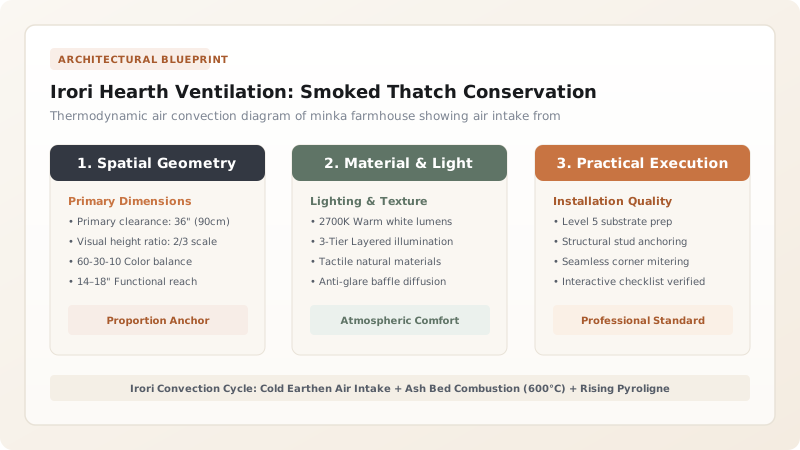
1. Irori Anatomy: The Sunken Firebox & Ash Thermodynamics
Positioned at the social and functional center of the minka's elevated floorboards, the Irori (囲炉裏) is an ancient thermal engine:
Unlike Western raised fireplaces that lose up to 80% of their heat up a masonry chimney, an irori radiates 100% of its thermal energy into the living envelope:
- The Firebox Well (Hitsu): A square cavity (typically 900mm to 1,200mm square and 350mm to 450mm deep) constructed of heavy timber boards (often rot-resistant chestnut) lined internally with refractory clay or beaten copper sheeting.
- The Wood Ash Bed (Hai): The cavity is filled with 150mm to 200mm of fine, powdery wood ash (typically sifted ash from burned rice hulls or white oak). The porous ash has exceptionally low thermal conductivity (\(k \approx 0.08\text{ W/m}\cdot\text{K}\)), insulating the surrounding wooden floorboards from fire hazards while holding buried charcoal embers alive for up to 16 hours.
- The Gotoku Trivet: A heavy three-legged cast iron trivet set in the center of the ash bed supports cooking pots, while charcoal blocks (binchotan or mountain oak sumi) are arranged radially around it. Discover full minka framing in our minka architecture hub.

2. Biochemical Smoke Curation: Pyroligneous Acid & Kayabuki Thatch
The absence of a chimney is not an architectural oversight; it is a vital Material Preservation Technology:
- Chemical Composition of Smoke: Burning seasoned mountain hardwoods (oak, beech, chestnut) produces smoke rich in Pyroligneous Acid (Wood Vinegar), Phenolic Compounds, and Carbon Soot.
- Biocidal Sterilization: As this warm smoke rises through the attic space, it permeates the thick layers of dried kaya (Miscanthus reed thatch) and braided straw ropes (wara-nawa):
$$\text{Microbial Growth Rate } \mu = 0 \quad \text{when pH} < 3.5 \text{ and Phenol Deposition} > 15\text{ mg/m}^2$$The acidic, antiseptic coating prevents colonization by wood-boring deathwatch beetles, termites, and fungal decay. It also repels rodents and dries out moisture that wicks in from seasonal driving rains.
- Susudake (Smoked Bamboo): Bamboo ceiling lattices (tenjou) exposed to irori smoke for over a century transform into susudake (soot bamboo)—a rich, glossy mahogany-to-ebony material that will never rot or be attacked by insects. Susudake from dismantled minka is so rare and structurally stable that it sells for thousands of dollars per culm for traditional tea scoops and flutes. Learn bentwood beam techniques in zelkova bentwood roof beams.
3. Thermal Stack Convection & Gable Smoke Exhausts
Living with an open hearth requires precise passive aerodynamics to keep ground-level air breathable:
- The Thermal Stratification Buffer: The warm smoke ascends rapidly toward the high ceiling due to thermal buoyancy (stack effect). As long as drafts are controlled, a stable boundary forms at roughly 2.0 to 2.2 meters above the floor: the living zone below remains clear, while the attic canopy above is engulfed in preservative smoke.
- Kemuri-Dashi (Smoke Outlets): In the steep triangular gable peaks of gassho-zukuri farmhouses, small slatted wooden louvers or hood dormers (kemuri-dashi) allow excess smoke to dissipate slowly into the outdoor atmosphere without creating downdrafts.
- Earthen Doma Air Makeup: Fresh combustion air is drawn into the house through the unsealed gaps of the sliding wooden storm shutters (amado) and the low earthen entrance hall (doma), establishing a continuous, gentle laminar draft that feeds the fire without creating turbulent room vortexes. Study the central column in Daikokubashira load distribution.
Irori Fuel, Thatch Interaction & Preservation Matrix
Use this reference table to calculate exact physical dimensions, ratios, and specifications before purchasing:
| Fuel Type | Combustion Temp | Smoke Phenol Content | Thatch Impact | Indoor Air Quality | Preservation Efficacy |
|---|---|---|---|---|---|
| Seasoned White Oak (Kunugi / Nara) | 700 - 850°C | Very High (Optimal acids) | Excellent chemical tanning | Clean aromatic smoke; low soot | Maximum (40-50 yr thatch life) |
| Hardwood Charcoal (Binchotan) | 900 - 1,100°C | Low (Smokeless combustion) | Radiant heat only; no smoke | Pure CO2/heat; zero odor | Thermal drying only (No biocide) |
| Resinous Softwood (Pine / Cedar) | 500 - 650°C | High Creosote & Tar | Sticky black soot accumulation | Heavy irritating eye sting | Moderate (Creosote fire hazard) |
| Rice Straw & Agricultural Waste | 400 - 550°C | Low Phenol / High Ash | Dusty residue; poor penetration | Dense choking particulate | Poor (Rapid thatch mold risk) |
Irori Hearth & Ventilation Constraints
Every successful decoration project must account for physical and environmental constraints:
Carbon Monoxide Accumulation
Modern airtight window glazing traps deadly carbon monoxide gas; traditional minka relied on loose sliding screens (shoji/fusuma) for natural air exchange.
Combustible Attic Creosote
Decades of resinous wood burning coat upper timbers in flammable soot; sparks flying upward from poorly tended fires can ignite dry thatch instantly.
Ember Tending Vigilance
Traditional households maintained an unwritten rule: the irori fire was never left burning unattended at night; embers were deeply buried under cold ash before retiring.
Lack of Thatchers for Maintenance
When historic minka are converted into modern museums and irori fires are banned for municipal fire codes, the thatched roofs rot within 8-12 years.
Irori Construction, Ash Bedding & Smoke Curation Protocol
Execute this professional sequence to achieve flawless results without backtracking:
Floor Opening Framing
Frame a 1,000 x 1,000mm opening in the timber floor joists, reinforcing perimeter headers with heavy chestnut beams.
Firebox Cavity Construction
Build a 400mm deep box of rot-resistant timber, lining the floor and sidewalls with refractory fireclay mortar or 1.5mm beaten copper plate.
Ash Sifting & Bedding
Sift dry white hardwood ash through a 2mm wire mesh. Fill the firebox with 200mm of clean, fluffy ash, leveling with an ash spatula (hai-narashi).
Trivet & Pot Hook Mounting
Anchor the cast iron gotoku trivet in the center of the ash bed. Secure the bamboo jizai-kagi pot hook to a main roof purlin directly overhead.
Initial Low-Fire Curing
Ignite small sticks of seasoned white oak in the center of the gotoku, burning gently for 4 hours to drive moisture out of the surrounding wood box.
Charcoal Bed Management
Add seasoned binchotan or oak charcoal blocks. Form the embers into a cone and bank with ash to calibrate heat release.
Attic Smoke Verification
Inspect upper roof framing to verify smoke rises smoothly through the bamboo ceiling lattice and exhausts gently through the gable kemuri-dashi louvers.
Common Mistakes & Countermeasures
Avoid these costly errors that compromise aesthetics, ergonomics, and budget:
Burning damp, green pine firewood in an open indoor irori
Sealing building air gaps with modern weatherstripping around an active irori
Retrofitting a modern metal chimney pipe directly over the irori
Project Execution Checklist
Track your physical progress. Checkboxes persist automatically on this device:
Frequently Asked Questions
Why is the jizai-kagi pot hook counterweight carved in the shape of a fish?
The fish represents a water creature. Because it lives in water and never closes its eyes (even when asleep), it symbolizes eternal vigilance against fire. The fish serves as both a functional friction lock and a spiritual water talisman protecting the wooden house from burning.
How did minka occupants survive winter cold with open attic smoke vents?
The massive thickness of the kayabuki thatch roof (400-600mm) possesses immense thermal insulating value (R-value ~ R-30). Warm air rising from the irori forms a permanent warm air cushion in the attic, acting as a thermal blanket over the living quarters.
What is white ash (shiro-hai) and how is it prepared?
White ash is created by burning clean hardwood or rice hulls and washing/sifting the residue repeatedly to remove unburned carbon charcoal flecks. The resulting powdery grey-white ash is velvety smooth, odor-free, and ideal for sculpting aesthetic ash patterns (hai-kata) during tea gatherings.


