
Engineer indoor lap pool HVAC systems by maintaining room air temperature 2°F warmer than water temperature (e.g., 84°F air vs 82°F water) to suppress water evaporation. Install a dedicated natatorium dehumidifier (such as Desert Aire or Dectron) maintaining 50%–60% relative humidity, wash all exterior windows with continuous linear slot supply air curtains, and operate the space under negative air pressure.
At a Glance: Key Takeaways
- The 2°F Golden HVAC Rule: Air Temp = Water Temp + 2°F (84°F Air / 82°F Water) drastically lowers latent evaporation load by 40%.
- 50% to 60% Relative Humidity Target: Below 50% increases bather chill and evaporation; above 60% breeds structural mold and window condensation.
- Negative Room Pressure (-0.05" WC): Prevents corrosive chlorine odor and moisture from migrating into adjoining living rooms.
- Window Air Curtain Slot Diffusers: Blows warm, dry air downward across glass surfaces, keeping surface temperature above dew point.
- Low-Level Chloramine Exhaust: Heavier-than-air trichloramines settle on water surfaces; low-level exhaust grilles extract fumes directly.
In-Depth Guides in this Directory
Explore specialized subtopic blueprints, technical dimensions, and execution checklists:
Pool Psychrometrics: Air/Water Ratios & Evaporation Math
Master indoor pool psychrometric engineering: ASHRAE evaporation equations, latent moisture loads (lbs/hr), Air = Water + 2°F setpoints, and relative humidity (50%–60% RH).
Pool Envelopes: Vapor Barriers & Window Air Curtains
Master indoor pool building envelope engineering: continuous Class I 6-mil poly vapor barriers (<0.1 perms), linear slot diffuser window air curtains (500 FPM), and condensation prevention.
Chloramine HVAC: Negative Pressure (-0.05" WC) & Exhaust
Master natatorium air quality & pressure balancing: maintaining -0.05" WC negative room pressure, low-level deck chloramine exhaust grilles, and preventing chlorine migration.
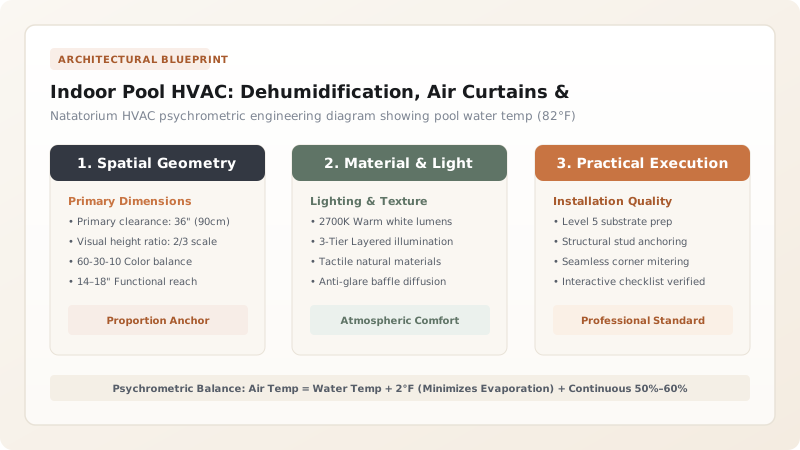
1. Psychrometric Physics: The 2°F Evaporation Suppression Rule
An uncovered 10ft × 40ft indoor lap pool can evaporate over 50 gallons of water per day if the mechanical HVAC is misconfigured, causing structural wood rot and peeling drywall.
Evaporation rate is governed by vapor pressure differential. By maintaining the Room Air Temperature at \(2^{\circ}\text{F}\) Above Water Temperature (\(84^{\circ}\text{F}\text{ Air vs } 82^{\circ}\text{F}\text{ Water}\)), the vapor pressure boundary layer stabilizes, slashing daily evaporation by 40%. Master psychrometric math in evaporation math and temperature ratios and coordinate with steam shower architecture.

2. Continuous Vapor Retarder Envelopes & Negative Air Pressure
Pool chemicals contain corrosive volatile chlorides that destroy electrical outlets and metal fasteners in neighboring rooms.
Wrap the room in a continuous 6-mil poly vapor barrier envelope with window air curtains and balance HVAC with negative pressure ventilation and low-level chloramine exhaust.
Natatorium Dehumidification Technologies Comparison
Use this reference table to calculate exact physical dimensions, ratios, and specifications before purchasing:
| Dehumidification System | Moisture Extraction Efficiency | Pool Water Heat Recovery | Adjoining Room Protection |
|---|---|---|---|
| Dedicated Natatorium Dehumidifier with Heat Recovery (Optimal) | Extracts 50–200 lbs moisture/hr | 100% Recovers latent heat to warm pool water | 100% Negative pressure isolation |
| Commercial 100% Outdoor Air System | High winter efficiency / Poor in humid summer | Zero heat recovery (High energy bills) | Moderate |
| Standard Residential AC Unit (Avoid) | FAILS: Freezes coils at 84°F air temp | Zero (Wastes heat outside) | FAILS: Corrodes copper coils in 6 months |
| Bathroom Exhaust Fan Only (Avoid) | FAILS: Inadequate CFM capacity | Zero | FAILS: Catastrophic structural rot |
Chlorine Corrosion HVAC Coil Constraints
Every successful decoration project must account for physical and environmental constraints:
Chloramine Air Corroding Standard Copper HVAC Evaporator Coils Causing Refrigerant Leaks
Airborne chlorine gas rapidly eats standard copper/aluminum AC coils within 12 months; strictly specify custom natatorium equipment with ElectroFin e-coated epoxy-dipped coils, stainless steel cabinetry, and PVC-jacketed ductwork.
How to Design and Commission an Indoor Lap Pool HVAC System
Execute this professional sequence to achieve flawless results without backtracking:
Calculate Pool Surface Area and Latent Evaporation Load
Determine pool surface area (e.g., 10ft × 40ft = 400 sq ft); calculate evaporation load (lbs of moisture/hr) using ASHRAE Chapter 5 formulas.
Size Dedicated Natatorium Dehumidifier Unit
Specify dehumidifier unit rated for 120% of peak evaporation load (including bather activity factors).
Wrap Room Envelope with 6-Mil Continuous Vapor Barrier
Install 6-mil poly on all walls and ceiling, taping all penetrations with acoustic vapor sealant.
Install Linear Slot Diffusers Over All Exterior Windows
Position supply slot diffusers 4" from glass, throwing warm dry air at 500 FPM downward to cover 100% of glass surface.
Plumb Low-Level Chloramine Exhaust Grilles
Locate exhaust return grilles 12" above pool water deck to capture heavy chloramine gas layer.
Calibrate Negative Air Pressure (-0.05" WC)
Set exhaust air volume 10% higher than supply air volume; verify negative pressure with magnehelic differential gauge.
Common Mistakes & Countermeasures
Avoid these costly errors that compromise aesthetics, ergonomics, and budget:
Blowing Supply Air Directly Across the Pool Water Surface
Project Execution Checklist
Track your physical progress. Checkboxes persist automatically on this device:
Frequently Asked Questions
Why does an indoor pool room smell strongly of chlorine?
Strong 'chlorine smell' is not chlorine, but volatile chloramines (trichloramines) formed when chlorine reacts with sweat and ammonia. A properly designed natatorium HVAC with low-level deck exhaust and UV-C water treatment eliminates 100% of chloramine odors.


