
Calculate indoor pool evaporation using the ASHRAE Chapter 5 formula: \(W_p = \frac{A}{Y} \times (P_w - P_a) \times (0.10 + 0.078V)\). Minimize evaporation load by keeping room air temperature 2°F above pool water temperature (e.g., 84°F air for 82°F lap pool water) and maintaining 50% to 60% relative humidity.
At a Glance: Key Takeaways
- ASHRAE Evaporation Equation: Calculates exact pounds of water evaporated per hour (\(\text{lbs/hr}\)) based on surface area, bather activity, and vapor pressure.
- The Vapor Pressure Delta (\(P_w - P_a\)): When air is warmer than water, saturation vapor pressure differential drops, suppressing evaporation.
- Water Temperature Standards: 78°F–82°F for fitness lap pools; 84°F–86°F for leisure pools; 102°F–104°F for hot tubs/spas.
- Activity Factor Multipliers: Residential lap swimming (\(F_a = 0.65\)) vs Commercial water aerobics / wave pools (\(F_a = 1.50\)).
- Latent Heat Re-Capture: Dehumidifiers extract heat from condensing water vapor and return it directly to the pool water via titanium heat exchangers.
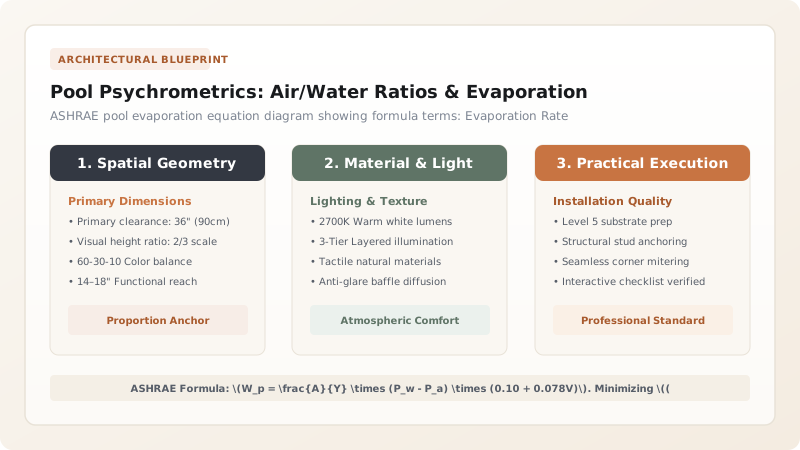
1. Mathematical Engineering: The ASHRAE Evaporation Formula
To properly size a mechanical dehumidifier, HVAC engineers apply the ASHRAE HVAC Applications (Chapter 5) Evaporation Equation:
$$W_p = 0.10 \times A \times (P_w - P_a) \times F_a$$
Where:
- \(W_p\) = Evaporation rate (lbs of water / hour)
- \(A\) = Pool water surface area (sq ft)
- \(P_w\) = Saturation vapor pressure at water surface temperature (in. Hg)
- \(P_a\) = Partial vapor pressure at room air dew point (in. Hg)
- \(F_a\) = Activity factor (0.5 for calm water, 0.65 for lap swimming, 1.0 for public pool)
When air is colder than water, \(P_w - P_a\) spikes, creating runaway evaporation. Learn envelope design in vapor barrier envelopes and window air curtains.

2. 50%–60% RH Boundaries & Titanium Heat Exchanger Recovery
Maintaining relative humidity between 50% and 60% RH provides the optimal balance: it prevents mold growth while avoiding bather evaporative chilling.
Modern dehumidifiers use Titanium Coaxial Heat Exchangers to pump the captured latent heat back into the pool water. Review ventilation balancing in negative pressure ventilation and explore indoor pool HVAC hub.
Air vs Water Temperature Setpoints vs Evaporation Load
Use this reference table to calculate exact physical dimensions, ratios, and specifications before purchasing:
| Pool Water Temp | Room Air Temp | Relative Humidity | Evaporation Load (400 sq ft pool) |
|---|---|---|---|
| 82°F Lap Pool (Optimal) | 84°F (+2°F Warmer) | 55% RH (Balanced) | 18.5 lbs water / hour (Low load) |
| 82°F Lap Pool | 82°F (Equal) | 55% RH | 26.2 lbs water / hour (+41% increase) |
| 82°F Lap Pool (Poor) | 76°F (-6°F Cold Air) | 55% RH | 48.0 lbs water / hour (+160% spike) |
| 104°F Hot Tub Spa | 86°F (Enclosed room) | 55% RH | 38.0 lbs water / hour per 60 sq ft spa |
Summer Solar Heat Gain Air Overheating Constraints
Every successful decoration project must account for physical and environmental constraints:
Intense Summer Sun Overheating Pool Room Air Beyond 90°F Causing Bather Discomfort
Large south-facing natatorium glass walls trap solar heat, driving room air to 95°F; size the dehumidifier refrigeration system with an auxiliary outdoor air-cooled condenser to reject excess space heat outside during summer months.
How to Calculate Natatorium Moisture Load and Size Dehumidifier
Execute this professional sequence to achieve flawless results without backtracking:
Measure Pool and Spa Water Surface Areas
Calculate separate square footages for lap pool (e.g., 400 sq ft) and attached hot tub spa (e.g., 50 sq ft).
Establish Operating Water and Air Temperatures
Set lap pool water to 82°F, hot tub to 102°F, and program natatorium room air thermostat to 84°F.
Lookup Vapor Pressures from Psychrometric Table
Find \(P_w\) for 82°F water (1.10 in. Hg) and \(P_a\) for 84°F air @ 55% RH (0.65 in. Hg); \(\Delta P = 0.45\text{ in. Hg}\).
Calculate Total Evaporation Rate (lbs/hr)
Apply ASHRAE formula: \(400 \times 0.10 \times 0.45 \times 0.65 = 11.7\text{ lbs/hr}\) pool + \(8.2\text{ lbs/hr}\) spa = \(19.9\text{ lbs/hr}\).
Select Dehumidifier with 25% Safety Factor
Specify dehumidifier rated for minimum 25 lbs/hr (600 lbs/day) moisture removal at 84°F / 55% RH.
Connect Titanium Pool Water Reheat Loop
Plumb pool water circulation return through dehumidifier's titanium condenser coil to recycle heat.
Common Mistakes & Countermeasures
Avoid these costly errors that compromise aesthetics, ergonomics, and budget:
Lowering Room Air Temperature to 72°F to Feel 'Cooler'
Project Execution Checklist
Track your physical progress. Checkboxes persist automatically on this device:
Frequently Asked Questions
Should an indoor pool have an automatic motorized pool cover?
YES! An automated motorized pool cover reduces evaporation by 95% when the pool is not in use, cutting natatorium HVAC operating energy costs by over 60% annually.


