
Protect indoor pool envelopes by installing a continuous Class I vapor barrier (6-mil polyethylene, <0.1 perms) on the warm interior side of all walls and ceilings. Prevent window condensation by positioning continuous ceiling linear slot diffusers 4 inches from exterior glass, blowing warm dry supply air downward across the glass at 500 FPM.
At a Glance: Key Takeaways
- Class I Vapor Barrier Envelope (<0.1 Perms): 6-mil poly or foil-faced membrane prevents high-pressure moisture from migrating into wall studs.
- Window Air Curtain Physics: Warm air flow keeps the interior surface temperature of glass above the room air dew point (66°F).
- Linear Slot Diffuser Geometry (500 FPM Velocity): Throws a 4"–6" wide blade of air covering 100% of the glass surface from top to bottom.
- Thermally Broken Aluminum Curtain Walls: Prevents metal frame thermal bridging from conducting freezing winter cold inside.
- Acoustic Vapor Sealant Taping: All electrical box and pipe penetrations must be bedded in non-skinning butyl vapor sealant.
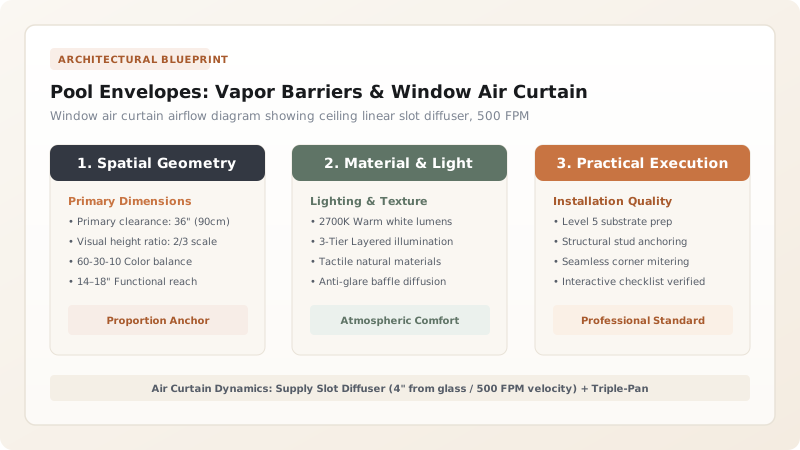
1. Building Science: Continuous Class I Vapor Barrier Envelopes
Indoor natatoriums generate extreme vapor pressure differences. In winter, warm humid pool air (\(84^{\circ}\text{F} / 60\%\text{ RH}\)) forces water vapor through standard drywall and insulation like steam through a sieve, rotting roof trusses within three years.
Architects encapsulate the entire space in a Continuous Class I Vapor Barrier (<0.10 Perms) using Heavy 6-Mil Polyethylene or Foil-Faced Polyiso Sheathing. All seams are overlapped 6 inches and sealed with non-skinning butyl mastic. Explore psychrometric math in evaporation math and temperature ratios.

2. Air Curtain Engineering: Linear Slot Diffusers & Glass Washing
Exterior glass windows are the coldest surfaces in an indoor pool pavilion. If window surface temperature drops below the \(66^{\circ}\text{F}\) Dew Point, condensation sheets down the glass, pooling on window sills.
To eliminate fogging, install Continuous Ceiling Linear Slot Diffusers mounted 4 to 6 inches from the glass. The diffusers project a \(500\text{ FPM}\) downward air curtain that washes the window in warm dry air. Review exhaust balancing in negative pressure ventilation.
Natatorium Glazing & Air Wash Systems Comparison
Use this reference table to calculate exact physical dimensions, ratios, and specifications before purchasing:
| Glazing / Air Wash Configuration | Interior Glass Surface Temp (Winter 20°F) | Condensation Risk | Aesthetic Clarity |
|---|---|---|---|
| Triple-Pane Low-E + Slot Air Curtain (Optimal) | 74°F (Far above 66°F dew point) | 0% (Completely crystal clear) | 100% Floor-to-ceiling clear view |
| Double-Pane Low-E + Slot Air Curtain | 68°F (Above dew point) | 0% (Clear under normal loads) | Clear view |
| Double-Pane Glass with NO Air Curtain (Avoid) | 58°F (Below 66°F dew point) | Severe continuous fog & dripping | FAILS: Fogged glass / Rotted sills |
| Single-Pane Glass (Avoid) | 38°F (Freezing cold) | Catastrophic ice & water pooling | FAILS: Severe structural failure |
Recessed Can Light Vapor Penetration Constraints
Every successful decoration project must account for physical and environmental constraints:
Recessed Ceiling Downlights Puncturing Vapor Barrier Allowing Steam into Attic
Standard recessed light fixtures leak warm humid air into cold roof spaces; install strictly Vapor-Proof IP65 sealed LED downlights housed inside airtight sealed drywall backer boxes wrapped in 6-mil poly and sealed with acoustic sealant.
How to Install an Indoor Pool Vapor Barrier and Window Air Curtain
Execute this professional sequence to achieve flawless results without backtracking:
Insulate Wall and Ceiling Framing to High R-Values
Install closed-cell spray foam insulation (minimum R-21 walls, R-49 ceiling) to eliminate cold exterior thermal bridges.
Hang Continuous 6-Mil Polyethylene Vapor Barrier
Wrap all walls and ceilings in 6-mil poly; overlap all sheet joints 6 inches and seal with non-hardening butyl tape.
Seal Electrical Boxes and Penetrations Airtight
Install vapor-barrier junction box boots; seal wire penetrations with expanding closed-cell polyurethane foam.
Install Continuous Linear Slot Supply Air Diffusers
Mount extruded aluminum linear slot diffusers along entire perimeter of all exterior glass walls (4" offset).
Hang Purple Moisture-Resistant / Cement Board
Fasten moisture-resistant gypsum panels; finish with mold-inhibiting elastomeric natatorium paint.
Calibrate Supply Air Velocity to 500 FPM at Glass
Adjust supply duct dampers to achieve 500 FPM downward discharge velocity, washing all glass from top to sill.
Common Mistakes & Countermeasures
Avoid these costly errors that compromise aesthetics, ergonomics, and budget:
Using Standard Paper-Faced Fiberglass Batt Insulation
Project Execution Checklist
Track your physical progress. Checkboxes persist automatically on this device:
Frequently Asked Questions
What type of paint should be used on an indoor pool ceiling?
Use specialized high-solids Epoxy or Chlorinated Rubber Natatorium Paint containing active antimicrobial mildewcides. Standard latex ceiling paint will blister and peel off within 12 months under continuous pool humidity.


