
Ironwood post-and-beam mortise joinery with rattan lashings is the ancient seismic-resistant timber framing system of Balinese bale pavilions. Utilizing hyper-dense, rot-immune Borneo ironwood (ulin) or teak (jati), structural frames are joined with precision through-mortise and tenon connections locked with removable tapered hardwood wedges (pasak). Critical structural nodes are bound with split rattan vine cordage, creating an elastic frame that dissipates earthquake shocks through friction without structural failure.
At a Glance: Key Takeaways
- Borneo Ironwood (Ulin / Eusideroxylon zwageri): Wood so dense it sinks in water (density 1,050 kg/m³), completely impervious to marine borers, rot, and termites.
- Through-Tenon with Pasak Wedge: Mortise-and-tenon connections secured with removable wooden keys, allowing seasonal dismantling or tightening.
- Split Rattan (Rotan) Cordage: Flexible vines split into 5mm ribbons, soaked in coconut oil, and wrapped tightly under tension to bind bamboo and timber joints.
- Sendi Unanchored Stone Pedestals: Timber columns rest unbolted on sculpted andesite stone bases, allowing the building to slide safely during severe tremors.
- Bale Column Configurations: Four-post (Bale Sakapat), six-post (Bale Sakenem), or eight-post (Bale Tiang Sanga) structural modules.
- Biological Shock Dampers: The combination of wooden wedges and flexible rattan acts as an organic suspension system absorbing dynamic seismic loads.
1. Material Metallurgy: The Chemistry of Borneo Ironwood (Ulin)
In the hot, humid jungle climate of the Indonesian archipelago, softwoods and ordinary temperate hardwoods rot into soil within three years. For monumental royal pavilions and temple shrines, Balinese builders specify Ulin (Borneo Ironwood):
- Extreme Density: With an air-dry density of \(1,040\text{ to }1,150\text{ kg/m}^3\), ulin is heavier than water and has a crushing strength exceeding \(75\text{ MPa}\).
- Chemical Defense: Ulin contains high concentrations of natural polyphenols and silica crystals that dull standard steel saw blades but render the wood 100% immune to subterranean termites (Coptotermes) and fungal rot for over two centuries.
2. Structural Dynamics: The Through-Tenon and Pasak Wedge
The primary joint connecting the vertical column (tiang) to horizontal ring beams (sunduk) is the through-tenon with locking pasak wedge:
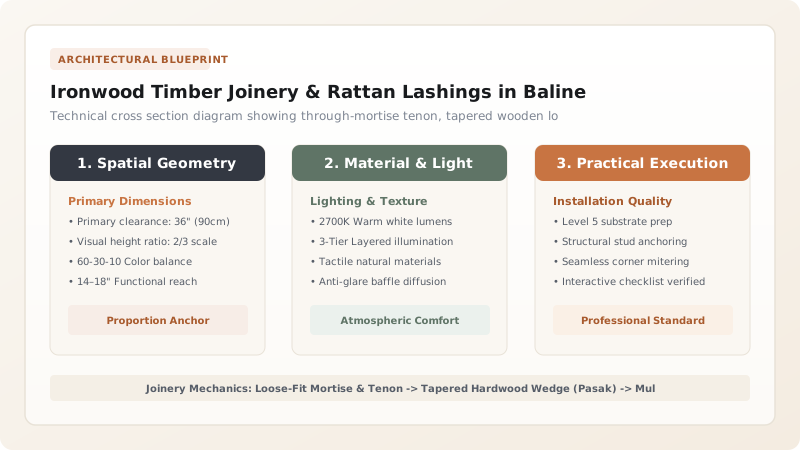
The horizontal beam passes completely through a rectangular mortise chiseled into the vertical column. A vertical slot is chiseled into the protruding tenon tip, through which a tapered hardwood wedge (pasak) is driven home with a mallet:
Because the joint is held by the friction of the wedge rather than rigid glue, it accommodates wood swelling during the monsoon season. If the joint loosens during dry spells, the village carpenter simply taps the wedge further in to re-tighten the entire pavilion.
3. The Rattan Binding: Shock Absorption and Elasticity
Where bamboo roof trusses meet timber columns, metal screws would split the hollow bamboo culm walls. The Undagi utilizes split rattan lashings:
- Strips of climbing palm vine (Calamus rotang) are split into \(4\text{ to }6\text{ mm}\) ribbons and soaked in raw coconut oil to impart permanent elasticity.
- The rattan is wrapped around the joint in complex figure-eight cross-patterns under high manual tension. As the vine dries, it shrinks by \(3\%\), clamping the joint with immense hoop stress.
- During an earthquake, the rattan bindings flex elastically, absorbing and dampening kinetic energy through internal fiber friction without breaking.
Explore black palm thatch roofing in black sugar palm fiber ijuk thatched roof waterproofing.
Tropical Architectural Joinery Comparison
Use this reference table to calculate exact physical dimensions, ratios, and specifications before purchasing:
| Fastening Technology | Tensile Flexibility | Corrosion in Salt Humidity | Seismic Kinetic Damping | Serviceability | Lifespan |
|---|---|---|---|---|---|
| Ulin Through-Tenon + Pasak + Rattan | High (Elastic Joint) | Zero (100% Organic Wood/Vine) | Supreme (Friction Damped) | High (Re-Wedgeable) | 80 to 120+ Years |
| Galvanized Steel Bolts & Plates | Zero (Rigid Metal) | Rusts & Expands in 10 Yrs | Poor (Concentrates Stress) | Moderate (Corroded Nuts Seize) | 15 to 25 Years in Tropics |
| Epoxy Glued Finger Joints | Zero (Brittle Plastic) | Zero | Poor (Snaps Under Shear) | Zero (Irreversible) | 10 to 15 Years (Delaminates) |
| Wire Rope Clamps (Modern Bamboo) | Moderate | Moderate (Requires 316 Stainless) | Good | High (Turnbuckles) | 30 to 40 Years |
Practical Constraints
Every successful decoration project must account for physical and environmental constraints:
Extreme Tool Dulling When Machining Ulin Ironwood
Due to microscopic crystalline silica embedded in ironwood tracheids, standard carbon steel hand planes and chisels lose their cutting edge within five minutes of carving. Undagi craftsmen must utilize tungsten carbide-tipped chisels or fire-hardened spring-steel blades honed frequently on lubricated diamond whetstones.
Rattan Degradation from Direct Ultraviolet Solar Radiation
While rattan lasts for decades inside shaded roof eaves, split rattan exposed to direct tropical sun and rain becomes brittle and snaps within five years. Exterior structural joints must be positioned beneath deep thatched roof overhangs, or protected by sacrificial carved wooden decorative slip-collars (cincin).
Execution Blueprint & Craftsmanship Sequence
Execute this professional sequence to achieve flawless results without backtracking:
Ulin Pillar Hewing & Mortise Chiseling
Hew ironwood logs into square columns (150mm x 150mm). Chisel rectangular through-mortises using heavy mortise chisels, ensuring sides are smooth and parallel.
Through-Tenon Beam Profiling & Pasak Slotting
Hew horizontal ring beams with extended tenons matching column mortises. Bore and chisel a tapered rectangular vertical slot through the protruding tenon tip.
Erecting Posts on Unanchored Sendi Stone Pedestals
Position carved andesite stone sendi pedestals on the raised floor plinth. Rest the four or six timber columns directly onto the pedestals without mortar or anchor bolts.
Frame Assembly & Hardwood Pasak Wedge Driving
Slide the horizontal tie-beams through the column mortises. Drive tapered ironwood pasak wedges into the tenon slots using a wooden mallet until the joints clamp rigid.
Split Rattan Soaking & Bamboo Truss Lashing
Soak split rattan ribbons in coconut oil for 24 hours. Lay bamboo roof rafters across the tie-beams. Wrap joints in multi-strand figure-eight bindings, levering taut with a wooden marlinspike.
Common Mistakes & Countermeasures
Avoid these costly errors that compromise aesthetics, ergonomics, and budget:
Using Steel Nails to Secure Rattan or Bamboo Joints
Gluing Pasak Wedges into Tenon Slots
Project Execution Checklist
Track your physical progress. Checkboxes persist automatically on this device:
Frequently Asked Questions
Can a traditional Balinese bale be disassembled and moved to a new site?
Yes. Because the entire structure is joined with removable wooden pasak wedges and unanchored to stone pedestals, a family can knock out the wedges, untie the rattan, dismantle the entire pavilion in one day, and reassemble it on a new plot without damaging any timbers.
Why is Borneo ironwood preferred over teak for the primary columns?
While teak is beautiful and termite-resistant, ironwood possesses greater structural crushing strength, denser grain, and zero shrinkage, making it ideal for the critical structural columns supporting heavy thatched roofs.


