
Black sugar-palm fiber ijuk thatched roof waterproofing is the master roofing craft reserved for sacred temples (Meru towers) and royal bale pavilions across Bali. Harvested from the dense black fiber mantle wrapping the trunk of the sugar palm (Arenga pinnata), ijuk is virtually rot-proof, naturally termite-immune, and fire-retardant. Bound into thick bundles stitched across bamboo roof battens to a depth of 150mm at a steep 45° slope, ijuk provides up to 80 years of maintenance-free waterproofing in severe tropical climates.
At a Glance: Key Takeaways
- Arenga pinnata Sugar Palm Fiber: Coarse, horsehair-like black fibers containing high natural lignin and silica, rendering them impervious to bacterial decay.
- 50 to 80 Year Tropical Lifespan: Outlasts ordinary grass thatch (alang-alang) by a factor of ten, surviving torrential monsoons without rot.
- Natural Fire Retardancy: High mineral and silica ash content in ijuk fibers resists catching fire from stray embers, unlike dry grass thatch.
- Bamboo Needle Stitching: Bundles are stitched to horizontal bamboo battens using giant bamboo needles threaded with durable split bamboo cordage.
- 150mm Compressed Thickness: A dense, impenetrable fibrous mat that deadens torrential tropical rain sounds into a gentle whisper.
- Meru Tower Roof Architecture: Clads multi-tiered pagoda roofs (up to 11 sacred tiers) in dramatic, silhouettes against tropical skies.
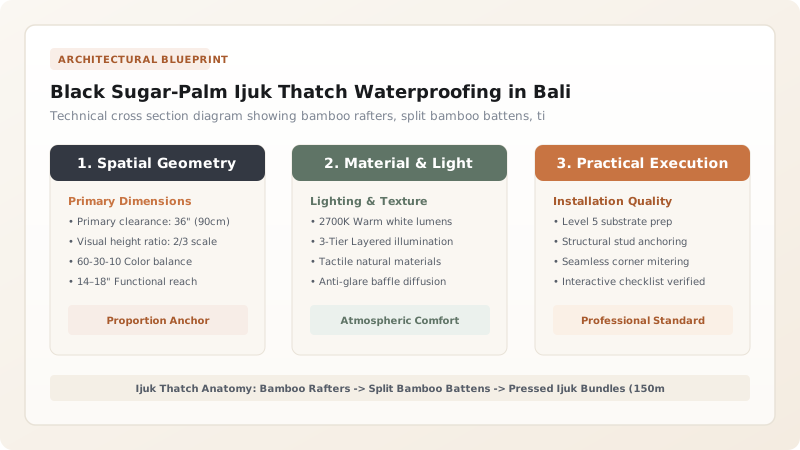
1. Botanical Metallurgy: The Indestructible Arenga Pinnata Fiber
While ordinary thatch made from cogon grass (alang-alang) or coconut fronds (kelapa) absorbs water, harbors mold, and decomposes into compost within five years, the sacred Balinese temple relies on ijuk.
Ijuk is harvested from the sugar palm (Arenga pinnata, known locally as Pohon Aren). The tree covers its trunk in a dense, tangled fibrous mantle that protects the living tree from tropical moisture and fungal rot:
- Chemical Incorruptibility: The fibers contain over \(42\%\) lignin and high concentrations of insoluble silica. It does not swell when saturated, does not rot when permanently wet, and is completely unpalatable to wood-boring insects and termites.
- Jet-Black Optical Aesthetic: The natural obsidian-black color creates an iconic visual contrast against golden carved teak and green tropical forest canopies.
2. Hydraulic Defense: Slope Dynamics and Water Shedding
Thatch roofs do not act like impervious rubber membranes; they function through capillary drainage dynamics. Water does not penetrate the full depth of the thatch—it clings to the outer slope of individual fibers and flows swiftly downward via gravity:
To ensure runoff speed exceeds water infiltration rate, Balinese thatchers mandate a minimum roof pitch of \(45^\circ\) (\(1:1\) slope\), with upper temple tiers sloping up to \(60^\circ\). At this angle, equatorial rain falling at \(100\text{ mm/hr}\) runs off the outer \(20\text{ mm}\) layer of ijuk, leaving the remaining \(130\text{ mm}\) of underlying thatch completely dry.
3. The Thatching Technique: Bundles, Needles, and Rattan Stitching
Applying ijuk requires specialized hand craftsmanship:
- Bundle Fabrication (Ijuk Pelipit): Raw fibers are combed with iron combs to remove short debris, aligned parallel, and clamped between split bamboo slats into flat, dense shingles.
- Needle Stitching: Master thatchers use \(400\text{ mm}\) long curved bamboo needles to thread split bamboo ties through the ijuk bundles, securing them tightly to the structural bamboo roof battens.
- Eave Trimming: The bottom edge of the thatch is trimmed with a razor-sharp crescent knife (blakas) to form a dense, perfectly straight \(150\text{ mm}\) thick black edge that sheds water clear of the veranda.
Review the entire bale system in Balinese bale pavilions: Sanga Mandala and bamboo joinery.
Tropical Thatching Material Performance Comparison
Use this reference table to calculate exact physical dimensions, ratios, and specifications before purchasing:
| Thatch Type | Botanical Source | Lifespan in Monsoon Tropics | Fire Resistance | Termite Immunity | Waterproofing Depth |
|---|---|---|---|---|---|
| Black Sugar-Palm Fiber (Ijuk) | Arenga pinnata Palm Trunk | 50 to 80 Years (Supreme) | Naturally Fire Retardant | 100% Immune to Insects | 150mm Compressed Layer |
| Alang-Alang Grass Thatch | Imperata cylindrica Cogon Grass | 5 to 8 Years (High Rot) | Extreme Fire Hazard | Prone to Moths & Termites | 100mm Shingle Layer |
| Nipa Palm Shingles (Atap) | Nypa fruticans Mangrove Fronds | 7 to 10 Years | Moderate Fire Risk | Vulnerable to Beetle Borer | Folded Frond Shingles |
| Ironwood Shingles (Sirap) | Eusideroxylon zwageri Shakes | 50 to 75 Years | Good Fire Resistance | High Insect Immunity | Overlap Board Layer |
Practical Constraints
Every successful decoration project must account for physical and environmental constraints:
High Scarcity and Cost of Mature Sugar Palm Ijuk
An Arenga pinnata palm must grow for 15 to 20 years before its trunk produces harvestable, high-grade long ijuk fibers. A single 7-tier temple roof requires thousands of kilograms of fiber. Due to deforestation and agricultural clearing, authentic long-staple ijuk has become expensive, prompting modern conservation programs in Bali to establish dedicated sacred palm reserves.
Debris Removal and Airway Maintenance
Falling tropical leaves, palm fronds, and fruit bat droppings can lodge in the fibrous surface of the ijuk thatch. If left uncleaned, decaying organic leaves create pockets of compost that nurture airborne weed seeds and parasitic ferns. Temple custodians must sweep the ijuk roof surfaces with bamboo brooms every dry season.
Execution Blueprint & Craftsmanship Sequence
Execute this professional sequence to achieve flawless results without backtracking:
Ijuk Fiber Harvesting & Combing
Harvest fibrous sheaths from mature Arenga pinnata palm trunks. Comb fibers with iron-toothed rakes to remove dust and separate long structural fibers from short fuzz.
Pelipit Bundle Clamping
Align long ijuk fibers parallel between two 1.2-meter long split bamboo battens. Bind the bamboo clamps tightly with rattan cordage to form rigid, flat thatching shingles.
Bamboo Roof Rafter & Batten Installation
Erect Petung bamboo rafters at a steep 45° to 50° pitch. Lash horizontal bamboo battens across the rafters at 100mm vertical spacing.
Bottom-Up Stitching with Bamboo Needles
Lay the first ijuk bundle along the eave line. Using a 400mm curved bamboo needle, stitch the bundle to the bamboo battens using split bamboo or marine cordage. Layer subsequent courses with a 75% overlap.
Ridge Capping & Crescent Knife Trimming
Cap the roof ridge with folded ijuk saddles clamped under heavy bamboo poles. Trim the bottom eave overhang with a razor-sharp blakas knife to form a clean, monolithic 150mm thick edge.
Common Mistakes & Countermeasures
Avoid these costly errors that compromise aesthetics, ergonomics, and budget:
Laying Ijuk Thatch on a Shallow Roof Pitch (Under 35 Degrees)
Using Ordinary Steel Wire to Stitch Ijuk Bundles
Project Execution Checklist
Track your physical progress. Checkboxes persist automatically on this device:
Frequently Asked Questions
Why is ijuk thatch used almost exclusively on sacred temples rather than houses?
Historically, sumptuary laws in Bali reserved the precious, long-lasting black ijuk for sacred temple Meru shrines, royal palaces, and bale kulkul drum towers, while common domestic dwellings utilized agricultural alang-alang grass thatch.
Does an ijuk roof smell or attract insects?
No. Unlike grass thatches that smell musty when damp, cured ijuk is clean and virtually odorless. Its natural silica and chemical tannin content repels spiders, beetles, and termites naturally.


