
The scratch and brown coats form the structural backbone of three-coat lime plastering. The scratch coat is a 1:2.5 mix of fat lime putty and coarse sharp sand heavily reinforced with washed horse or ox hair (4.5 to 5.5 kg/m³) to resist shrinkage tension. The brown (floating) coat is a 1:3 mix leveled across screeds to create an optically plumb plane for the setting skim.
At a Glance: Key Takeaways
- Washed Tail and Mane Hair: Degreased, sterilised animal hair (25 to 50mm length) providing multi-directional tensile shear reinforcement.
- 1:2.5 Coarse Scratch Ratio: One part matured fat lime putty to 2.5 parts coarse washed sharp sand graded from 0.5mm up to 4.0mm.
- Lath Comb Scratching: Scored with 45-degree diagonal intersecting grooves (3mm depth) to provide mechanical dovetail keys for the brown coat.
- 1:3 Floating Brown Coat: Leaner mortar ratio minimizing drying shrinkage across a uniform 8 to 10mm leveling plane.
- Wood Derby Screeding: Worked with long timber darbies and floats to eliminate hollows and establish true flat walls.
- Slow Moisture Curing: Kept damp under hessian sacking for 10–14 days per coat to ensure robust crystalline carbonation.
1. Animal Hair Reinforcement: Physics & Preparation
In historic lime renders, animal hair (historically sourced from cattle hides, horse tails, or goat fleeces) is not an incidental additive—it is a structural composite reinforcement. Pure lime putty contracts by \(5\%\text{ to }8\%\) volumetrically as gauging water evaporates during initial setting.
Without reinforcement, this tensile stress creates vertical shrinkage fractures that cause the plaster keys behind the laths to snap. High-tensile animal hair distributes stress evenly throughout the matrix:
Where \(V_f\) is the fiber volume fraction. Ox hair (shorter and crimped) forms an interlocking mesh, while horse tail hair (longer and smoother) provides exceptional bridge strength across lath gaps. The hair must be washed to remove natural oils and beaten into dry sand with wooden laths before introducing the wet lime putty to prevent clumping.
2. Scratch Coat Formulation & Diamond Key Scoring
The scratch coat (also called the pricking-up coat on lath) requires coarse, angular silica sand. The grains must range from \(0.5\text{ mm to }4.0\text{ mm}\) to provide mechanical aggregate interlock.
The mix ratio is strictly 1 part aged lime putty to 2.5 parts coarse sand, with \(5\text{ kg}\) of teased hair per cubic meter. Applied \(10\text{ mm}\) thick, it must be keyed within 2 to 4 hours using a two- or three-pronged lath scratcher.
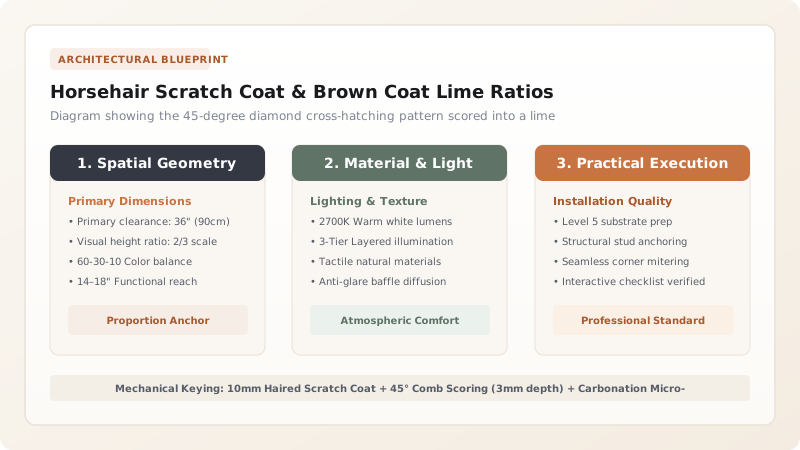
The grooves are drawn diagonally at \(45^\circ\) in both directions, forming a diamond lattice. Horizontal scoring is prohibited because dust and water collect in horizontal troughs, weakening adhesion.
3. The Brown Floating Coat: Establishing True Plumb
After the scratch coat has carbonated for 10 to 14 days, the brown coat (floating coat) is applied. This layer contains finer sand (\(0.2\text{ to }2.5\text{ mm}\)) and a leaner 1:3 ratio of lime putty to sand to minimize curing shrinkage.
Plasterers run vertical plaster grounds or screeds every 1.8 meters, filling between them and leveling with a 2-meter wooden derby. The surface is rubbed with a circular motion using a wooden float (trowel float) to bring a slurry of lime paste to the face while closing all micro-fissures.
Scratch vs. Brown Coat Batching Parameters
Use this reference table to calculate exact physical dimensions, ratios, and specifications before purchasing:
| Plaster Layer | Putty : Sand Volumetric Ratio | Aggregate Size Distribution | Hair Dosing per m³ | Target Layer Thickness |
|---|---|---|---|---|
| Scratch Coat (Pricking-Up) | 1 : 2.5 (High fat binder) | Sharp river sand 0.5–4.0 mm | 4.5 to 5.5 kg washed hair | 9 to 12 mm overall |
| Brown Coat (Floating) | 1 : 3.0 (Leaner mix) | Medium washed sand 0.2–2.5 mm | 1.0 to 1.5 kg (optional) | 8 to 10 mm overall |
| Curing Requirement | Damp hessian cover 10–14 days | Air carbonation 7–10 days | N/A | Must be firm before skimming |
| Surface Texture | 45° diamond comb grooves (3mm) | Open-grained wood-floated face | N/A | Zero high spots (> 1mm over 2m) |
| Aggregate Shape | Angular crushed silica / river grit | Sub-angular washed pit sand | N/A | Rounded beach sand prohibited (no grip) |
Mixing & Structural Constraints
Every successful decoration project must account for physical and environmental constraints:
Hair Clumping
Never toss dry hair directly into wet lime putty; the hair will ball up into dense lumps that leave soft hollow voids in the wall.
Carbonation Rate
Non-hydraulic lime cures by absorbing CO2 from the air at approximately 1mm per month; applying brown coat over green scratch coat halts carbonation.
Aggregate Cleanliness
Sand must be washed clean of loam, clay, and silt (< 1% silt content); silt coats sand grains and prevents lime crystal bonding.
Scratch & Brown Coat Execution Workflow
Execute this professional sequence to achieve flawless results without backtracking:
Hair Teasing & Sand Blending
Tease dry horsehair by hand or with wire cards and beat it thoroughly into dry sharp sand with wooden paddles until fully dispersed.
Mortar Batching & Coarse Chopping
Add aged lime putty to the haired sand and chop with a plasterer's larry or roller pan mixer until a rich, cohesive paste forms.
Scratch Coat Application
Trowel mortar firmly into pre-wetted laths to form full 10mm body and extruded keys behind.
Comb Scratching
Draw a lath comb diagonally across the green plaster in overlapping 45-degree diamond passes without gouging down to the wood.
Damp Hessian Curing
Cover walls with damp burlap sacks for 10 days, misting with clean water daily to encourage slow, deep carbonation.
Brown Coat Derby Floating
Dampen the cured scratch coat, rule on the 1:3 brown coat, and work with a wooden float in circular motions to achieve a flat, open-textured tooth.
Common Mistakes & Countermeasures
Avoid these costly errors that compromise aesthetics, ergonomics, and budget:
Applying the brown coat before the scratch coat has fully stiffened and carbonated
Scoring the scratch coat with straight horizontal lines
Using unwashed, greasy animal hair containing farm debris or animal fat
Project Execution Checklist
Track your physical progress. Checkboxes persist automatically on this device:
Frequently Asked Questions
Can polypropylene or fiberglass strands replace animal hair in heritage plaster?
While synthetic fibers provide tensile strength, they lack the microscopic surface scales of natural animal hair that physically interlock with lime crystals. Furthermore, synthetic fibers resist traditional wooden float finishes, poking out of the surface like stiff plastic whiskers.
What is the difference between sharp sand and soft building sand?
Sharp sand (concreting sand) consists of angular, jagged quartz grains (up to 4mm) that interlock mechanically. Soft building sand consists of rounded, wind-blown grains with high clay/loam content; using soft sand in base coats causes catastrophic drying shrinkage and crumbling.
How thick should the combined three coats of lime plaster be?
The combined thickness typically ranges between 19mm and 25mm (3/4 inch to 1 inch): 10mm scratch coat + 8mm brown coat + 2mm finish skim.


