
Federal style elliptical fanlights are semi-elliptical glazed transom windows positioned directly over primary entry doors. Constructed using laminated steam-bent wood jambs and glazed with hand-drawn H-channel lead came (3/16" or 4.8mm wide) holding antique mouth-blown cylinder glass, their tracery patterns feature radiating sunbursts, interlacing festoons, or delicate spiderweb arrays that flood central stair halls with natural daylight.
At a Glance: Key Takeaways
- True Mathematical Ellipse: Drawn using the trammel method or string-and-pin geometry (eccentricity \(e \approx 0.70\text{ to } 0.82\)).
- Narrow H-Channel Lead Came: Hand-drawn 4.8mm (3/16") lead profiles providing delicate sightlines impossible with wooden muntins.
- Mouth-blown Cylinder Glass: 2mm to 2.5mm restoration glass with subtle seeds and wave distortion creating historic refraction.
- Spiderweb & Sunburst Tracery: Symmetrical radial lines intersecting concentric elliptical arcs to create jewel-like optical facets.
- Concealed Brass Stiffeners: Thin high-tensile brass wires soldered to came backs to prevent long-term gravitational sagging.
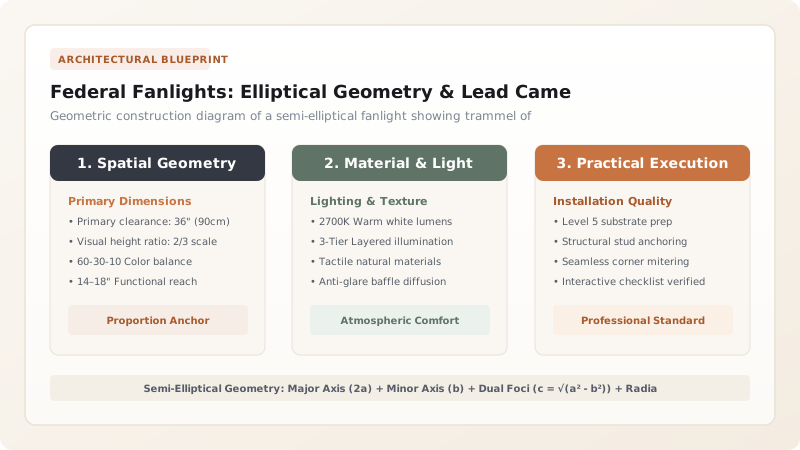
1. Mathematical Layout: Trammel Construction & Laminated Jambs
Unlike earlier Georgian semicircular fanlights, the signature hallmark of the high Federal style is the Semi-Elliptical Arch:
Where \(a\) is the semi-major horizontal radius (typically 600mm to 900mm) and \(b\) is the semi-minor vertical rise (typically 350mm to 550mm):
- The Trammel of Archimedes Layout: Rather than approximating ellipses with crude three-centered compass arcs, Federal joiners laid out true mathematical ellipses using wooden trammels or string-and-pins anchored at the two focal points \(F_1(-c, 0)\) and \(F_2(c, 0)\).
- Laminated Steam-Bent Pine Jambs: The curved outer arch frame is formed from multiple 3mm to 4mm strips of clear, rift-sawn Eastern white pine (Pinus strobus). The strips are steamed for 45 minutes in a steam chest, coated with waterproof resorcinol or urea-formaldehyde glue, and clamped around a rigid plywood elliptical bending buck until cured.
- Rebate Detailing: A continuous 12mm x 15mm glass rebate (rabbet) is routed into the interior face of the curved jamb to receive the completed leaded came panel. Discover portico design in slender Roman Ionic porticos.

2. Lead Came Fabrication, Soldering & Structural Reinforcement
Wooden muntin bars cannot bend into delicate tight ellipses without snapping. Federal artisans achieved hair-thin tracery using Hand-Drawn Lead Cames:
- Came Profile Sizing: Federal fanlights utilize slender 3/16" (4.8mm) or 1/4" (6.4mm) H-profile lead came. The lead came is stretched 2-3% on a bench vise prior to assembly to work-harden the metal, straightening twists and increasing rigidity.
- Intersecting Joint Soldering: At each junction, came ends are trimmed square with a came knife, fluxed with stearin or oleic acid, and soldered with 60/40 Tin-Lead Solder using a temperature-controlled 100W soldering iron.
- Concealed Brass Reinforcement: Over 100 years, gravity and wind pressure cause unreinforced lead panels to belly inward. Modern conservators solder 1.5mm x 6mm brass rebar wires (blind saddle bars) along the interior came channels, providing structural rigidity while remaining invisible from the exterior street view. Learn plaster detailing in Adamesque plaster friezes.
3. Cementing, Waterproofing & Mouth-Blown Cylinder Glass
A leaded glass panel is structurally weak and leaks air until it undergoes Cementing (Grouting):
- Whiting and Boiled Linseed Matrix: A specialized slurry consisting of boiled linseed oil, whiting (calcium carbonate), mineral spirits, and lampblack (carbon pigment) is scrubbed forcefully beneath the lead leaves on both sides of the panel using natural bristle brushes.
- Capillary Sealing: As the putty hardens over 30 days, it completely fills the voids between the glass and lead channel, turning the loose individual components into a rigid, weatherproof, drum-tight architectural unit.
- Restoration Glass Selection: To preserve historic authenticity, broken original panes must be replaced with mouth-blown restoration glass (such as Lamberts Restauro or Saint-Just). Modern flat float glass creates jarringly sterile reflections that betray historical authenticity. Master overall Federal proportions in our Federal architecture hub.
Federal Fanlight Lead Came & Glazing Matrix
Use this reference table to calculate exact physical dimensions, ratios, and specifications before purchasing:
| Tracery Pattern | Came Width | Glass Type | Eccentricity (e) | Wind Load Reinforcement | Historical Era |
|---|---|---|---|---|---|
| Spiderweb Geometric | 3/16" (4.8 mm) | Mouth-Blown Cylinder Glass | e = 0.72 - 0.78 | Internal brass came stiffener | High Federal (1790 - 1810) |
| Radiating Sunburst | 1/4" (6.4 mm) | Restoration Light Seeded | e = 0.65 - 0.72 | Concealed steel perimeter hoop | Early Federal (1780 - 1795) |
| Interlacing Gothic Loops | 3/16" (4.8 mm) | Antique Crown Bullseye Glass | e = 0.80 - 0.85 | Solder-tacked bronze tie wires | Late Federal / Regency (1810 - 1825) |
| Cast Lead Rosette Appliques | N/A (Cast Lead) | Opaque Lead/Pewter Pendants | N/A | Direct mechanical pinning | McIntire Salem School (1800 - 1815) |
Fanlight Fabrication & Glazing Constraints
Every successful decoration project must account for physical and environmental constraints:
Complex Glass Template Cutting
In an elliptical fanlight, every glass segment in an eccentric ring has a unique radius; each pane requires an individual cardboard pattern template.
Thermal Expansion Mismatch
Lead expands at \(\alpha = 29 \times 10^{-6}/^\circ\text{C}\) while glass expands at only \(8.5 \times 10^{-6}/^\circ\text{C}\); cement putty must retain micro-elasticity to absorb differential expansion.
Lead Toxicity During Restoration
Scraping old lead oxide dust and soldering requires HEPA-filtered downdraft extraction tables, nitrile gloves, and P100 lead-rated respirators.
Weather Barrier Condensation
High indoor humidity in winter can condense on single-glazed fanlights; installing an unvented exterior storm sash creates greenhouse temperatures that melt lead cement.
Elliptical Fanlight Fabrication, Glazing & Cementing Protocol
Execute this professional sequence to achieve flawless results without backtracking:
Full-Scale Layout (Cartoon)
Draw the exact semi-ellipse on a 3/4" plywood assembly board using a trammel of Archimedes, drafting all radial came tracery lines in black ink.
Outer Laminated Jamb Bending
Steam-bend 4 plies of 3mm Eastern white pine around the perimeter buck, clamping with polyurethane glue to form the 100mm deep curved frame.
Glass Pattern Scribing
Trace each glass segment from the cartoon onto heavy cardstock, cut templates with 1mm came allowance shears, and score mouth-blown cylinder glass.
Lead Came Assembly
Pin the outer perimeter came to the board. Work outward from the bottom center, inserting cut glass panes into 3/16" H-cames, holding parts with horseshoe nails.
Fluxing & Soldering
Apply liquid oleic acid flux to each joint. Melt a small bead of 60/40 solder over every came intersection on both the front and back of the panel.
Putty Cementing
Scrub linseed oil and whiting black cement under all came flanges using a stiff horsehair brush. Pack tightly and burnish the lead leaves down against the glass with a wood fid.
Jamb Installation & Glazing
Bed the leaded panel into the laminated wooden jamb rebate with linseed oil glazing compound, securing with brass glazing pins and cedar stops.
Common Mistakes & Countermeasures
Avoid these costly errors that compromise aesthetics, ergonomics, and budget:
Using modern zinc or rigid brass came for tight elliptical tracery curves
Omitting the waterproofing cement slurry (dry came glazing)
Installing modern float glass panes with mirror-like reflections
Project Execution Checklist
Track your physical progress. Checkboxes persist automatically on this device:
Frequently Asked Questions
Why did Federal architects prefer semi-elliptical fanlights over semicircular ones?
A semi-ellipse allows a wider entrance opening with a lower ceiling height without appearing squatted. Semicircular fanlights require a height equal to half their width, which often forced entrance headers awkwardly close to second-floor window sills.
How do you repair a bowed or sagging historic leaded fanlight?
Carefully remove the panel from the wooden frame, soak in a gentle detergent bath to dissolve dried cement, lay flat on a heated workbench under sandbags to slowly relax the lead back to flat, solder high-tensile brass rebars to the back, and re-cement.
What is the function of the cast lead ornaments on Federal fanlights?
Makers like Samuel McIntire and Asher Benjamin often soldered decorative cast lead or pewter rosettes, urns, and swags directly over came intersections. These covered structural solder joints while adding rich three-dimensional classical ornament.


