
Adamesque plaster reliefs and composition ornaments ('compo') are delicate Neoclassical bas-relief decorations used on Federal style fireplace mantels, door overdoors, and ceiling friezes. Formulated from whiting chalk, animal hide glue, boiled linseed oil, and pine rosin, compo is pressed into hand-carved reverse boxwood molds. While warm and pliable, it adheres seamlessly to curved wood surfaces, creating crisp miniature urns, bellflower garlands, and acanthus rinceaux.
At a Glance: Key Takeaways
- The Authentic Compo Recipe: Chalk whiting (70%), animal hide glue (15%), boiled linseed oil (8%), and pine rosin (7%) forming an elastic dough.
- Hand-Carved Boxwood Molds: Dense, close-grained boxwood (Buxus sempervirens) dies carved in negative intaglio relief by master moldmakers.
- Steam-Box Reactivation: Dried, stiff compo ornaments are warmed in steam chambers to restore leather-like flexibility, allowing bending around curved moldings.
- Reversible Protein Adhesion: Applied directly to wood with warm 140°F animal hide glue, forming a bond stronger than the wood fiber itself.
- Neoclassical Iconography: Classical draped urns, trailing bellflowers, wheat sheaf bundles, weeping willows, and American patriotic eagles.
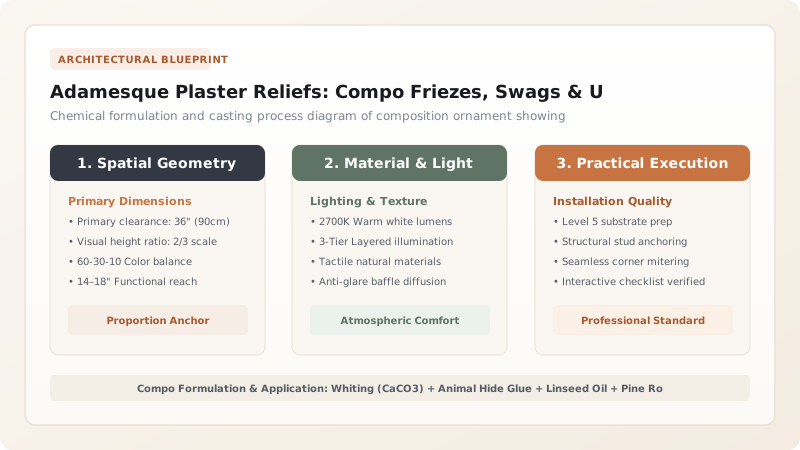
1. The Adam Revolution: Composition Ornament Chemistry
In traditional Georgian architecture, intricate decorative moldings had to be laboriously hand-carved in solid hardwood by master woodcarvers—a slow, expensive process accessible only to the wealthiest aristocracy.
Scottish architect Robert Adam patented a revolutionary alternative in the 1770s (popularized in America by craftsmen like Samuel McIntire and Robert Wellford): Composition Ornament (Compo):
- The Chemical Matrix: Compo is an ancient thermoplastic protein polymer:
$$\text{Matrix: } \underbrace{\text{Hide Glue + Linseed Oil + Pine Rosin}}_{\text{Elastic Binder (30\%)}} + \underbrace{\text{Precipitated Whiting (CaCO}_3\text{)}}_{\text{Mineral Filler (70\%)}}$$Hide glue provides structural tensile cohesion, linseed oil provides long-term flexibility, pine rosin adds water resistance, and whiting chalk provides crisp dimensional stability.
- Precision Relief: Unlike plaster of Paris (which is brittle, chalky, and shrinks), hot compo reproduces the absolute finest micro-details—hair-thin laurel leaves, individual drapery threads, and feather barbs—without chipping during demolding.
- Lightness of Tone: Adamesque decoration rejected heavy gilded Baroque scrolls in favor of slender, linear arabesques, giving Federal interiors their celebrated serene, aristocratic poise. Review entry fanlights in elliptical fanlights.

2. Boxwood Intaglio Dies & Screw Press Fabrication
The sharpness of authentic Federal compo relies entirely on the quality of the Carved Mold:
- Boxwood (Buxus sempervirens) Superiority: True Turkish or European boxwood is so dense (specific gravity \(> 0.95\)) that it displays virtually no visible annual rings. It allows the moldmaker to carve negative intaglio lines with microscopic precision that will not crush under thousands of pressing cycles.
- The Pressing Sequence: The mold cavity is lightly brushed with light mineral oil or kerosene as a release agent. A warm ball of freshly mixed compo is placed over the cavity. The mold is inserted into a heavy cast-iron fly press or screw press, applying 1.5 to 2.5 MPa of pressure to force dough into every crevice.
- Demolding & Slicing: The mold is removed from the press. The artisan uses a thin, flexible wire or drawknife to slice excess backing dough flush with the mold face, then inverts the mold and taps it gently; the leather-hard relief falls out cleanly. Learn column proportions in slender Roman Ionic porticos.
3. Application Craft: Steam Reactivation & Hide Glue Bonding
Applying and conserving historic compo requires traditional guild techniques:
- Steam-Box Plasticizing: Cast compo hardens within an hour as the hide glue gels. If an artisan needs to apply ornaments to a curved bow-front mantel or round column neck, the pieces are placed inside a wooden steam box for 3 to 5 minutes. The steam softens the glue matrix, allowing the ornament to bend around tight radii without cracking.
- Application with Warm Hide Glue: The wooden ground is lightly scored and sized with thin glue. The back of the warm compo is coated with 140°F (60°C) liquid animal hide glue (192-gram bloom strength) and pressed firmly onto the wood with a damp sponge. Small headless brass brads temporarily secure thick medallions until the glue sets.
- Conservation & Paint Stripping: Historic compo must never be subjected to caustic chemical dips, which dissolve the animal protein binder. Conservators use infrared heat lamps or dry mechanical dental picks to remove old encrusted oil paint layers, revealing razor-sharp 200-year-old detailing. Study full Federal style architecture in our Federal architecture hub.
Adamesque Composition Ornament Formulation & Application Matrix
Use this reference table to calculate exact physical dimensions, ratios, and specifications before purchasing:
| Ingredient / Step | Optimal Percentage / Spec | Function in Formulation | Critical Quality Requirement | Common Restoration Failure |
|---|---|---|---|---|
| Precipitated Whiting (CaCO3) | 68 - 72% by Weight | Incompressible mineral body | Ultra-fine particle size (< 10 microns) | Coarse particles cause chalky crumbling |
| Animal Hide Glue | 14 - 16% by Weight | High-tensile protein binder | 192-251 Bloom gram strength | Synthetic PVA glue fails to gel or hold shape |
| Boiled Linseed Oil | 7 - 9% by Weight | Plasticizer & flexibility agent | Double-boiled with manganese driers | Raw oil never cures; stays sticky |
| Pine Rosin (Colophony) | 6 - 8% by Weight | Tackifier & water barrier | Dissolved warm into linseed oil | Omission causes compo to absorb room moisture |
| Steam Reactivation Box | 100°C steam for 3-5 min | Restores leather elasticity | Gentle wet steam (no boiling immersion) | Excess steam melts glue into liquid paste |
Compo Ornament Fabrication & Conservation Constraints
Every successful decoration project must account for physical and environmental constraints:
Shelf Life of Mixed Dough
Fresh compo dough must be pressed within 30 to 45 minutes of mixing before the gelatinous hide glue matrix sets hard.
Relative Humidity Cycling
Severe winter indoor dry air (< 20% RH) in radiator-heated homes shrinks compo faster than wood, causing cracks unless whole-home humidification is maintained.
Mold Scarcity
Antique hand-carved boxwood molds from the 18th century are museum artifacts; modern reproductions rely on high-durometer polyurethane rubber castings.
Non-Reversible Modern Adhesives
Applying compo with modern construction adhesive or polyurethane glue ruins historic wood mantels, preventing future reversible conservation.
Adamesque Compo Batching, Pressing & Mounting Sequence
Execute this professional sequence to achieve flawless results without backtracking:
Glue & Rosin Cooking
Melt 150g animal hide glue in 200ml water at 140°F in a double boiler. In a separate pan, melt 70g pine rosin into 80g hot boiled linseed oil; blend together.
Whiting Dough Kneading
Pour 700g warm precipitated whiting chalk onto a marble slab; create a well, pour the hot glue-rosin liquid, and hand-knead into a smooth, pliable dough.
Mold Preparation
Brush the carved boxwood intaglio die with a microscopic film of mineral oil release agent.
Screw Pressing
Press a warm lump of dough into the die; place in the fly press and crank the iron screw to compress dough deeply into the carved recesses.
Back Slicing & Extraction
Slice excess dough off the back with a wet taut piano wire; invert the mold and gently flex or tap to release the crisp ornament.
Steam Conditioning (If Needed)
If applying to curved moldings, place ornament in a steam box for 3 minutes to restore rubbery pliability.
Hide Glue Mounting
Coat wood surface with 140°F hot animal hide glue; press compo into place with a damp warm cellulose sponge and clamp until dry.
Common Mistakes & Countermeasures
Avoid these costly errors that compromise aesthetics, ergonomics, and budget:
Submerging dry historic compo directly into hot water to soften it
Using plaster of Paris instead of authentic compo for delicate mantel swags
Stripping paint off historic mantels with harsh alkaline caustic lye
Project Execution Checklist
Track your physical progress. Checkboxes persist automatically on this device:
Frequently Asked Questions
What is the difference between plaster ornament and composition ornament (compo)?
Plaster of Paris (gypsum) is mixed with water, poured as a liquid slurry, and sets into a rigid, brittle mineral stone used primarily for broad ceilings and crown moldings. Compo is an elastic dough made of whiting, animal hide glue, linseed oil, and rosin that can be pressed into crisp miniature molds and bent around curved wooden surfaces when warmed.
Can missing pieces of antique compo be recreated today?
Yes. Conservators take a flexible silicone or dental impression mold from an undamaged matching motif on the mantel, cast new authentic compo using the traditional 18th-century recipe, and mount it with reversible hide glue.
What paints are historically appropriate for Adamesque Federal plasterwork?
Federal interiors utilized matte distemper paint (whiting and hide glue) or flat oil paint in historical pastel shades—sage green, Wedgwood blue, pale straw ochre, and warm alabaster white—often with ornaments picked out in subtle tonal contrast.


