
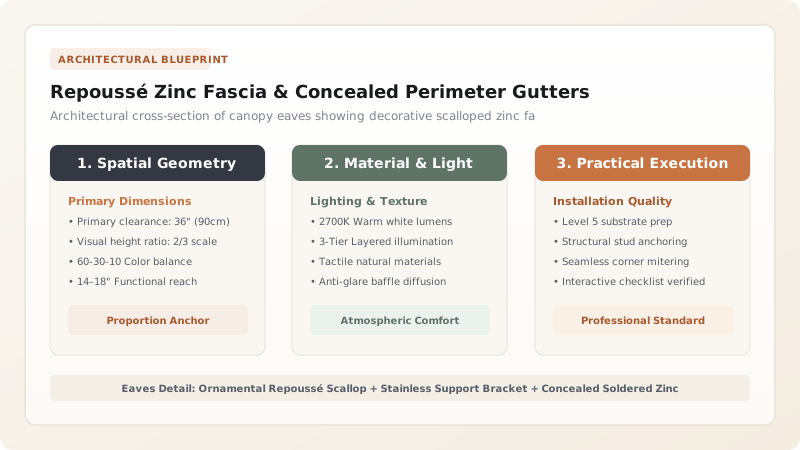
The scalloped repoussé zinc fascia and hidden perimeter gutter provide the artistic crown and drainage management for a Beaux-Arts marquise canopy. Hand-embossed using the repoussé technique over pitch beds, the decorative zinc lambrequin masks the glass edges while concealing a continuous soldered sheet-zinc gutter with integrated emergency overflow scuppers.
At a Glance: Key Takeaways
- Repoussé Zinc Craft: Hand-hammering 0.8–1.0mm titanium-zinc sheets from behind against elastic pitch to form classical high-relief motifs.
- Scalloped Lambrequin Valence: Traditional pendant drapery scallops that deflect wind and provide an ornate decorative silhouette.
- Concealed Eaves Box Gutter: Internal folded zinc trough sloping at 1:100 to catch all roof runoff unseen from the street below.
- Emergency Overflow Weirs: Rectangular scuppers cut into the exterior fascia 25mm below the lip to prevent storm flooding across entrance glass.
- Integrated Hollow Downspouts: Rainwater routed discreetly through structural hollow iron scrolls back to building drainage risers.
- Soldered Expansion Seams: Expansion joints incorporating vulcanized neoprene bellows every 6 meters to prevent thermal seam tearing.
1. Belle Époque Metalwork: The Art of Repoussé Zinc
In Parisian Beaux-Arts architecture, the perimeter valence of a marquise was considered its primary calling card. Tinsmiths (couvreurs-zingueurs) utilized the ancient art of repoussé (hammering from the reverse) and chasing (detailing from the front).
Working on a resilient bed of pine rosin and pitch, craftsmen hand-beat \(0.8\text{ to }1.0\text{ mm}\) titanium-zinc sheet with rounded boxwood mallets. They created classical Belle Époque motifs: acanthus leaf scrolls, lion heads, rosettes, and draped scalloped lambrequins that catch low sunlight and cast intricate shadows over the doorway.
2. Drainage Mechanics: The Concealed Perimeter Box Gutter
A poorly detailed marquise dumps sheets of water around its perimeter during heavy downpours, drenching guests entering under its protection. Master fabricators solved this with a concealed perimeter box gutter integrated behind the decorative fascia.
Folded from matching architectural zinc or sheet copper, the gutter is mounted directly to the perimeter structural steel channel. It is set with a continuous fall of \(1:100\) (\(10\text{ mm per meter}\)) toward the rear facade corners, collecting water from every glass glazing bay.
3. Emergency Overflow Scuppers & Thermal Expansion
Zinc expands and contracts significantly under solar heat (linear thermal expansion \(\alpha = 22 \times 10^{-6}\ \text{K}^{-1}\)). Over a 6-meter span, seasonal temperature swings create over \(7\text{ mm}\) of movement. To prevent seams from tearing, gutter lengths are spliced with vulcanized neoprene expansion joints.
Additionally, because Parisian plane tree leaves frequently clog downspout nozzles, emergency overflow scuppers are cut into the front face of the gutter. If water rises within 25mm of the glass edge, it spills forward out through decorative gargoyles or concealed slots, preventing water from flooding backward over the entrance threshold.
Perimeter Fascia & Gutter Technical Specifications
Use this reference table to calculate exact physical dimensions, ratios, and specifications before purchasing:
| System Component | Zinc Material Specification | Copper Material Specification | Maintenance Requirement |
|---|---|---|---|
| Decorative Fascia | 0.80mm pre-weathered titanium-zinc | 0.70mm (20 oz) cold-rolled copper | Inspect every 5 years for mechanical clip tightness |
| Concealed Box Gutter | 1.00mm hard-rolled zinc (soldered) | 0.80mm (24 oz) copper with lead solder | Clean out leaves and silt every autumn |
| Minimum Gutter Slope | 1:100 (10 mm fall per meter) | 1:100 (10 mm fall per meter) | Check with water level test during commissioning |
| Thermal Expansion Joint | Neoprene bellows joint every 6 m | Sliding expansion cleat every 8 m | Inspect rubber bellows for UV cracking at 10 yrs |
| Overflow Scupper Capacity | 2x maximum design 50-yr storm flow | 2x maximum design 50-yr storm flow | Ensure weir slots remain free of bird nests |
| Downspout Routing | 50mm ID copper pipe inside scroll | 50mm ID brass conduit to facade | Flush annual with high-pressure hose |
Sheet Metal Fabrication & Water Constraints
Every successful decoration project must account for physical and environmental constraints:
Zinc Soldering Temperature
Zinc melts at 419°C; soldering irons must be kept at 250°C–270°C using hydrochloric acid flux. Overheating burns a hole right through thin repoussé sheet.
Dissimilar Metal Runoff
Never allow runoff from an upper copper roof to drain into a zinc marquise gutter; cupric ions will dissolve the zinc through rapid galvanic attack.
Fascia Wind Flutter
Scalloped zinc pendants must be backed with 3mm stainless steel stiffening straps to prevent harmonic vibration and metal fatigue in high winds.
Perimeter Gutter & Repoussé Fascia Assembly
Execute this professional sequence to achieve flawless results without backtracking:
Perimeter Channel Outrigger Mounting
Weld stainless steel bracket outriggers along the perimeter steel channel to support gutter and fascia clips.
Box Gutter Folding & Sloping
Brake-form 1.0mm zinc sheet into a box gutter profile, shimming the brackets to achieve a continuous 1:100 fall toward drains.
Soldering & Expansion Jointing
Solder all transverse gutter seams with 50/50 tin-lead solder, integrating vulcanized neoprene expansion couplings every 6 meters.
Overflow Scupper Piercing
Mill rectangular overflow slots 25mm below the upper gutter rim, fitting them with soldered discharge spouts through the front face.
Repoussé Fascia Hand-Clipping
Slide hand-hammered repoussé zinc valence panels onto continuous lower hem cleats and lock the top edge over the gutter flange.
Water Flow Commissioning
Conduct a continuous 30-minute water deluge test using garden hoses to confirm complete drainage with zero standing water pockets.
Common Mistakes & Countermeasures
Avoid these costly errors that compromise aesthetics, ergonomics, and budget:
Soldering long continuous runs of zinc gutter without expansion joints (> 8 meters)
Mounting decorative zinc fascia rigidly with face screws through un-slotted holes
Omitting overflow scuppers on canopies surrounded by deciduous trees
Project Execution Checklist
Track your physical progress. Checkboxes persist automatically on this device:
Frequently Asked Questions
What is the lifespan of an authentic architectural zinc gutter on a marquise?
High-grade titanium-zinc naturally develops a protective hydroxycarbonate patina in the atmosphere, delivering a functional lifespan of 80 to 100+ years without painting or maintenance.
Can the concealed gutter be equipped with electric de-icing heat cables?
Yes. In cold climates subject to heavy snowfall and freeze-thaw cycles, self-regulating 240V heat-trace cables are installed along the gutter bottom to prevent ice dams from backing up onto the glass panes.
How are corners resolved where the front and side scalloped fascias meet?
Corner joints are hand-mitered at 45 degrees, carefully matching the repoussé motif profile. The seam is soldered from behind and reinforced with an internal copper angle gusset, leaving a virtually invisible corner joint.


