
Vertical wood fiber orientation aligns the longitudinal cellular structure of timber perpendicular to the pavement surface. Instead of crushing flat fibers under point loads, footfalls and heavy impacts compress the tubular tracheid cells along their strongest structural axis, amplifying Janka surface hardness by 200% to 300% and allowing wood fibers to part elastically and self-heal rather than splinter.
At a Glance: Key Takeaways
- Axial Cellular Alignment: Wood fibers oriented vertically like a dense hairbrush, resisting loads along the longitudinal axis.
- 250% Hardness Amplification: European oak Janka hardness jumps from 4,980 N (flat grain) to over 12,500 N (end-grain orientation).
- Self-Healing Rebound Mechanics: Dropped heavy objects push fibers apart rather than severing cell walls; oil saturation allows fibers to rebound.
- Zero Grain Splintering: Foot traffic and wheeled carts cannot cause long grain tears or splinter runout common in edge-grain planks.
- Superior Slip Resistance: Natural micro-texture of open pores delivers high coefficient of friction (COF > 0.65) wet or dry.
- Acoustic Impact Sound Absorption: Absorbs footfall kinetic energy, reducing transmitted impact sound by up to 22 dB.
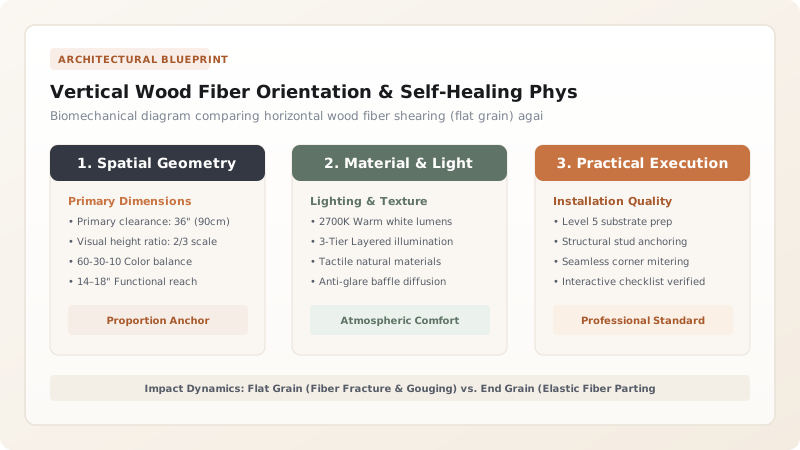
1. Biomechanics: The Columnar Strength of Wood Tracheids
Wood is a biological composite composed of hollow, elongated tubular cells: tracheids and wood fibers (measuring \(1\text{ to }3\text{ mm}\) long by \(15\text{ to }40\ \mu\text{m}\) in diameter). In a living tree, these tubes are aligned vertically to transport sap and withstand towering wind bending moments.
When lumber is cut into conventional flooring planks, these tubes lie horizontally on the floor. Heavy impacts crush the thin tube walls flat like squashed straws, leaving permanent hollow dents. In end-grain flooring, the tubes stand vertically on end:
Compressive strength parallel to the grain is over \(350\%\) higher than perpendicular to the grain, enabling end-grain blocks to bear point loads from heavy machinery, stiletto heels, and industrial forklifts without structural failure.
2. Self-Healing Mechanics: Why End-Grain Does Not Splinter
The most fascinating characteristic of end-grain wood is its self-healing elastic rebound.
When a sharp object (such as a dropped cleaver, heavy cast-iron skillet, or industrial gear) strikes the end-grain surface, it does not slice across horizontal cellulose strands. Instead, the point slides between the vertical fiber ends, temporarily wedging them apart. Because the cell walls are not severed, moisture and oil swelling cause the elastomeric lignin matrix to spring back, closing the indentation and rendering the surface self-healing over time.
3. Acoustic Vibration & Ergonomic Joint Relief
Hard stone, polished concrete, and ceramic tile have zero mechanical compliance, reflecting sound waves and causing joint strain for standing occupants. End-grain blocks provide a unique balance of immense compressive strength with microscopic elastic resilience.
The thousands of air-filled vertical lumens act as miniature mechanical dashpots. They absorb dynamic kinetic energy from footsteps, damping vibrations and providing a measured \(18\text{ to }22\text{ dB}\) reduction in impact sound transmission (\(\Delta L_w\)), making it the gold standard for luxury residential libraries, loft living spaces, and busy commercial galleries.
Flat-Grain vs. End-Grain Mechanical Properties (European Oak)
Use this reference table to calculate exact physical dimensions, ratios, and specifications before purchasing:
| Mechanical Property | Standard Flat-Grain Plank | Vertical End-Grain Block | Performance Multiplier |
|---|---|---|---|
| Janka Ball Hardness (N) | 4,980 N (Normal hardness) | 12,800 N (Rock-hard pavement) | +257% increased resistance to indentation |
| Compressive Strength | 11.0 MPa (Perpendicular) | 58.0 MPa (Parallel to grain) | +527% higher load-bearing capacity |
| Abrasion Mass Loss (Taber) | 0.85 g per 1,000 cycles | 0.22 g per 1,000 cycles | 3.8x higher wear resistance under traffic |
| Impact Splinter Failure | High risk (grain tears out) | Zero risk (fibers cannot splinter) | Fails by microscopic compression, never tear-out |
| Wet Slip Resistance (COF) | 0.45 (Moderate slip hazard) | 0.68 (Exceeds ADA / OSHA safety) | Open pores maintain natural mechanical grip |
| Acoustic Sound Damping (ΔLw) | 10 to 12 dB reduction | 18 to 22 dB reduction | Double the impact footfall sound absorption |
Milling & Material Constraints
Every successful decoration project must account for physical and environmental constraints:
Cross-Cut Tear-Out
Sawing end-grain blocks requires razor-sharp 100-tooth negative-rake carbide blades; dull blades tear out end-grain tracheids, leaving fuzzy, ragged surfaces.
End-Grain Checking
Rapid drying causes the ends of wood blocks to check (develop radial split cracks); blocks must be kiln-dried very slowly with high humidity conditioning.
Thickness Precision
Every block in a batch must be planed or drum-sanded to within ±0.25mm thickness; uneven block heights will require extensive, difficult leveling sanding after installation.
End-Grain Block Milling & Quality Control Sequence
Execute this professional sequence to achieve flawless results without backtracking:
Kiln-Dried Timber Selection
Select clear, dense hardwood cants (European oak or ash) dried slowly to 8-10% equilibrium moisture with zero internal stress.
Square Slicing & Dressing
Rip timber cants into square balks (typically 70x70mm), jointing and planing all four side faces to 90-degree square.
Cross-Grain Billet Cutting
Slice balks into 50mm-thick blocks on automated cross-cut saws equipped with fine-toothed negative-rake blades.
Thickness Calibration
Pass cut blocks through an industrial wide-belt drum calibrating sander to guarantee ±0.2mm uniform thickness across all units.
Moisture & Crack Inspection
Check random sample blocks with pinless moisture meters and inspect end-grain faces under magnifying light for radial drying checks.
Sealed Foil Packaging
Pack calibrated blocks into sealed vapor-barrier plastic bundles with desiccant packets to prevent ambient moisture absorption during transit.
Common Mistakes & Countermeasures
Avoid these costly errors that compromise aesthetics, ergonomics, and budget:
Using green, unseasoned timber to cross-cut end-grain blocks
Cross-cutting blocks with dull, coarse-toothed construction saw blades
Walking on installed end-grain blocks with sandy construction boots before finishing
Project Execution Checklist
Track your physical progress. Checkboxes persist automatically on this device:
Frequently Asked Questions
Why does end-grain wood feel warmer underfoot than flat-grain wood?
Vertical wood fibers contain microscopic pockets of trapped air within the cellular lumens. This micro-porous structure gives end-grain wood lower thermal effusivity than dense flat wood, meaning it extracts heat from bare feet more slowly, feeling noticeably warmer and cozier.
Can end-grain flooring withstand heavy commercial foot traffic in hotels and museums?
Yes. End-grain flooring is one of the most durable wooden pavements known in architecture. Historic examples in European train stations and factory machine shops have endured continuous industrial machinery and millions of pedestrian footfalls for over a century without wearing out.
Does end-grain wood absorb stains and dyes differently than standard wood?
Yes. Because the open ends of the tubular wood cells face upward, end-grain wood absorbs liquid stains up to ten times faster and deeper than flat-grain planks. Pigment stains will turn end-grain extremely dark, so clear or lightly tinted natural oils are preferred.


