
Polyurethane mastic expansion bedding and perimeter relief gaps are the critical engineering defenses against floor buckling in end-grain installations. Because end-grain blocks expand horizontally in all directions, they must be bedded in a continuous 3.5mm layer of permanently elastic, high-shear polyurethane adhesive and framed with 20–25mm perimeter cork expansion joints that absorb seasonal swelling without lifting.
At a Glance: Key Takeaways
- Multi-Directional Horizontal Swelling: Radial and tangential wood movement vectors lie in the floor plane, requiring 360° expansion allowances.
- Elastic Polyurethane Mastic: High-solids, solvent-free adhesive with > 150% elongation at break, flexing with individual block movement.
- Continuous 3.5mm Adhesive Bed: Combed with a B11 or B15 notched trowel to ensure 100% transfer without hollow voids.
- Compressible Cork Perimeter Joints: 20–25mm high-density cork strips installed around all perimeter walls, columns, and thresholds.
- Intermediate Expansion T-Joints: In rooms exceeding 8 meters in width, concealed 12mm expansion joints integrated every 6 to 8 meters.
- Subfloor Vapor Barrier Primer: Two-component epoxy barrier preventing concrete slab moisture from driving upward into the wood blocks.
1. Volumetric Physics: The Multi-Directional Expansion of End-Grain
In conventional plank flooring, wood expands primarily across its width, while movement along its length is negligible (under \(0.1\%\)). In end-grain flooring, both the radial and tangential grain axes lie parallel to the subfloor.
This means the floor expands like a hydraulic piston in all directions. If moisture content increases by \(4\%\) during humid summer months, a \(10\text{-meter wide}\) room will expand by:
If constrained against rigid walls, the expanding wood generates compressive stresses exceeding \(5\text{ MPa}\), which will crack concrete stem walls or blow the center of the floor upward in a dramatic pyramid buckle.
2. The Adhesive Cushion: High-Elongation Polyurethane Mastic
Rigid adhesives (epoxy, water-based PVA, or cement) cannot tolerate the dynamic micro-movements of individual end-grain blocks. Installers mandate 100% solids elastic polyurethane or silane-modified polymer (SMP) adhesives (such as SikaBond or Wakol MS).
These specialized adhesives cure through atmospheric moisture into a tough, permanently elastic rubber matrix with an elongation at break exceeding \(150\%\). Spread at a rate of \(1.2\text{ to }1.5\text{ kg/m}^2\) with a notched trowel, the adhesive bed acts as thousands of independent shock absorbers, dissipating shear stresses between the expanding wood block and the rigid concrete subfloor.
3. Expansion Joint Architecture: Cork Strips & Intermediate Relief
To safely absorb the calculated expansion, the perimeter of the room must be decoupled from all vertical structures:
- High-Density Natural Cork Strips: A continuous strip of \(20\text{ to }25\text{ mm}\) compressible agglomerated cork is glued to the base of all walls, columns, pipes, and stair stringers prior to block laying. Cork compresses to 40% of its thickness without crumbling, absorbing floor expansion.
- Intermediate Room Breaks: For open-plan halls exceeding \(8\text{ meters}\) in any dimension, the floor is partitioned with an intermediate \(12\text{ mm}\) cork relief joint flush with the blocks, concealed under room dividers or aligned with architectural columns.
Adhesive & Expansion Joint Sizing Matrix
Use this reference table to calculate exact physical dimensions, ratios, and specifications before purchasing:
| Room Dimension / Span | Perimeter Cork Joint Width | Intermediate Expansion Joints Required | Adhesive Bed Thickness |
|---|---|---|---|
| Under 4.0 meters span | 15 mm perimeter cork strip | None required | 3.0 mm (B11 trowel) |
| 4.0 to 8.0 meters span | 20 to 25 mm perimeter cork strip | None required | 3.5 mm (B11 trowel) |
| 8.0 to 14.0 meters span | 25 mm perimeter cork strip | 1 intermediate 12mm cork break at center | 4.0 mm (B15 trowel) |
| Over 14.0 meters span | 30 mm perimeter cork strip | Intermediate 12mm breaks every 7 meters | 4.0 mm (B15 trowel) |
Subfloor & Installation Constraints
Every successful decoration project must account for physical and environmental constraints:
Concrete Curing Age
New concrete slabs must cure for at least 60 days before installation; green concrete emits moisture that causes explosive bottom swelling in end-grain blocks.
Trowel Notch Wear
As notched trowels drag across abrasive concrete, teeth wear down; trowel blades must be replaced every 50 square meters to ensure constant 3.5mm adhesive depth.
Cork Compression Setting
Low-density craft cork will turn to powder under expansion pressure; use strictly commercial architectural high-density expansion cork (minimum 200 kg/m³ density).
Subfloor Decoupling & Mastic Bedding Sequence
Execute this professional sequence to achieve flawless results without backtracking:
Subfloor Moisture Barrier Priming
Roll two-part epoxy moisture vapor barrier over clean concrete subfloor, scattering fine silica sand over the wet second coat for mechanical key.
Perimeter Cork Installation
Bond 25mm-thick high-density cork strips along all perimeter walls using polyurethane contact adhesive.
Mastic Combing
Pour one-part elastic polyurethane adhesive onto the primed slab, combing with a B11 notched trowel held at 60 degrees to maintain 3.5mm ridge height.
Block Setting & Tamping
Press end-grain blocks into the adhesive with a slight twisting motion, tamping flat with a non-marking rubber dead-blow mallet.
Expansion Gap Verification
Verify with a gauge block that a minimum 20mm gap is maintained between the outer blocks and all wall masonry.
Adhesive Cure & Sanding Wait
Allow the polyurethane mastic to cure undisturbed for 48 to 72 hours before allowing heavy foot traffic or commencing drum sanding.
Common Mistakes & Countermeasures
Avoid these costly errors that compromise aesthetics, ergonomics, and budget:
Pinching end-grain blocks tight against door frames or pipes without expansion gaps
Using water-based dispersion adhesives for end-grain block flooring
Walking on or drum-sanding the floor before the polyurethane adhesive has fully cured
Project Execution Checklist
Track your physical progress. Checkboxes persist automatically on this device:
Frequently Asked Questions
How is the 25mm perimeter cork gap hidden in a finished room?
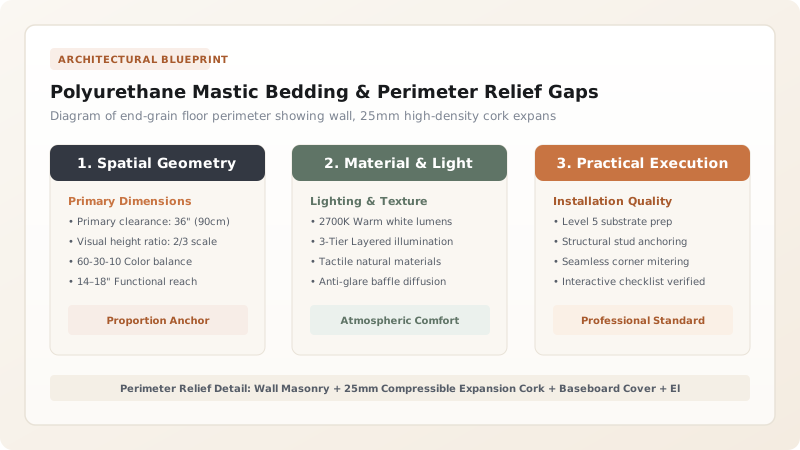
The perimeter expansion gap is completely concealed beneath thick architectural baseboards (skirting boards) and matching shoe moldings fastened strictly to the wall—never to the floor—allowing the floor to slide freely beneath.
Can end-grain wood flooring be installed over an existing wooden subfloor?
Yes, provided the wooden subfloor consists of at least 19mm exterior-grade plywood or OSB-3 screwed tightly to joists without deflection. An elastic polyurethane primer must be applied before spreading the adhesive mastic.
What happens if an end-grain block floor gets flooded with water?
If flooded, end-grain blocks will swell rapidly. If proper perimeter cork joints were installed, the cork compresses to absorb initial swelling. Dehumidifiers must be deployed immediately to extract moisture before the blocks reach their maximum volumetric limit.


