
Penetrating hardwax-oil deep soaking is the mandatory finishing system for end-grain block pavements. Formulated from natural vegetable oils (linseed, sunflower, and soybean) and hard plant waxes (carnauba and candelilla), it saturates open vertical wood tracheids up to 15mm deep, polymerizing inside the cellular lumina to create a water-repellent, non-slip (R10 safety rating), micro-porous surface that never flakes or peels.
At a Glance: Key Takeaways
- 15mm Deep Capillary Saturation: Vertical wood fibers draw liquid oil deep into cell cavities, anchoring the finish internally.
- Vegetable Oils & Carnauba Waxes: Purified natural plant oils that polymerize via oxidative cross-linking without synthetic plastic films.
- Breathable Micro-Porous Membrane: Water droplets bead on the surface while allowing internal vapor transmission (Class I vapor open).
- R10 / P3 Anti-Skid Slip Resistance: Preserves the natural micro-texture of wood, preventing slips even in wet entrance foyers.
- Spot Repairability: Localized scratches and stains buff out with maintenance oil without requiring full room drum sanding.
- Rotary Buffer Thermal Activation: Buffed with white polishing pads at 175 RPM to melt carnauba wax into a velvety satin sheen.
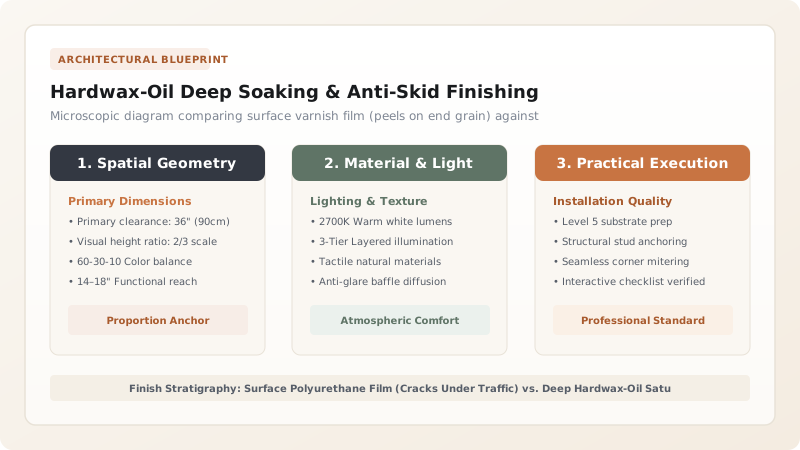
1. Finishing Physics: Capillary Absorption in Vertical Tracheids
On conventional flat-grain hardwood flooring, finish penetration is negligible—typically less than \(0.2\text{ mm}\)—because horizontal cell walls block fluid absorption. Film-forming varnishes rely on forming a plastic blanket across the top of the wood.
On end-grain flooring, the open tracheid lumens act as millions of capillary tubes. The penetration depth \(h\) is governed by the Lucas-Washburn capillary flow equation:
Where \(\gamma\) is oil surface tension, \(r\) is pore radius, and \(\eta\) is oil viscosity. Low-viscosity natural hardwax-oils penetrate \(10\text{ to }15\text{ mm}\) deep into the wood. As the oil absorbs atmospheric oxygen, it polymerizes into a tough, solid linoxin matrix within the cell walls, making the wood itself water-repellent throughout its top layer.
2. Natural Surface Armor: Carnauba Wax & Anti-Skid Safety
While the drying oils penetrate deep into the cells, the carnauba and candelilla waxes remain on the surface. Carnauba wax is the hardest natural plant wax known, boasting a melting point of \(82^\circ\text{C to }86^\circ\text{C}\).
When buffed with high-speed floor machines, frictional heat softens the wax micro-crystals, spreading a micro-thin, water-repellent seal that fills surface pores. Unlike polyurethane—which becomes dangerously slick when wet—wax-impregnated end-grain wood retains its natural wood tooth, easily achieving an R10 commercial anti-skid rating and a pendulum test value (PTV) > 40 in wet conditions.
3. Maintenance Philosophy: Zero-Sanding Lifetime Renewal
Polyurethane varnished floors require complete room clearing and aggressive drum sanding every 7 to 10 years to fix worn traffic paths. End-grain floors treated with hardwax-oil never require sanding again.
High-traffic commercial paths (such as hotel entrance lobbies or museum hallways) can be renewed overnight. Janitorial staff clean the floor with vegetable oil soap and buff in a micro-thin coat of maintenance oil with a rotary buffer. The fresh oil bonds molecularly with the existing polymerized oil, restoring full color depth and water repellency with zero dust and zero downtime.
End-Grain Floor Finish Comparison
Use this reference table to calculate exact physical dimensions, ratios, and specifications before purchasing:
| Finish Technology | Penetration Depth | Slip Resistance (Wet PTV) | Wear & Maintenance Life Cycle |
|---|---|---|---|
| Penetrating Hardwax-Oil | 10 to 15 mm deep capillary soak | PTV > 40 (R10 safety rating) | Indefinite; re-buff high traffic areas without sanding |
| Traditional Boiled Linseed + Wax | 8 to 12 mm deep soak | PTV > 36 (Good traction) | Requires annual wax buffing; warm amber patina |
| Film-Forming Polyurethane (Prohibited) | 0.1 mm surface film | PTV < 25 (Severe slip hazard wet) | FAILS: Cracks and flakes off within 2 to 4 years |
| Epoxy Floor Coating (Prohibited) | 0.5 mm surface cap | PTV < 20 (Glass-like slickness) | FAILS: Traps moisture; discolors and delaminates |
Application & Safety Constraints
Every successful decoration project must account for physical and environmental constraints:
Spontaneous Combustion Hazard
Rags soaked in linseed-based hardwax-oils generate heat as they oxidize and can spontaneously combust into flames; all oily rags must be submerged in water or burned in an outdoor incinerator immediately after use.
Oil Consumption Rates
End-grain absorbs 3 to 4 times more oil than flat-grain planks (approx 1 liter per 8–10 m² for the first coat); ensure sufficient material is batched on site.
Curing Ventilation
Natural drying oils require atmospheric oxygen to cross-link; job sites must maintain continuous warm ventilation (20°C, 50% RH) for 7 days until fully cured.
Hardwax-Oil Application & Buffing Sequence
Execute this professional sequence to achieve flawless results without backtracking:
Multi-Stage Rotary Sanding
Sand end-grain blocks with a rotary planetary sander using 60-grit, 80-grit, and 100-grit ceramic mesh discs; vacuum all pore dust thoroughly.
First Deep Oil Flooding
Pour penetrating hardwax-oil directly onto the floor, spreading generously with a neoprene squeegee to allow open pores to drink freely for 20 minutes.
Mechanical Buffer Dispersion
Work the oil into the wood pores using a 175 RPM rotary floor buffer fitted with a green or red nylon pad, driving oil deep into vertical lumens.
Surface Squeegee & Wipe-Off
Squeegee off all excess standing surface oil with a clean rubber blade and buff dry with cotton cloths under a white pad; leave zero puddles.
Second Thin Coat Application
Apply a second, thin coat of hardwax-oil 24 hours later (approx 1 liter per 25 m²), buffing immediately with a white polishing pad.
Oxidative Curing Period
Allow the floor to cure under natural ventilation for 48 hours before light sock foot traffic, and 7 days before washing with water.
Common Mistakes & Countermeasures
Avoid these costly errors that compromise aesthetics, ergonomics, and budget:
Leaving thick puddles of hardwax-oil on the surface to 'dry like varnish'
Throwing oil-soaked cotton rags into a pile in a plastic trash can
Sanding end-grain blocks with very fine sandpaper (> 120 grit)
Project Execution Checklist
Track your physical progress. Checkboxes persist automatically on this device:
Frequently Asked Questions
Can I use hardwax-oil on an end-grain kitchen butcher block?
Yes. For food-contact surfaces (cutting boards and kitchen islands), specify certified food-safe, solvent-free hardwax-oils formulated exclusively from cold-pressed linseed oil, beeswax, and carnauba wax that comply with FDA 21 CFR 175.300 and EN 71.3 (safe for toys and food).
How do you remove red wine or coffee stains from an oiled end-grain floor?
Because the oil penetrates 15mm deep, liquids cannot easily reach the raw wood. Wipe spills promptly. If a stain penetrates, scrub the affected spot with a scotch-brite pad and concentrated oil soap, wipe clean, and re-apply a drop of hardwax-oil.
Does end-grain wood change color when oiled?
Yes. Penetrating oils bring out the rich, wet, natural character of the timber, turning pale white oak into a warm golden-amber and emphasizing the dark concentric rings of latewood and medullary rays.


