
Fabricate structural curved staircase stringers by rolling 1/2-inch (12mm) Grade 50 steel plates on a 3D hydraulic variable-axis plate-rolling machine. Maintain strict fabrication tolerances within ±1.5mm of the CAD mathematical helix, welding folded steel tread pans between inner and outer stringers to create a rigid torsional box structure.
At a Glance: Key Takeaways
- 1/2-Inch (12mm) Grade 50 Steel Plate: Delivers extreme tensile strength (\(50,000\text{ PSI}\)) and torsional stiffness.
- 3D Hydraulic Plate Rolling: Bends steel simultaneously along a circular radius and vertical pitch angle.
- Torsional Box Structure: Inner stringer, outer stringer, and welded steel tread pans form an interconnected torque tube.
- ±1.5mm Fabrication Tolerance: Essential precision to ensure curved glass railings and wood treads fit without on-site cutting.
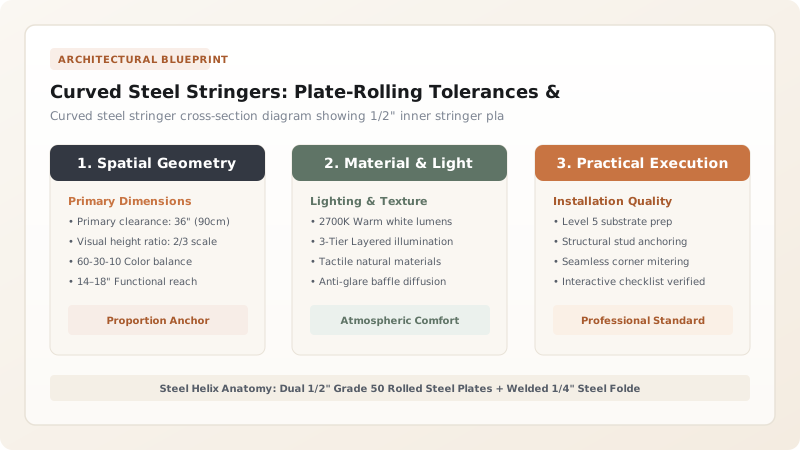
1. Heavy Metallurgy: 3-Roll Variable-Axis Bending Physics
Rolling a flat steel plate into a 3D Helical Stringer requires specialized machinery. Unlike rolling a simple pipe cylinder (2D curve), a stair stringer must curve along a horizontal radius while rising continuously at a 34-degree to 38-degree helical pitch angle.
Specialized steel fabricators use 4-Roll Variable-Geometry Hydraulic Plate Rolls to form 1/2-inch (12mm) Grade 50 structural steel plate. The high yield strength of Grade 50 steel prevents permanent deformation under dynamic stair foot traffic. Pair with helical winder tread geometry.

2. Torsional Box Rigidity & Laser Inspection Tolerances
A single curved steel plate will flex under lateral loads. To achieve complete structural rigidity, the inner and outer stringers are welded to 1/4-inch folded steel tread pans and closed on the underside with a smooth soffit plate.
This forms a continuous Torsional Box Beam that eliminates all bounce and vibration. Verify tolerances with 3D laser scanning to within ±1.5mm of the CAD model. Learn balustrade anchoring in baluster anchoring methods.
Curved Staircase Stringer Materials Comparison
Use this reference table to calculate exact physical dimensions, ratios, and specifications before purchasing:
| Stringer Material & Structure | Torsional Deflection | Open Central Eye Capacity | Visual Profile Slenderness |
|---|---|---|---|
| Dual Rolled 1/2" Steel Plate Box (Optimal) | < 1.5mm (Ultra-Rigid) | Large open central eye (No center post) | Slim 1/2" visible plate profile |
| Curved Laminated Timber Box Stringer | < 3.0mm (Good) | Requires wider 2" wood walls | Substantial wood architectural profile |
| Center Steel Mono-Pipe (Spiral) | < 2.0mm | Small footprint (No open eye) | Industrial commercial look |
| Field-Bent Wood 2x12s (DANGER) | FAILS: Severe bounce & creaks | Cannot bridge open spans | Low-end residential (Fails code) |
Thermal Welding Warpage Twist Constraints
Every successful decoration project must account for physical and environmental constraints:
Heavy MIG Welding Causing Curved Steel Stringers to Pull Out of Radius
Continuous welding creates intense localized heat that shrinks steel, warping the helical radius; utilize staggered pulse MIG welding techniques and weld stringers while clamped inside a rigid steel jig frame to preserve exact ±1.5mm CAD tolerances.
How to Fabricate and Erect Curved Steel Stringers
Execute this professional sequence to achieve flawless results without backtracking:
Generate 3D SolidWorks Helical Model
Model exact 3D inner and outer stringer geometry, extracting flat plate development cut files.
CNC Plasma / Laser Cut 1/2" Steel Plates
Cut inner and outer stringer plates from Grade 50 steel with pre-notched tread slots.
Roll Plates on 4-Roll Hydraulic Bender
Roll plates to exact helical pitch and radius, checking against CNC plywood radius templates.
Assemble in Jig and Weld Tread Pans
Lock stringers in 3D jig; weld 1/4" folded steel tread pans using staggered low-heat passes.
Deliver and Crane Hoist into Foyer
Crane welded steel staircase assembly into building; bolt baseplates to concrete slab with M20 anchors.
Tie Upper Header into Floor Diaphragm
Weld upper stringer flanges to structural steel floor beams for complete lateral stability.
Common Mistakes & Countermeasures
Avoid these costly errors that compromise aesthetics, ergonomics, and budget:
Attempting to Heat-Bend Steel Stringers with an Oxy-Acetylene Torch On-Site
Project Execution Checklist
Track your physical progress. Checkboxes persist automatically on this device:
Frequently Asked Questions
Can curved steel stringers be concealed with smooth plaster underneath?
Yes! Fasten curved metal lath to the underside of the welded steel stringers and trowel 3 coats of cementitious or Venetian plaster to create a breathtaking seamless curved white soffit.


