
Calculate helical stair winder treads by dividing the total rotation angle (e.g. 180°) by the number of treads to find the angle per tread (\(\theta\)). Verify that the walkline arc length \(T_w = \frac{\pi \cdot (R_1 + 12) \cdot \theta}{180^{\circ}}\) is at least 10.0 inches (IBC R311.7.5.2) and the inner edge arc \(T_1 = \frac{\pi \cdot R_1 \cdot \theta}{180^{\circ}}\) is at least 6.0 inches.
At a Glance: Key Takeaways
- The 12-Inch Walkline Arc Formula: \(T_w = \frac{\pi \cdot R_w \cdot \theta}{180^{\circ}}\) governs the legal tread depth where humans walk.
- Minimum 6-Inch Inner Edge Rule: Prevents narrow inside tread points from creating dangerous foot slips.
- Angular Symmetry: Every winder tread must share the exact same angular rotation (\(\theta\)) for circadian muscle memory.
- Riser Height Uniformity (3/8" Tolerance): The maximum variation between the tallest and shortest riser cannot exceed 3/8" (9.5mm).
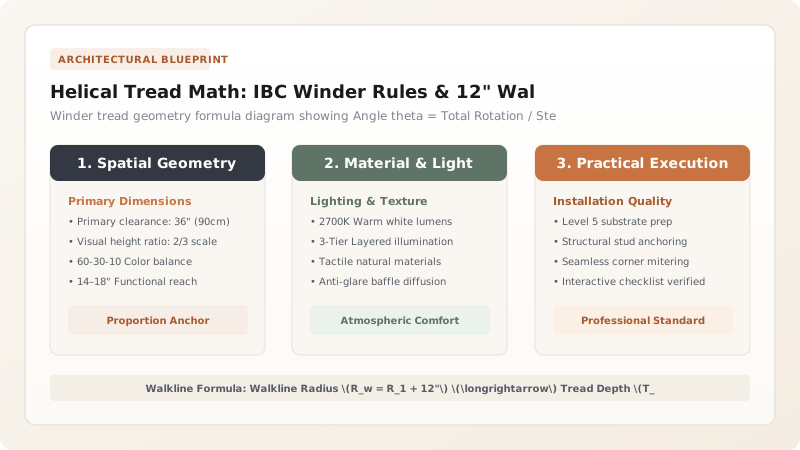
1. Trigonometric Formulas: Deriving Tread Depths Along Circular Arcs
Unlike straight stairs where tread depth is uniform from left to right, a curved winder tread expands radially like a fan slice. To prevent tripping, building codes evaluate tread depth along the Natural Human Walkline (positioned exactly 12 inches / 305mm from the inner handrail).
The mathematical equations governing helical winders:
$$\theta = \frac{\text{Total Rotation Angle}}{\text{Number of Treads}} \qquad R_w = R_1 + 12"$$
$$\text{Walkline Tread Depth } T_w = \frac{\pi \cdot R_w \cdot \theta}{180^{\circ}} \ge 10.0" \qquad \text{Inner Edge Depth } T_1 = \frac{\pi \cdot R_1 \cdot \theta}{180^{\circ}} \ge 6.0"$$
If \(T_1 < 6.0\text{ inches}\), you must increase the inner radius (\(R_1\)) or expand the total rotation angle. Learn handrail construction in laminated curved wood handrail mechanics.

2. Practical Calculation: 180° Half-Turn Helical Staircase
Consider a 180-degree half-turn helical stair with a floor-to-floor rise of \(119\text{ inches}\) (17 risers / 16 treads). Setting total rotation to \(180^{\circ}\) across 16 treads gives:
$$\theta = \frac{180^{\circ}}{16} = 11.25^{\circ}\text{ per tread}$$
To satisfy \(T_1 \ge 6.0\text{ inches}\):
$$R_1 = \frac{6.0 \times 180^{\circ}}{\pi \times 11.25^{\circ}} = 30.56\text{ inches (Round up to } 31\text{ inches)}$$
With \(R_1 = 31\text{ inches}\), the walkline radius is \(R_w = 31 + 12 = 43\text{ inches}\), giving a walkline tread depth of \(T_w = \frac{\pi \times 43 \times 11.25^{\circ}}{180^{\circ}} = 8.44\text{ inches}\) (Too small!). To fix this, increase total rotation to \(220^{\circ}\) or expand the inner radius to \(45\text{ inches}\). Explore stringer fabrication in curved steel stringer rolling tolerances.
Helical Staircase Geometry Parameters
Use this reference table to calculate exact physical dimensions, ratios, and specifications before purchasing:
| Parameter | IBC Code Minimum | Luxury Recommended Spec | Functional Impact |
|---|---|---|---|
| Walkline Tread Depth (Tw) | 10.0 Inches (254mm) | 11.0 - 12.0 Inches | Ensures comfortable, natural adult gait |
| Inner Edge Tread Depth (T1) | 6.0 Inches (152mm) | 7.0 - 8.0 Inches | Prevents slipping when walking near inner rail |
| Clear Stair Width | 36.0 Inches (914mm) | 42.0 - 48.0 Inches | Allows two people to pass comfortably |
| Inner Radius (R1) | 24.0 Inches (610mm) | 36.0 - 48.0 Inches | Creates grand, open sculptural central eye |
Riser Height Unevenness Stumble Constraints
Every successful decoration project must account for physical and environmental constraints:
Varying Riser Heights by 1/2 Inch Around the Curve
The human brain memorizes stair rise in the first two steps; a 1/2" difference on curved steps causes occupants to trip; maintain uniform 7.0-inch riser heights across all steps to within a strict 1/8-inch (3mm) maximum tolerance.
How to Calculate Winder Tread Layout Dimensions
Execute this professional sequence to achieve flawless results without backtracking:
Determine Number of Risers and Treads
Divide total rise by 7.0" (e.g. 112" rise ÷ 7.0" = 16 risers = 15 winder treads).
Set Rotation Angle (Total Degrees)
Establish total stair rotation (e.g. 210°); calculate angle per tread \(\theta = 210^{\circ} / 15 = 14.0^{\circ}\).
Calculate Minimum Inner Radius (R1)
Apply \(R_1 = \frac{6.0 \cdot 180}{\pi \cdot \theta} = \frac{1080}{43.98} = 24.6\text{ inches}\) (Set to 26").
Verify Walkline Depth (Tw >= 10.0")
\(R_w = 26 + 12 = 38\text{ inches}\). Calculate \(T_w = \frac{\pi \cdot 38 \cdot 14^{\circ}}{180^{\circ}} = 9.28"\) -> Expand radius to 42" to reach 10.26" depth.
CAD Plot Outer Tread Width (T2)
Calculate outer edge width at \(R_2 = 42 + 42 = 84\text{ inches}\) (\(T_2 = 20.5\text{ inches}\)) for fabrication.
Common Mistakes & Countermeasures
Avoid these costly errors that compromise aesthetics, ergonomics, and budget:
Measuring Tread Depth at the Centerline Instead of the 12" Walkline
Project Execution Checklist
Track your physical progress. Checkboxes persist automatically on this device:
Frequently Asked Questions
Can a helical stair have open risers?
Yes! Helical stairs can feature open risers, provided the vertical gap between adjacent treads is strictly less than 4.0 inches (102mm) to satisfy the 4-inch child safety sphere building code test.


