
Contrasting colored gravel, crushed brick, and mineral sand infill fields are the non-living decorative grounds that give French parterres de broderie their high-contrast, tapestry-like appearance. By filling negative spaces between boxwood hedges with crushed red terracotta brick (tuileau), white crystalline calcite, black basalt slag, and golden alluvial sand laid over heavy-duty geotextile membranes and locked behind metal edging strips, landscape architects create permanent, weed-free polychromatic tapestries.
At a Glance: Key Takeaways
- Tuileau (Crushed Red Terracotta Brick): Fired ceramic chamotte graded 2–5mm providing intense, fade-resistant cadmium red and terracotta fields.
- White Calcite & Quartzite Gravel: 4–8mm angular crushed crystalline limestone reflecting sunlight and framing emerald green boxwood hedges.
- Black Basalt & Industrial Coal Slag: Dense dark aggregate used to accentuate heraldic monograms and dramatic depth shadows.
- Woven Polypropylene Geotextile (200 g/m²): Heavy water-permeable needle-punched barrier preventing mineral migration into subsoils and stopping weed growth.
- Concealed Metal Divider Edging: 3mm aluminum or corten steel strips anchored with ground stakes to keep contrasting mineral colors permanently separated.
- Zero-Pesticide Maintenance: Clean mineral beds swept with fine brooms and leaf-blown, eliminating chemical herbicide requirements.
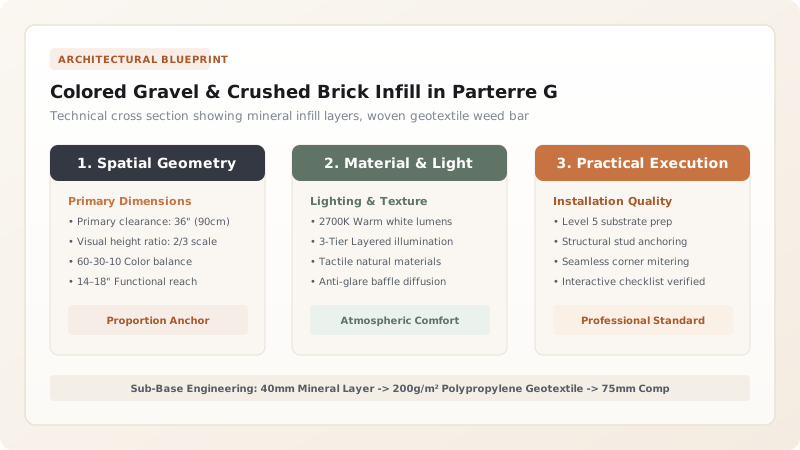
1. Mineral Heraldry: Color Theory in the Royal French Parterre
When King Louis XIV looked down from the Hall of Mirrors at Versailles, the parterres below functioned as gigantic royal heraldic emblems. Living flowers fade, wilt, and drop petals, disrupting the razor-sharp clarity of royal monograms and scrollwork.
To ensure permanent, year-round color saturation, French architects utilized natural mineral aggregates:
- Crushed Terracotta Brick (Tuileau): Made from crushed roof tiles and discarded kiln pottery, delivering vibrant warm red fields that contrast intensely against emerald boxwood.
- White Limestone / Crystalline Calcite: Sourced from Burgundy or Champagne quarries, reflecting high-angle sun to create crisp white dividing borders.
- Black Metallurgical Slag / Basalt: Dense, dark mineral gravel that absorbs light, creating deep contrast pockets that make boxwood swirls appear to float in three dimensions.
2. Sub-Base Engineering: Preventing Sinking and Color Bleed
Dumping colored gravel directly onto garden soil is an engineering catastrophe: earthworms pull mud up into the gravel, seasonal rain drives mineral chips down into the subsoil, and within two seasons, the crisp white gravel becomes a dull brown-gray mud slurry.
Authentic parterre infill requires a multi-layered aggregate profile:
The woven polypropylene geotextile must be water-permeable (minimum \(100\text{ L/(m}^2\cdot\text{s)}\)) to prevent surface water puddling while maintaining a microscopic pore size under \(0.1\text{ mm}\) to block soil capillary action and worm casting.
3. The Edging Boundary: Concealed Aluminum and Corten Separators
Because adjacent compartments often contain starkly contrasting minerals (such as black basalt against pure white calcite), a physical barrier must separate the materials. If gravels touch without a physical divider, wind, maintenance rakes, and pedestrian footsteps inevitably scatter the stones together, ruining the pattern irrevocably.
Modern restorations install \(3\text{ mm}\) thick flexible aluminum or weathering corten steel edging. The top of the metal edging sits exactly \(10\text{ mm}\) above the finished gravel line but \(150\text{ mm}\) below the top of the boxwood hedge, rendering the metal divider completely invisible from the château terrace. Review site sightlines in laser-surveyed terrace axial sightlines and stone retaining plinth.
Parterre Mineral Infill Comparison
Use this reference table to calculate exact physical dimensions, ratios, and specifications before purchasing:
| Infill Material | Color / Visual Effect | Grading / Size | Algae / Staining Resistance | Particle Weight / Wind Resistance | Historical Authenticity |
|---|---|---|---|---|---|
| Tuileau (Crushed Red Brick) | Vibrant Terracotta Red | 2mm to 5mm (Angular) | Very High (Fired Ceramic) | Heavy (Stays Put in Wind) | 100% Authentic French Baroque |
| White Calcite Limestone | Brilliant Crystalline White | 4mm to 8mm (Chipped) | Moderate (Algae in Damp Shade) | Heavy (Resists Leaf Blowers) | Historical (Burgundy Stone) |
| Crushed Black Basalt | Deep Matte Charcoal Black | 3mm to 6mm (Angular) | Supreme (Zero Staining) | Very Heavy (Dense Volcanic) | Authentic 17th Century |
| Golden Alluvial River Sand | Warm Ochre Sand | 0.5mm to 1.5mm | Low (Tracks into Hedges) | Light (Blows Away in Storms) | Used for Delicate Borders |
Practical Constraints
Every successful decoration project must account for physical and environmental constraints:
Autumn Leaf Removal Without Sucking Up Mineral Infill
When autumn leaves fall from nearby park trees into fine 3mm gravel or crushed brick fields, standard heavy commercial leaf vacuums suck up the expensive mineral aggregates along with the leaves. Gardeners must use low-velocity battery leaf blowers held horizontally at a shallow angle (grazing incidence) to float leaves across the surface without disturbing the aggregate.
Limestone Leaching and Soil pH Alteration
Water percolating through white calcite limestone gravel dissolves calcium carbonate, leaching high-alkali runoff into the root zone of adjoining boxwood hedges. This raises soil pH above 7.8, causing iron chlorosis (yellowing foliage). A vertical root-barrier liner must isolate the limestone bed from the boxwood planting trench.
Execution Blueprint & Craftsmanship Sequence
Execute this professional sequence to achieve flawless results without backtracking:
Compartment Base Excavation & Subgrade Compaction
Excavate negative parterre compartments to a uniform depth of 115mm below finished lawn grade. Compact native subgrade soil using a vibrating plate compactor to 95% Proctor density.
Concealed Aluminum Divider Edging Installation
Stake 3mm x 100mm flexible aluminum edging strips along all internal compartment dividing lines using 300mm steel spiral pins driven at 450mm intervals. Verify smooth curving arcs.
Crushed Stone Sub-Base Installation
Spread a 75mm layer of non-frost-susceptible crushed limestone scalpings (Type 1 MOT or 0-20mm). Compact firmly to form a non-yielding, free-draining structural foundation.
Geotextile Membrane Tailoring & Pegging
Cut heavy-duty 200 g/m² needle-punched non-woven polypropylene geotextile fabric to fit each compartment precisely. Overlap seams by 150mm and secure to the sub-base with galvanized U-pins.
Mineral Infill Placement & Flat Compaction
Shovel clean, washed crushed brick (tuileau), white calcite, or basalt gravel into designated compartments to a depth of 40mm. Level with an aluminum asphalt rake and roll with a smooth water-filled hand roller.
Common Mistakes & Countermeasures
Avoid these costly errors that compromise aesthetics, ergonomics, and budget:
Using Lightweight Recycled Rubber Mulch Instead of Real Stone
Omitting Geotextile Membrane Underlays
Project Execution Checklist
Track your physical progress. Checkboxes persist automatically on this device:
Frequently Asked Questions
How do you clean green algae off white limestone parterre gravel?
Spray the gravel on a sunny morning with a dilute solution of sodium percarbonate (oxygen bleach) or biodegradable quaternary ammonium algicide. The organic algae dissolves within 48 hours without releasing hazardous acid fumes that harm boxwood roots.
Can crushed brick infill bleed red dye onto adjacent white limestone paths?
Authentic tuileau is fired terracotta clay (chamotte), not dyed gravel. It will never bleed chemical dyes. However, fine brick dust must be washed out before installation to prevent surface dust runoff during the first rain.


