
Broderie arabesque planting and pruning is the rigorous horticultural discipline of creating and maintaining low, densely woven boxwood hedges in complex swirling lace patterns. Utilizing dwarf boxwood (Buxus sempervirens 'Suffruticosa') planted at high densities of 8 to 10 stems per linear meter, the hedges are sheared biannually into trapezoidal profiles (300mm height, 85° slope) to ensure full sunlight penetration to lower foliage while resisting wind dislodgement and fungal pathogens.
At a Glance: Key Takeaways
- Buxus sempervirens 'Suffruticosa': The true historic dwarf boxwood, featuring dense internodes and diminutive 15mm rounded leaves ideal for micro-topiary.
- High-Density Linear Trenching: Plants set at 100mm to 120mm intervals into enriched loam trenches, achieving seamless hedge fusion within two seasons.
- Trapezoidal Pruning Batter: Shearing hedge sides at an 80° to 85° outward batter ensures bottom branches receive identical photosynthetic photon flux as the crown.
- Biannual Shearing Schedule: Primary architectural cut in late May (Derby cut), followed by secondary refinement cut in late August.
- Sterilization Protocol: Shears soaked in 70% isopropyl alcohol between hedge compartments to halt the transmission of Calonectria pseudonaviculata spores.
- Biological & Cultural Controls: Pheromone trapping for Cydalima moths and copper octanoate prophylactic fungicidal treatments.
1. Botanical Selection: Dwarf Cultivars and High-Density Trenching
Ordinary common boxwood (Buxus sempervirens) grows too vigorously (\(150\text{ to }200\text{ mm}\) annually) and has loose foliage, making it unsuitable for crisp \(300\text{ mm}\) high parterre embroidery. True historic broderie specifies Buxus sempervirens 'Suffruticosa' or modern blight-resistant hybrids such as Buxus 'Green Velvet' or 'Faulkner':
- Micro-Internode Spacing: Suffruticosa produces short branchlets with internodes under \(8\text{ mm}\), creating a tight, cushion-like green surface that conceals woody branch interiors.
- Continuous Trench Planting: Rather than digging individual holes, gardeners dig a continuous \(250\text{ mm}\) wide by \(300\text{ mm}\) deep trench along the scribed arabesque curves. Rootballs are placed shoulder-to-shoulder at \(8\text{ to }10\text{ plants per meter}\) to eliminate gaps.
2. Pruning Mechanics: The Trapezoidal Batter Formula
The most widespread failure in formal parterre maintenance is shearing hedges with plumb, vertical sides (\(90^\circ\)). Because the upper foliage casts shade directly down the vertical wall, the lower leaves receive insufficient Photosynthetically Active Radiation (PAR), causing chronic defoliation and bare woody branch bases.
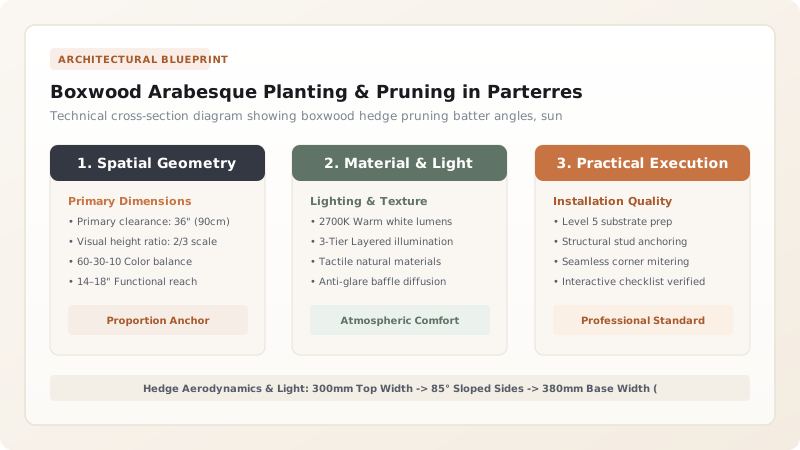
To ensure permanent bottom density, French topiarists employ a trapezoidal batter:
For a \(300\text{ mm}\) high hedge with a \(250\text{ mm}\) crown width and an \(85^\circ\) batter angle, the base width must be \(302.5\text{ mm}\). For a taller \(450\text{ mm}\) hedge at \(80^\circ\), the base expands to \(408\text{ mm}\). This subtle trapezoidal taper ensures sunlight strikes the base foliage throughout morning and afternoon sun angles.
3. Hand-Shearing Protocols and Disease Quarantine
Gas-powered or electric rotary hedge trimmers should never be used on historic parterres. High-speed spinning blades tear and bruise the boxwood leaves, leaving frayed brown edges and microscopic entry wounds for fungal spores.
Artisans utilize Japanese carbon steel hand-shears (Okatsune 217 or similar) honed with ceramic waterstones. Blades are dipped in \(70\%\) isopropyl alcohol or Virkon S disinfectant between each garden compartment to prevent cross-contamination of boxwood blight. Learn about mineral ground settings in contrasting colored gravel crushed brick and sand infill fields.
Formal Parterre Hedging Species Comparison
Use this reference table to calculate exact physical dimensions, ratios, and specifications before purchasing:
| Species / Cultivar | Annual Growth Rate | Blight Susceptibility | Caterpillar Resistance | Foliage Density | Cold Hardiness |
|---|---|---|---|---|---|
| Buxus sempervirens 'Suffruticosa' | 30–50 mm (Very Slow) | High (Requires Monitoring) | Low (Requires Trapping) | Exceptional (Velvet Texture) | USDA Zone 5 (-23°C) |
| Buxus microphylla 'Faulkner' | 60–90 mm (Moderate) | High Resistance | Moderate | Dense Spherical Habit | USDA Zone 6 (-18°C) |
| Ilex crenata 'Dark Green' | 80–120 mm (Moderate) | Immune to Box Blight | Immune to Box Moth | Very Good (Holly Look) | USDA Zone 6 (-18°C) |
| Taxus baccata 'Repandens' | 50–80 mm (Slow) | Immune to Box Blight | Immune to Box Moth | Dense Dark Conifer Needle | USDA Zone 5 (-23°C) |
Practical Constraints
Every successful decoration project must account for physical and environmental constraints:
Snow Load and Branch Splay Under Winter Weight
Heavy wet snow settling onto flat-topped parterre hedges bends and splays the internal branches outwards, splitting the central crowns and permanently disfiguring the arabesque curves. In cold regions, hedges are sheared with a slightly domed (cambered) top rather than a dead-flat horizontal top to shed snow loads naturally.
Sunscald on Newly Sheared Summer Foliage
Clipping boxwood on hot, sunny days exposes tender interior shade-adapted leaves to intense ultraviolet solar radiation, causing widespread leaf bleaching and brown necrotic scorch within 24 hours. Pruning must be scheduled during overcast, cloudy days or late afternoon.
Execution Blueprint & Craftsmanship Sequence
Execute this professional sequence to achieve flawless results without backtracking:
Soil Trenching & Organic Amending
Dig 250mm x 300mm continuous trenches along arabesque curves. Blend excavated soil with 25% composted pine bark and 5% volcanic pumice to optimize root zone aeration and drainage.
High-Density Planting & Root Teasing
Lightly tease circular root masses of container-grown plants. Set plants at 100mm spacing along the trench line, packing soil firmly around the root crown flush with the original container soil line.
Deep Root Soaking & Subsurface Drip Line Setup
Install twin lines of 12mm subsurface drip irrigation tubing equipped with pressure-compensating emitters along both sides of the planting trench. Soak thoroughly with mycorrhizal root stimulator.
Guideline Setup & Primary Shearing Cut
In late spring, erect taut nylon horizontal stringlines at 300mm height. Use razor-sharp hand shears to cut the top horizontal plane first, followed by the angled 85° trapezoidal sides.
Sanitation Cleanup & Prophylactic Spray
Rake and vacuum all fallen clippings immediately from the gravel beds using clean tarpaulins. Apply a preventative organic copper octanoate spray to protect fresh cutting wounds.
Common Mistakes & Countermeasures
Avoid these costly errors that compromise aesthetics, ergonomics, and budget:
Leaving Fallen Boxwood Clippings on the Ground
Shearing Boxwood with Dull Power Trimmers
Project Execution Checklist
Track your physical progress. Checkboxes persist automatically on this device:
Frequently Asked Questions
Can older, overgrown boxwood parterres be renovated and cut back hard?
Yes, but boxwood hard renovation must be executed staged over two years. Cut one side back hard to bare wood in late winter (February/March); allow new dormant bud break throughout the summer, then cut the opposing side back hard the following winter.
How do you achieve sweeping, perfectly fluid curves without wobbly kinks?
Master gardeners bend flexible 15mm fiberglass or PVC rod battens along the desired arc, anchoring the batten with steel ground staples every meter, and shear directly along the smooth curved guide.


