
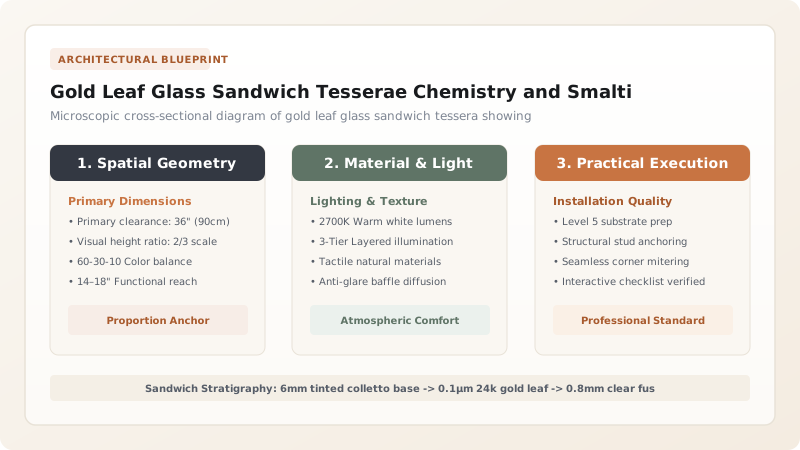
Gold leaf glass sandwich tesserae (often called oro smalti) are composite glass-metal artifacts developed in Late Antique and Byzantine imperial workshops. The production involves casting a 6–8mm thick plate of dense soda-lime-silica glass (the colletto), laying ultra-pure 24-karat gold leaf beaten to 0.1 microns across its surface, and delicately encasing it beneath a paper-thin molten glass veil (the coperta, 0.5–1.0mm). Re-heating in a muffle kiln to 800°C fuses the glass layers into a monolithic sandwich that shields the noble metal from atmospheric tarnishing for millennia. Once annealed over 48 hours to eliminate internal stresses, the glass slab is hand-fractured into cubic tesserae using a hardened martellina hammer against an iron anvil.
At a Glance: Key Takeaways
- Gold Purity: Minimum 23.5k to 24k pure gold to avoid alloy discoloration and oxidation under 800°C kiln heat.
- Glass Matrix: Low-expansion soda-lime-silica glass formulated with natron or purified plant ash fluxes.
- Colletto Base Slab: 6–8mm thick glass plate, tinted amber with iron or cobalt-blue to impart warm or cool luster.
- Coperta Protective Film: 0.5–1.0mm blown micro-sheet fused under secondary thermal firing.
- Annealing Cycle: 48-hour graduated temperature drop in a lehr kiln from 550°C to ambient to prevent thermal shock.
- Cleaving Mechanics: Conchoidal glass fracture produced by hardened high-carbon steel martellina hammer strikes.
1. Glass Batch Pyrotechnics: Silica, Fluxes, and Decolorizing Chemistry
Byzantine mosaic smalti is distinct from translucent vessel glass. It is an opaque, dense glass formulated with high concentrations of silica sand ($SiO_2$), soda flux ($Na_2O$) derived from Egyptian natron or coastal plant ash, and lime stabilizer ($CaO$).
To create the foundation for gold tesserae, the glassmaker melted this batch in wood-fired crucibles at 1,100°C. For yellow gold (oro giallo), minute traces of ferric oxide ($Fe_2O_3$) were added to tint the colletto base glass a warm amber-honey color, enhancing the warmth of the gold leaf above. For pale silver-gold effects, manganese dioxide was added as a decolorizer to create water-clear base glass.
2. Gold Beating, Sizing, and Muffle Kiln Coperta Fusion
The core innovation of Byzantine glass mosaic was hermetic thermal encapsulation:
- 24-Karat Foil Beating: Gold ingots were alloyed with virtually zero copper or silver, then hammered between parchment and vellum skins into leaves so thin that light transmitted through them appears emerald green.
- Cold Assembly: The gold leaf was laid onto the smooth, pre-cast colletto plate while slightly moistened with distilled water or egg-white albumen sizing.
- Blowing the Coperta: A glassblower gathered a small bubble of ultra-clear crystal glass and blew a spherical balloon with walls less than 1mm thick. While molten, the balloon was severed, opened flat, and pressed directly over the gold leaf.
- Furnace Re-Fusion: The assembled plate was slipped into a muffle kiln heated to 780°C–820°C. The top veil softened and bonded molecularly with the base glass, trapping the gold leaf in an airless, permanent vacuum seal.
3. Thermal Annealing Kinetics and Chisel-Hammer Fracturing
Molten glass plates cooled too rapidly develop severe tensile residual stresses that shatter into dust upon contact with a tool. The fused gold-glass cakes (measuring 200–300mm diameter and 7mm thick) were placed in the annealing chamber (lehr) where temperature was gradually decreased at 10°C per hour over 48 hours.
Once cool, the master artisan cleaved the cake into individual cubes. The cake was rested on the sharp chisel edge of an iron stake (tagliolo) embedded in a heavy oak stump. Striking directly above the anvil with a hardened steel hammer (martellina) induces controlled conchoidal fracture. Rather than smooth polished faces, the cleavage plane produces jagged micro-facets that scatter incoming light in radiant multidirectional angles.
Gold Glass Smalti Manufacturing and Quality Control Standards
Use this reference table to calculate exact physical dimensions, ratios, and specifications before purchasing:
| Production Parameter | Standard Metric | Allowable Tolerance | Defect if Failed | Craft Remediation |
|---|---|---|---|---|
| Gold Leaf Purity | 99.9% (24-karat) | ±0.2% | Red/green oxidation stains under heat | Reject alloy; use chemically refined gold |
| Base Slab (Colletto) Depth | 6.0 mm | 5.5–7.0 mm | Excess thickness causes cleavage drag | Calibrate iron rolling table stops |
| Covering Veil (Coperta) Depth | 0.8 mm | 0.5–1.2 mm | Excess thickness clouds gold luster | Blow thinner crystal glass balloon |
| Muffle Fusing Temperature | 800°C | 780°C–820°C | Bubbles at <760°C; burn-off at >850°C | Verify pyrometric cones in wood kiln |
| Annealing Duration | 48 hours | Minimum 36h slow drop | Spontaneous shattering during cutting | Re-anneal cakes in secondary cycle |
| Finished Tessera Dimension | 10 x 10 x 7 mm | 8–12 mm variation | Loss of authentic visual scale | Sort tesserae into graded size batches |
Practical Constraints
Every successful decoration project must account for physical and environmental constraints:
Extremely High Raw Material Cost
Artisanal Furnace Master Skill
Artisanal Fabrication Sequence for Gold Leaf Glass Smalti
Execute this professional sequence to achieve flawless results without backtracking:
Base Glass Melting and Casting
Melt soda-lime-amber glass batch at 1,100°C; ladle molten glass onto iron casting tables and roll flat to 6mm thickness.
Base Slab Surface Inspection
Allow colletto plate to cool slowly; clean surface with alcohol to remove carbon ash and verify mirror-flat smoothness.
24k Gold Leaf Transfer
Using a squirrel-hair gilder's tip, lift beaten 24k gold leaf sheets and lay them across the glass slab with 2mm edge overlaps.
Coperta Veil Blowing and Laydown
Blow a thin crystal glass bulb; split and unroll the molten glass sheet directly over the gold foil using preheated iron pliers.
Muffle Kiln Fusion Firing
Slide composite plate into muffle furnace at 800°C for 6 minutes until the top veil fuses seamlessly into the base slab.
48-Hour Lehr Annealing
Transfer fused plate into annealing oven; cool gradually to room temperature over 2 days to relieve internal molecular shear tension.
Martellina Cleaving into Tesserae
Position glass plate over the iron tagliolo stake; strike with high-carbon martellina hammer to cleave uniform 10mm cubes.
Common Mistakes & Countermeasures
Avoid these costly errors that compromise aesthetics, ergonomics, and budget:
Using 18k or 22k jeweler's gold leaf containing copper alloys
Cooling glass cakes quickly on cold metal surfaces
Applying the coperta veil too thick (>2mm)
Project Execution Checklist
Track your physical progress. Checkboxes persist automatically on this device:
Frequently Asked Questions
Why is the top glass veil (coperta) blown so thin?
The coperta must be less than 1mm thick so that light strikes the gold leaf with minimal refractive absorption. If the top glass were thick, its internal mineral tint would distort the pure yellow brilliance of the gold and create distracting double reflections.
How do artisans cut glass cubes without safety glasses in antiquity?
Byzantine mosaicists positioned the tagliolo anvil at a specific waist-height angle. The martellina hammer strikes downward while the artisan's fingers hold the glass firmly against the edge. Experienced cutters follow the natural conchoidal fracture plane, sending spalls downward away from the eyes.
Can modern gold foil mirrors be used instead of smalti?
Modern flat mirror glass has a chemical silver or aluminum backing applied cold with paint backing. When embedded in wet alkaline lime plaster, the alkali attacks the backing within months, turning the mirror black. Byzantine gold smalti is fully vitreous, impervious to alkali, and permanent.


