
Angled setting techniques represent the optical brilliance of Byzantine mosaicists (musivarii). Rather than setting mosaic cubes flush and coplanar with the wall plaster, craftsmen deliberately tilted individual gold and colored smalti tesserae at angles between 15° and 30° relative to the wall plane, while creating undulating, wavy intonaco mortar beds. On high curved domes and apse vaults, gold cubes are tilted downward toward the nave floor, capturing natural daylight descending from high clerestory windows and redirecting concentrated specular reflections into the eyes of worshippers standing below. This dynamic alignment creates the celebrated phenomenon of optical scintillation—a sparkling, living field of light that changes with every step a visitor takes.
At a Glance: Key Takeaways
- Incline Angle: 15° to 30° downward tilt on upper vaults and domes to align with viewer sightlines.
- Undulating Mortar Bed: Hand-sculpted wavy intonaco plane producing irregular multi-faceted focal planes.
- Specular Reflection Vector: Directing high-level clerestory daylight into dark lower nave seating zones.
- Scintillation Effect: Shimmering sparkle produced as viewers move through changing specular reflection angles.
- Inter-Tesserae Spacing: 1.5 to 3.0mm gaps allowing setting mortar to form shadow collars around each cube.
- Fractured Face Orientation: Positioning the uneven cleave face outward to maximize diffuse micro-refraction.
1. Optical Physics of Scintillation: Specular vs. Diffuse Vault Reflections
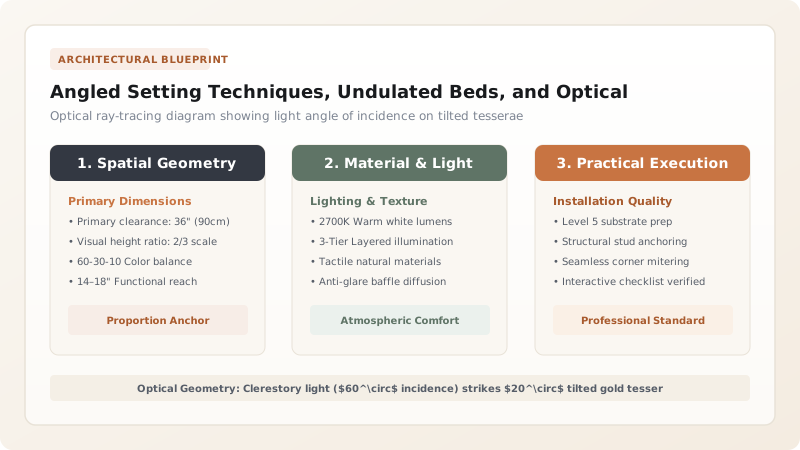
The visual impact of a Byzantine mosaic is fundamentally an optical engineering achievement. According to the law of reflection, the angle of incidence equals the angle of reflection ($\theta_i = \theta_r$). In a grand basilica like Hagia Sophia, windows are placed high in the drum of the dome, casting daylight downward at steep angles (typically 50° to 70° from horizontal).
If gold tesserae were set completely flat against a vertical wall, incoming light from the dome windows would reflect upward toward the opposite ceiling or downward into empty corners. By tilting each gold cube downward by 20° to 30°, the mosaicist shifts the normal vector of the reflective surface. Consequently, the downward-slanting sunlight hits the tilted gold face and bounces directly down toward the nave floor at a height of 1.5 to 2.0 meters, illuminating worshippers below with dazzling, golden brilliance.
2. Undulating Intonaco Beds and Manual Placement Ergonomics
The intentional irregularity of the mosaic surface begins with the mortar bed itself. Rather than screeding the finish intonaco with rigid straightedges, the craftsman floated the mortar with curved wooden spatulas, leaving soft, undulating waves (10–15mm amplitude across 500mm spans).
When embedding the tesserae, the mosaicist held each cube with brass tweezers or thumb and forefinger, pressing the lower edge deeper into the wet mortar while allowing the upper edge to project 2 to 3mm proud of the bed. Adjacent cubes were slightly staggered in both pitch and yaw. This micro-variation prevents the mosaic from acting like a mirror (which would create a blinding hot-spot and dark dead zones); instead, it scatters reflected photons in a broad, shimmering hemisphere of light.
3. Dynamic Perception: Candlelight Interplay and Spatial Scale
In medieval liturgical settings, artificial lighting was provided exclusively by beeswax candles, suspended oil polycandela, and silver lamps. Flame light is inherently unstable, pulsing and flickering with air currents created by moving clergy and worshippers.
Because the tesserae are set at thousands of distinct micro-angles, each tiny flicker of a candle flame illuminates a different cluster of gold facets. To the human eye, the mosaic does not appear static; rather, holy figures, golden halos, and star-studded skies appear to shimmer, breathe, and move across the curved vaults. The dark shadow collars formed by the mortar gaps between tesserae provide high-frequency contrast, enhancing the apparent luminosity of the gold through optical lateral inhibition.
Tesserae Angling and Optical Orientation Calibration Matrix
Use this reference table to calculate exact physical dimensions, ratios, and specifications before purchasing:
| Architectural Location | Typical Height Above Floor | Primary Light Source | Optimal Downward Tilt Angle | Optical Objective |
|---|---|---|---|---|
| High Dome Apex | 25–45 meters | 360° clerestory drum windows | 10°–15° radial tilt outward | Diffuse ambient glow across entire nave |
| Apse Semi-Dome | 12–20 meters | High sanctuary windows & altar lamps | 20°–30° downward tilt | Concentrates radiant gold halo on altar |
| Barrel Vaults & Arches | 8–15 meters | Side aisle windows & candles | 15°–25° angled toward nave axis | Guides eye along liturgical procession |
| Pendentives & Squinches | 15–25 meters | Cross-angled window light | Complex 3D twist (15° pitch, 10° yaw) | Bridges structural curves with sparkling light |
| Eye-Level Wall Panels | 1.5–4 meters | Direct candle and lamp light | 0°–10° subtle relief undulation | Intimate figurative realism and detail |
Practical Constraints
Every successful decoration project must account for physical and environmental constraints:
Severe Physical Ergonomics on Vaults
Parallax Error from Scaffolding
Field Procedure for Laying Angled Gold Smalti on Vault Plaster
Execute this professional sequence to achieve flawless results without backtracking:
Scaffolding Sightline Calibration
Determine primary viewer eye-level on nave floor; stretch sightline reference strings from floor to vault work platform.
Undulating Intonaco Floating
Spread 10mm finish lime-pozzolan bed using wooden paddle floats, creating soft 3mm undulating surface waves.
First Line Guideline Imprint
Lightly scribe curvature contours into damp mortar with bone styluses following the painted sinopia cartoon.
Tweezer Incline Setting
Grasp gold cube with non-marring brass tweezers; press lower edge firmly into mortar while tilting upper edge outward 25 degrees.
Micro-Yaw Alternation
Rotate alternating tesserae 3 to 5 degrees horizontally off-axis to prevent directional blinding glare lines.
Mortar Necking Inspection
Ensure wet lime mortar rises 30% up the sides of the cube, locking it securely without spilling onto the cleaved face.
Scaffolding Raking Light Check
Shine a directional halogen or candle lamp along the vault at 45 degrees to verify sparkling scintillation from floor view.
Common Mistakes & Countermeasures
Avoid these costly errors that compromise aesthetics, ergonomics, and budget:
Pressing tesserae completely flat against a straightedge board
Tilting tesserae too steeply (>40 degrees)
Grouting flush over angled tesserae with sponge floats
Project Execution Checklist
Track your physical progress. Checkboxes persist automatically on this device:
Frequently Asked Questions
How do you achieve consistent tilt angles across thousands of cubes?
Byzantine mosaicists did not use digital gauges; they relied on tactile hand ergonomics. By holding the cube at a consistent pinch angle with brass tweezers and resting the pinky finger on the adjacent set cube, the artisan's hand naturally replicates a uniform 20° to 25° downward inclination with astonishing speed.
Why are tesserae in dark corners tilted differently than in bright domes?
In dark shadowy niches or side aisles, tesserae are tilted aggressively toward the primary candle stands or arch openings to capture every available stray photon. In brightly lit domes with abundant sun, tilt angles are subtler (10°–15°) to avoid overwhelming glare.
Does the angle of the tessera weaken its mechanical hold in the plaster?
No. When pressed in at an angle, the lower edge penetrates deep into the plastic lime-pozzolan bed, while the mortar naturally necks up around three sides of the cube. Once the hydraulic pozzolana cures, the cube is locked into a rigid calcite socket.


